Artificial intelligence is changing how businesses work.
Today, a small business owner can use AI to develop marketing ideas, write social media content, create images, analyse information and prepare business strategies in a fraction of the time these activities once required.
What previously needed several people or specialist services can now be started with a laptop and access to the right tools.
This creates exciting opportunities, particularly for small businesses and entrepreneurs working with limited resources.
But there is another side to this development that deserves our attention.
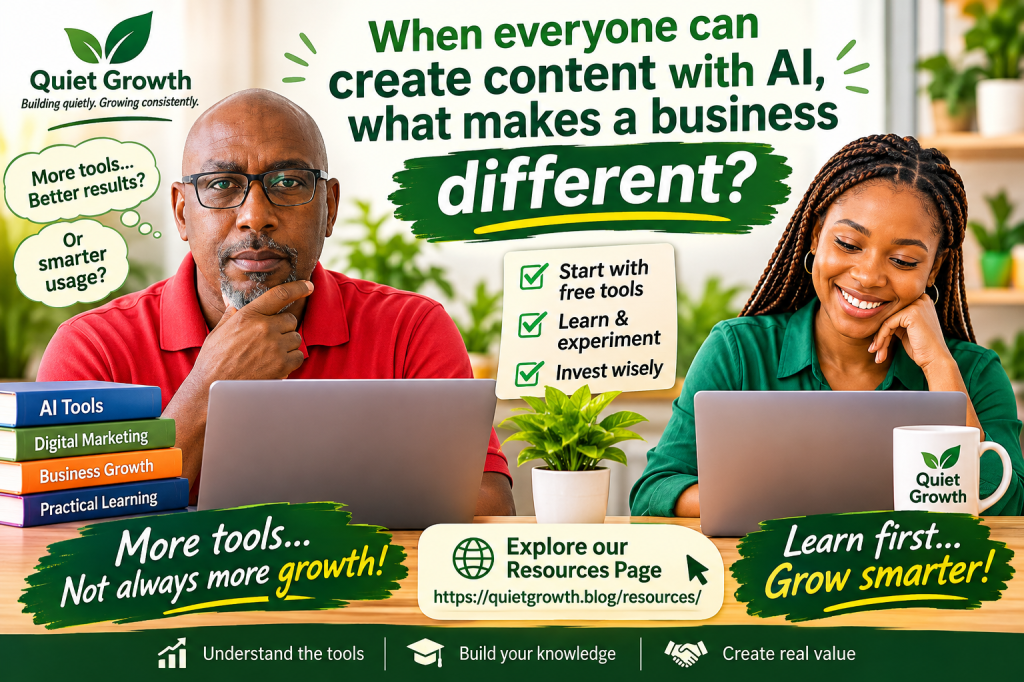
If AI can create our content, develop our strategies and help us make decisions, what makes a business different?
And more importantly, how do we make sure that technology helps us build better businesses rather than simply helping us do more things?
1. A good strategy must survive the reality of business
Imagine a small business owner who asks an AI tool to develop a marketing strategy.
The owner provides information about the business, its customers, available budget and growth objectives.
Within minutes, AI produces a structured plan with marketing activities, content ideas, customer segments and recommendations.
On paper, everything looks promising.
But business does not happen on paper alone.
Imagine that a customer places an order. The business confirms the order and schedules delivery.
Then something unexpected happens. Heavy rain makes the roads difficult to navigate, and the delivery cannot arrive as planned.
The customer is waiting.
At this point, the business needs more than a marketing strategy.
Someone must communicate with the customer, explain the situation, consider alternatives and take responsibility for the experience.
The original plan may have been excellent, but circumstances have changed.
This is where practical judgement becomes important.
AI can help prepare a strategy, but the business owner must understand the situation and decide what to do when reality does not follow the plan.
A business is not measured only by how well it plans for success. It is also measured by how it responds when things go wrong.
2. Technology can create content, but understanding creates value
There is another challenge emerging as AI becomes more accessible.
Almost anyone can now generate social media posts, marketing ideas, images and business plans.
This makes content creation easier, but it also raises an important question:
When everyone has access to similar tools, what makes one business different from another?
The answer cannot simply be the number of AI platforms a business uses.
Imagine two small business owners.
The first subscribes to several platforms. One creates content, another designs images, another prepares marketing plans and another offers automation.
Every month, money goes out for these subscriptions. Yet the owner has not fully understood how to use most of them.
The second owner takes a different approach.
They begin with the free tools available, choose one, learn how it works and experiment with how it can solve a genuine business problem.
Perhaps it helps organise customer enquiries, prepare better content or save time on routine tasks.
Gradually, the owner becomes more confident and understands what the business actually needs.
Both owners have access to technology, but they are building their knowledge differently.
Having more tools creates possibilities. Knowing how to use them effectively creates value.
3. Human judgement remains part of the equation
AI can process information, identify patterns, generate ideas and produce recommendations.
However, business decisions involve more than processing information.
They involve understanding people, circumstances, expectations and consequences.
Consider a marketing campaign that generates thousands of views but attracts the wrong audience.
The numbers may look encouraging, but are those views bringing the business closer to its objectives?
Or consider a business that publishes attractive content every day but cannot deliver the products or services it promises.
The content may look professional, but the customer experience tells a different story.
This is why businesses need people who can question results, recognise problems, understand customers and make responsible decisions.
Technology should support our judgement, not replace our willingness to think.
The objective should not be to use AI for everything. It should be to understand where AI can help and where human experience, creativity and responsibility are needed.
4. Start with what you have before investing in more
For many small businesses, limited capital is a reality.
Every subscription, piece of equipment and additional service represents an expense that must be justified.
This does not mean businesses should avoid paid tools. Some investments can save time, improve efficiency and create opportunities.
But before paying for another platform, it is worth asking:
- Have I learned to use the tools I already have?
- Can a free version solve my current problem?
- What additional value would a paid subscription provide?
- Will this investment improve my work or help me serve customers better?
A business does not necessarily need more technology. Sometimes it needs a better understanding of the technology already available.
Learning, experimenting and applying knowledge can be valuable investments in themselves.
When the need for a paid service becomes clear, the decision to invest becomes more informed.
5. Growth is about creating value, not collecting tools
At Quiet Growth 🌱, we believe meaningful growth does not require having everything at the beginning.
A business can begin with limited resources, develop its knowledge, understand its customers and improve through consistent action.
AI can make this journey easier by reducing certain costs, improving productivity and giving smaller businesses access to capabilities that were once difficult to afford.
But tools alone do not build trust.
Trust develops when businesses understand the people they serve, communicate honestly, deliver on their promises and take responsibility when challenges arise.
The combination of technology, knowledge, practical experience and human judgement is what creates a stronger foundation for sustainable growth.
Explore, learn and grow
We have created a Resources page to help entrepreneurs, small business owners and people developing their digital skills explore useful AI tools, digital marketing platforms and learning opportunities.
You do not need to purchase every tool or subscribe to every service.
Start by exploring what is available. Learn how the tools work, experiment with their possibilities and identify what genuinely supports your goals.
Visit the Quiet Growth Resources page:
A question worth considering
As artificial intelligence becomes more capable, businesses will have more opportunities to automate tasks, generate content and make decisions with technological support.
But perhaps the more important question is not how much AI a business can use.
It is how wisely that business can use it.
Can we build businesses that combine technology with human understanding? Can we use AI to become more efficient without losing sight of the people we serve? And can we make progress without spending money on things we do not yet understand?
At Quiet Growth, we believe the journey begins with learning, grows through application and becomes meaningful when it creates value for others.
You do not need everything to begin. You need to understand what you have, make thoughtful decisions and keep improving.
Technology can help us move faster. Knowledge and judgement help us move in the right direction.
Quiet Growth 🌱
Building quietly. Growing consistently.


Leave a Reply