SWOT analysis is often taught as four boxes:
Strengths.
Weaknesses.
Opportunities.
Threats.
Fill in the boxes. Read them. Move on.
But that is also where many businesses miss the real value of SWOT.
The boxes are not the strategy.
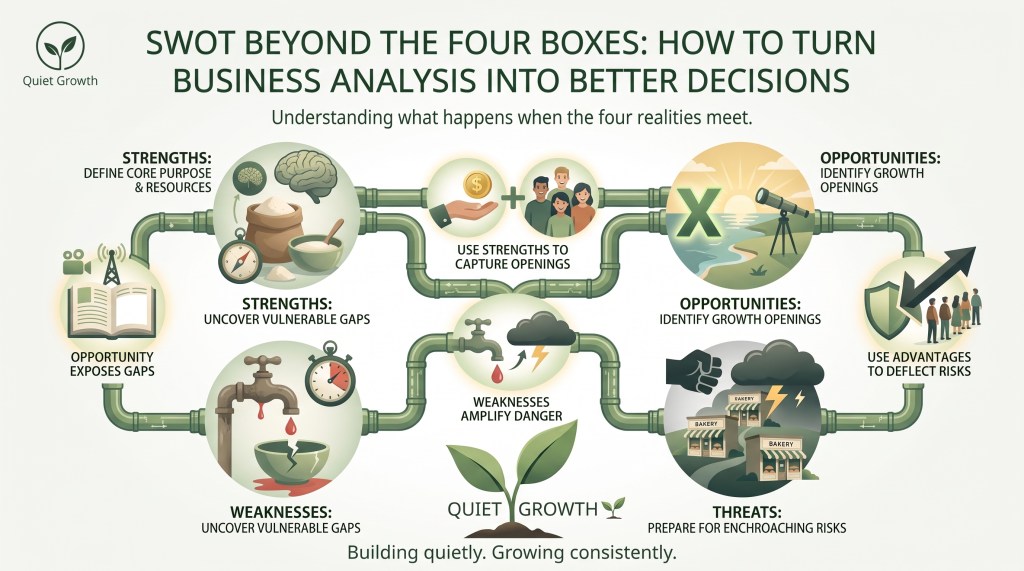
The value comes from understanding what happens when the four realities meet.
A strength can help you take advantage of an opportunity.
The same strength can protect you from a threat.
An opportunity can expose a weakness.
And a weakness can make an existing threat much more dangerous.
That is where SWOT becomes more than an exercise.
It becomes a way of thinking about what to do next.
A simple example: a local catering business
Imagine a small catering business.
The food is excellent.
Customers who have tried it are happy with the quality, the service and the experience.
But there is a problem.
Very few people know the business exists.
There is little online presence. There are few public reviews. Most new customers come through personal recommendations.
Now imagine a local event appears and the organiser is looking for a caterer.
Suddenly, the business has an opportunity.
But there is another catering company competing for the same event.
That company has more visibility, a stronger online presence and a reputation that already reaches a much larger audience.
Now we have all four parts of SWOT in one situation.
Strength
The small caterer has excellent food and good customer experiences.
That is something they already possess.
Weakness
Very few people know about the business.
Its visibility and digital presence are limited.
Opportunity
A local event could put the business in front of new customers.
Threat
A larger, more established competitor wants the same opportunity.
If we stop here, we simply have four observations.
But SWOT becomes much more useful when we ask:
What happens when these realities interact?
Strength + Opportunity: Use what already works
The event creates a chance to put the caterer’s strongest asset in front of more people.
The obvious goal is to win the event.
But there could be a bigger opportunity hidden inside it.
A successful event can create:
- new customers
- referrals
- testimonials
- photographs and content
- local recognition
- new conversations
- repeat business
The opportunity is not only the event itself.
It is what the event can create afterwards.
This is an important growth principle.
Sometimes the first opportunity is not the final goal.
It is the door that leads to the next one.
Strength + Threat: Compete with what you actually have
The larger competitor may have more followers, more visibility and more resources.
That does not automatically mean the smaller business has nothing to offer.
The smaller caterer may have advantages that are much harder to copy:
Personal service.
Local knowledge.
Closer relationships.
Flexibility.
A food experience customers genuinely remember.
This changes the question.
Instead of asking:
“How do we become bigger than them?”
the business can ask:
“What can we offer that makes our position valuable?”
That is a very different strategic question.
Not every competitor needs to be beaten everywhere.
Sometimes you need to become clearly valuable somewhere.
Weakness + Opportunity: Let the opportunity expose the gap
The event could also reveal the business’s biggest weakness.
People may love the food.
But what happens the week after the event?
Can they find the business online?
Can they see the menu?
Can they read customer reviews?
Can they contact the caterer easily?
Can they remember the name?
Can they recommend the business to someone else?
An opportunity can therefore do something very useful:
It can show you what is missing.
Perhaps the caterer needs a simple website or business profile.
Perhaps it needs better photographs.
Perhaps it needs customer reviews.
Perhaps it needs a clearer way for people to stay connected.
Perhaps it simply needs to make it easier for someone who enjoyed the food to find them again.
The opportunity is therefore not only something to capture.
It is also something that can diagnose the business.
Weakness + Threat: Understand what could make the situation harder
Now put the weakness beside the threat.
The larger competitor already has visibility.
The smaller caterer does not.
The competitor has a stronger reputation.
The smaller business is still building its public proof.
The competitor may already have established relationships with event organisers.
The smaller business is trying to create them.
The same weakness now matters much more because there is a strong competitor sitting beside it.
This is why SWOT should not be treated as four independent lists.
A weakness becomes more important when it interacts with a threat.
And an opportunity becomes more valuable when it can also help strengthen a weakness.
That is where the real thinking begins.
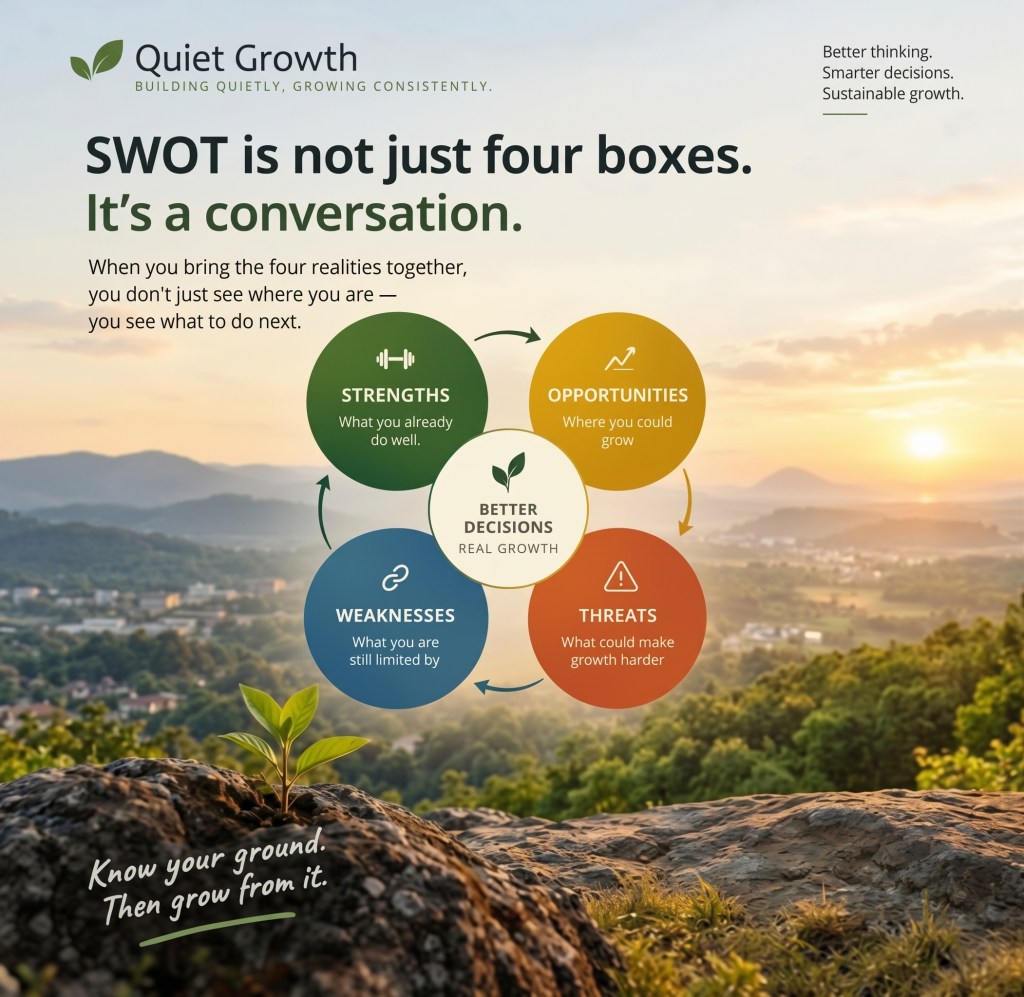
SWOT is a conversation, not a checklist
This is the part I think businesses often miss.
You can complete a SWOT table in fifteen minutes and still learn almost nothing.
The better questions are:
What does this strength allow us to do?
Which opportunity fits that strength?
Which weakness could prevent us from taking advantage of it?
Which threat makes that weakness more urgent?
What can we improve before the threat becomes bigger?
Now the four boxes are talking to each other.
And that conversation can lead to a decision.
What should the caterer actually do?
There may not be one perfect answer.
The business could:
- focus on winning the local event
- improve its online presence
- collect more customer reviews
- strengthen local relationships
- create a simple way for customers to find and contact the business
- use the event to generate content and proof
- differentiate itself from the larger competitor
- combine several of these actions
The important thing is that the business is no longer guessing.
It has looked at the situation from several angles.
That is what makes SWOT useful.
It does not make the decision for you.
It helps you understand the situation well enough to make the decision yourself.
Start where you can stand firmly
There is another lesson hidden inside this example.
A small business does not always need to begin by fighting for the entire market.
A local caterer can start locally.
Serve the people nearby.
Create good experiences.
Build relationships.
Collect proof.
Let satisfied customers talk about the business.
Then build on what already works.
By the time that business expands its digital presence, it is not starting from zero.
It already has:
experience
customers
stories
reviews
relationships
proof
That is a foundation.
And foundations matter because growth puts pressure on whatever you build underneath it.
Visibility is useful. But visibility alone is not the foundation.
A business can become more visible without becoming more trusted.
People can see your content.
They can see your business.
They can see your products.
But visibility does not automatically create understanding.
A customer who discovers the caterer through an event still needs a reason to remember the business.
That is where relationships, reputation and consistent experiences become important.
Growth is not simply getting more people to notice you.
It is building something worth remembering when they do.
A simple SWOT process you can use
You do not need a complicated strategy workshop to begin.
Take a real situation and ask four groups of questions.
1. Strengths
What do we already do well?
What do customers value?
What resources or capabilities do we already have?
2. Weaknesses
Where are we limited?
What are we missing?
Where do customers experience friction?
3. Opportunities
What is changing around us?
Where is there demand?
What new situation could create growth?
4. Threats
Who or what could make growth harder?
What could reduce our advantage?
What weakness could become more serious under pressure?
Then take the next step.
Connect them.
Ask:
Strength + Opportunity:
How can what we already do well help us take advantage of this opportunity?
Strength + Threat:
How can our existing advantage protect us?
Weakness + Opportunity:
What does this opportunity reveal that we need to improve?
Weakness + Threat:
What should we strengthen before the threat becomes more difficult?
That is where SWOT starts becoming actionable.
The Quiet Growth approach
At Quiet Growth, I believe growth should not be confused with movement.
Doing more does not automatically mean growing better.
Sometimes the smarter move is to pause, understand the ground and identify what actually deserves attention.
SWOT can help with that.
It gives you a way to step back from the noise and look at the situation as a whole.
What do you already have?
What is missing?
Where is the opening?
What could make it harder?
And most importantly:
What does all of that mean for your next move?
You do not always need to build faster.
Sometimes you need to understand better.
Because when you know what you are standing on, you can decide where to place the next step.
Know your ground. Then grow from it.
Quiet Growth 🌱
Building quietly. Growing consistently.