You don’t need a big budget, a large audience, or an impressive launch to begin building something meaningful. You need to give people a good reason to trust what you offer.
Before someone buys from you, they have a question
Imagine you discover a small business online. Its website looks professional, the pictures are attractive, and the owner promises excellent results.
But you have never heard of the business before.
Would you immediately spend your money?
Perhaps you would. Maybe you need the service urgently, or someone you trust recommended it. But you might also look for reviews, compare alternatives, read the information more carefully, or ask someone about their experience.
You are not necessarily looking for the cheapest option. You are trying to decide whether this business deserves your confidence.
Now imagine another business. It explains its services clearly, answers common questions, shares useful information, admits what it cannot do, and treats people respectfully—even before they become customers.
Over time, you may begin to feel more comfortable with that business.
What has changed?
The second business has given you reasons to trust it.
This is one of the most important principles of sustainable growth: people need reasons to believe in the value of what you offer, not simply reasons to notice you.
What does it really mean to build trust before revenue?
Building trust before revenue does not mean refusing to charge for your work or giving everything away for free.
It means understanding that a lasting business relationship involves more than a transaction.
Before people commit their money, time, attention, or reputation to something, they often want to understand three things:
- Value: Does this solve a problem I actually have?
- Reliability: Can I reasonably expect this person or business to deliver what it promises?
- Credibility: Is there a good reason to believe its claims?
You do not need to answer these questions with expensive advertising or grand announcements. You can begin answering them through your everyday actions.
Explain your offer honestly. Show people how your work helps. Deliver what you promise. Be clear about your limitations. When something goes wrong, take responsibility and try to put it right.
These actions may not produce immediate sales, but they help create the conditions in which people can make informed decisions and relationships can develop.
Trust is not something you can demand from an audience. It is something you earn through evidence, experience, and consistency.
You can start building trust before you have a business
One mistake people make is assuming this principle applies only to established companies.
It applies just as much to someone who is starting with very little.
Consider a person who has learned how to use a spreadsheet to manage household expenses. They could create a simple guide showing beginners how to record income, track spending, and understand where their money goes.
They do not need to claim to be a financial expert. They can explain exactly what the guide covers, demonstrate how it works, and acknowledge that it is not a substitute for professional financial advice where that is needed.
Or consider someone who has managed a small shop. They may have learned how to handle difficult customers, organise stock, or avoid common mistakes when buying supplies.
Sharing these lessons honestly could help another person who is just beginning.
A person learning a new digital skill can do something similar. They can document what they are learning, explain the problems they encountered, and show what helped them make progress.
In each case, the starting point is not money. It is useful knowledge, experience, and a willingness to communicate clearly.
The important distinction is that you do not need to know everything to help someone, but you do need to be honest about what you know.
Give people value before asking for their commitment
In the digital world, attention is easy to pursue and difficult to keep.
A business can publish daily, collect reactions, gain followers, and still struggle to build meaningful relationships. Visibility can introduce people to an idea, but it does not automatically demonstrate that the idea is useful.
Think about the difference between these two messages.
The first says, “Buy my course. It will change your life.”
The second explains one common problem, demonstrates a practical way to approach it, and tells readers what the course covers, who it is designed for, and what it cannot guarantee.
The second message gives people more information with which to decide.
This is why useful content can play an important role in building trust. A thoughtful article, a clear tutorial, a practical example, or an honest account of a lesson learned can help someone understand how you think and what you offer.
But useful content must be more than a sales pitch disguised as education. If every explanation ends with pressure to buy, people may begin to question whether the information was shared to help them or simply to capture their attention.
Give the audience something genuinely useful. If you have a relevant product or service, explain how it builds on that value. Let people decide whether it meets their needs.
A relationship built on informed choice is more meaningful than one built on exaggerated promises.
Trust is built in small moments
We often associate business growth with major achievements: the first thousand customers, a large investment, a successful launch, or a campaign that reaches millions of people.
Those achievements can matter. Yet trust is frequently shaped by much smaller experiences.
A customer asks a question and receives a clear answer.
A freelancer tells a client that a deadline needs to change instead of disappearing without explanation.
A creator corrects an inaccurate statement rather than leaving it online because it attracts attention.
A small business delivers exactly what it promised, even when nobody is watching.
A website explains its privacy practices instead of hiding them in confusing language.
None of these actions guarantees success. People can behave responsibly and still face difficult markets, limited resources, or circumstances outside their control.
Nevertheless, each action gives people information about what they can expect from you.
Research supports the importance of this relationship. In its 2025 Brand Trust special report, Edelman found that 88% of surveyed respondents considered trust in a brand important or a deal-breaker when choosing brands to buy or use. Trust appeared alongside product quality and value for money among the leading considerations.
The finding does not mean trust guarantees a purchase. It illustrates why a business should take credibility seriously rather than assuming that a good product or a persuasive advertisement will always be enough.
Read the 2025 Edelman Brand Trust report.
You do not need a large budget to begin
Limited resources can make growth difficult. Money can help a business reach customers, improve its products, hire people, and operate more efficiently.
We should not pretend otherwise.
But a limited budget does not mean you have to postpone every useful action until you have more money.
You can start by identifying one group of people you want to help and one problem they experience.
You can answer a question that repeatedly comes up in your work.
You can ask a few potential customers what they find confusing about an existing solution.
You can publish a useful guide, improve the clarity of your website, or make your service easier to understand.
You can also observe how people respond. Do they ask follow-up questions? Do they use your advice? Do they return for more information? Does your work address the problem you intended to solve?
These are useful signals, although no single comment, like, or visit proves that an idea will succeed.
The goal is to learn before committing more resources than you can comfortably afford to risk.
Instead of spending everything on a large launch based on assumptions, you can test a smaller version of your idea, listen to feedback, and improve it.
That is not thinking small. It is making thoughtful decisions with the resources available to you.
From trust to revenue: making the transition responsibly
Trust matters, but a business cannot survive indefinitely on goodwill alone.
If you want to build a sustainable business, you must eventually understand how the value you create can support the work required to deliver it.
This means asking practical questions.
Who benefits from what I offer?
Be specific. “Everyone” is rarely a useful starting audience. A beginner learning spreadsheets, a small retailer managing stock, and a growing company analysing sales may all need different solutions.
What problem am I solving?
A product may be interesting without being important enough for someone to pay for. Understand whether the problem is real, how people currently address it, and whether your solution makes a meaningful difference.
What evidence do I have?
Look beyond compliments. Where appropriate, observe whether people use the resource, return for another service, recommend your work, or express a clear willingness to pay.
Can I deliver what I promise?
Before increasing demand, make sure you can provide the quality, support, and reliability your offer requires. Growth that consistently disappoints customers can damage the trust you worked to build.
Can the numbers work?
Revenue is not the same as profit. Consider the time, materials, tools, fees, and other costs involved in delivering your offer. A useful service still needs a workable financial model if it is to support a business.
These questions connect trust with commercial reality. They help you move from simply being useful to building something that can continue to be useful.
And remember: some people will appreciate your free resources without ever becoming customers. That is normal. Trust does not entitle a business to a sale, and generosity should not be used to pressure people into buying.
The aim is to create genuine value and make a fair offer to the people who need more.
What if people notice you but do not buy?
This is where patience and good judgement matter.
If people read your content but do not purchase anything, the immediate conclusion should not be that you need to post more frequently or spend money on advertising.
First, examine what the evidence actually tells you.
Perhaps the content is useful, but the audience does not need your paid offer. Perhaps the offer is difficult to understand. Perhaps people are interested but cannot afford it right now. Perhaps you are reaching the wrong audience, or perhaps you have not yet demonstrated why your solution is different from the alternatives.
These possibilities require different responses.
Talk to people when appropriate. Review the questions they ask. Make the offer clearer. Improve the product. Test a different approach.
And sometimes, accept that an idea is not working.
Building trust includes being willing to learn from the market instead of insisting that people should want what you have created.
Sustainable growth is not about making every idea succeed. It is about making better decisions as you learn.
A simple way to begin this week
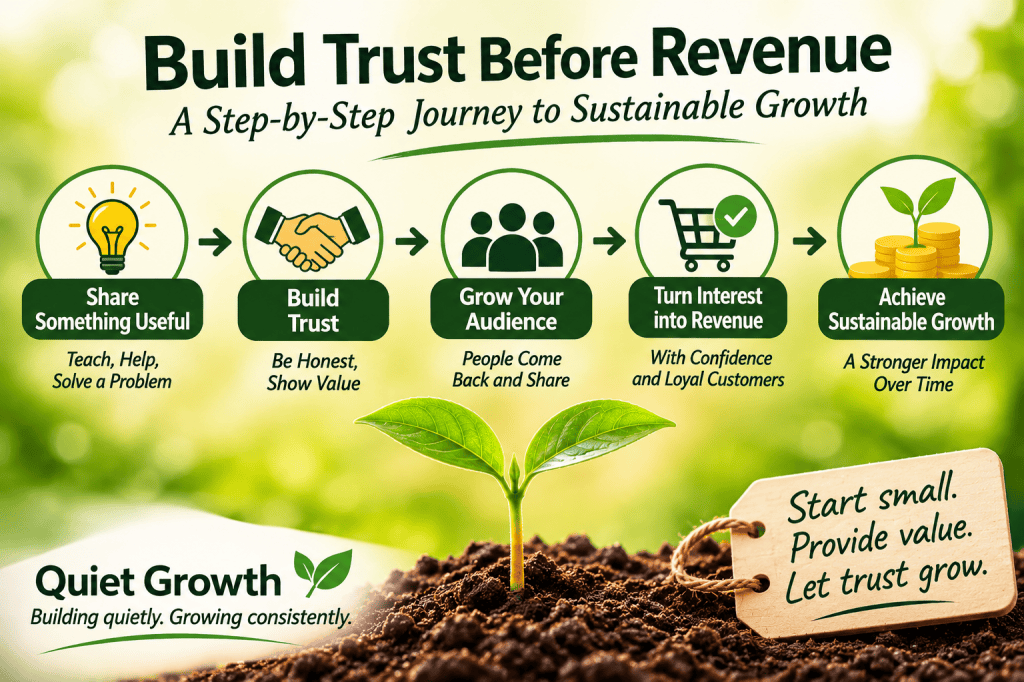
You do not need a complicated strategy to put this principle into practice. Start with one small experiment.
1. Choose one audience.
Identify a group of people whose problem you understand.
2. Choose one problem.
Focus on something specific enough that you can genuinely help.
3. Share one useful solution.
Write a short article, create a guide, demonstrate a process, or explain a lesson from experience.
4. Be clear about your knowledge.
Separate facts from personal opinions. Check important claims. Acknowledge uncertainty where it exists.
5. Observe the response.
Look for evidence that people understood, used, or benefited from what you shared. Do not judge the experiment by likes alone.
6. Decide what comes next.
Improve the resource, explore a paid offer, or test a different problem. Let what you learn inform the next decision.
The experiment may not produce revenue. It may not attract much attention at first. But if it helps you understand an audience, improve your work, or identify a genuine need, it can still be a worthwhile step.
You are building knowledge about the people you hope to serve, not simply publishing content and hoping for the best.
The principle behind Quiet Growth
At Quiet Growth, we believe meaningful progress does not require you to have everything at the beginning.
You may have limited money but valuable experience. You may have a skill but no audience. You may have an idea but still need to understand the people who could benefit from it.
None of those starting points guarantees success. Each can, however, provide something to work with.
Start by understanding what you have, what people need, and what you can responsibly offer. Use the resources available to you. Learn from real responses. Improve where necessary. Make decisions based on evidence rather than pressure to appear successful.
Then, when you are ready to charge for your work, let your offer reflect the value you can genuinely deliver.
You do not have to choose between helping people and building a viable business. The challenge is to create something useful, communicate its value honestly, and develop a model that allows you to keep delivering it.
That takes time. It also takes judgement, consistency, and a willingness to adapt.
There is no guarantee that trust will lead to revenue. But without credibility, clear value, and reliable delivery, sustainable growth becomes much harder to achieve.
Before asking people to invest in what you offer, give them a fair reason to believe in it.
Build something useful. Be honest about what it can do. Listen to the people you want to help. And let each step teach you something that makes the next one better.
You do not need to make a grand entrance. You need a sound starting point and the willingness to keep improving.
That is Quiet Growth.
Building quietly. Growing consistently. 🌱
Further reading
- Edelman — 2025 Brand Trust special report: Research on trust and consumer decisions.
- Think with Google — Build more meaningful customer relationships: Practical guidance on providing value and building customer trust.


Leave a Reply