Author: Ikenna Iyke Jude Mmadunwobi

  • If You Can’t Measure It, How Do You Know It’s Moving? A Practical Guide to Marketing Metrics and KPIs

    Growth is not just about doing more. It is about understanding what your actions are producing.

    A business can be busy every day and still struggle to grow.

    You publish content. You gain followers. People like your posts. Your website receives visitors. Your advertising reaches thousands of people.

    Everything appears to be moving.

    But are you getting closer to your goal?

    Are people becoming interested in what you offer? Are they contacting your business? Are those enquiries turning into customers? And is your business creating real value?

    These are important questions because activity and progress are not always the same thing.

    At Quiet Growth, we believe that understanding what works is just as important as taking action.

    That is where measurement comes in.

    1. Why measuring your progress matters

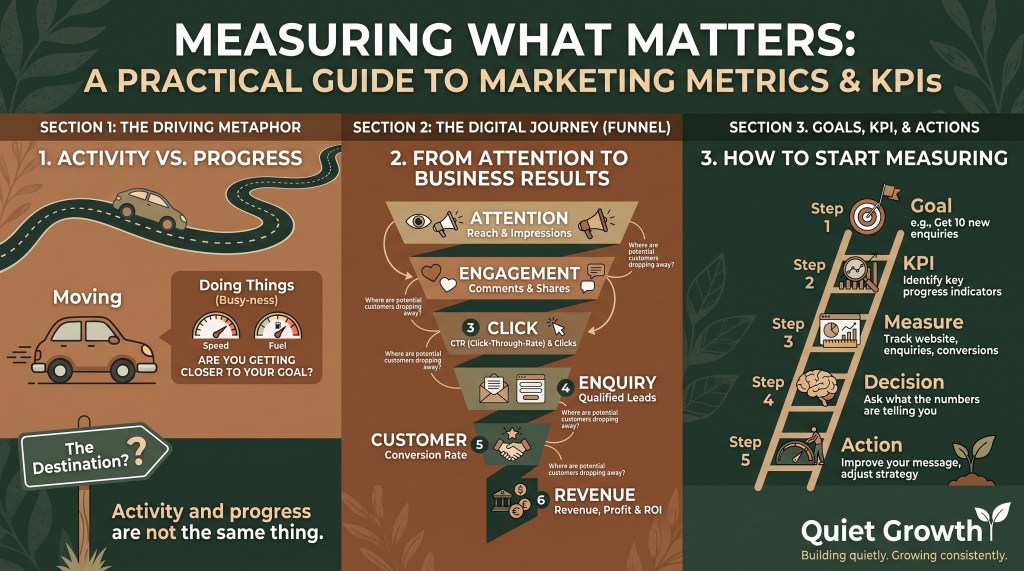
    Imagine driving a car without knowing your speed, how much fuel you have left, or whether you are getting closer to your destination.

    The car is moving, but you have limited information about your journey.

    Running a business without measuring results can feel the same way.

    You might spend hours creating content without knowing whether it reaches the right people. You might invest money in advertising without understanding whether it generates useful enquiries. You might gain followers without knowing whether any of them are interested in your products or services.

    Without measurement, you are relying heavily on assumptions.

    Measurement gives you information that helps you make better decisions.

    It can help you understand what is working, what needs attention, and where you may need to change your approach.

    The purpose of measurement is not simply to collect numbers. It is to use those numbers to make better decisions.

    2. What is a metric?

    A metric is a measurement that helps you understand something about your activity or performance.

    In digital marketing, common metrics include:

    • Impressions: how many times your content or advertisement was displayed.
    • Reach: how many unique people saw your content, where the platform provides that measurement.
    • Engagement: interactions such as likes, comments, shares, and other platform-defined actions.
    • Clicks: how many times people clicked a link or advertisement.
    • Website visits: how many visits your website received.
    • Leads: potential customers who have shown interest by taking a relevant action.
    • Sales: purchases made by customers.
    • Revenue: the money generated from sales.

    Each metric tells you something different.

    Impressions can help you understand visibility. Clicks can indicate interest in finding out more. Leads can indicate potential demand. Sales and revenue can help you assess commercial results.

    However, no single metric tells the entire story.

    For example, 10,000 impressions may be an excellent result for a campaign designed to increase awareness. But if the campaign was intended to generate sales, you need to examine what happened after people saw the advertisement.

    Did anyone click? Did anyone enquire? Did anyone buy?

    The meaning of a number depends on the question you are trying to answer.

    3. What is a KPI?

    KPI stands for Key Performance Indicator.

    In simple terms, a KPI is a measurement you choose because it helps you understand whether you are making progress toward an important goal.

    The key word is important.

    You can measure dozens of things in your business, but you do not need to give every number the same attention.

    Suppose your goal is to attract more potential customers. You might track qualified leads or enquiries.

    If your goal is to increase online sales, you might track purchases, conversion rate, and revenue.

    If your goal is to improve the profitability of your advertising, you might track customer acquisition cost and return on advertising spend.

    The right KPI depends on the outcome you want.

    Think of it this way:

    Goal β†’ KPI β†’ Measurement β†’ Decision β†’ Action

    First, decide what you want to achieve. Then choose the measurements that help you assess progress. Study the results, decide what they mean, and take appropriate action.

    This keeps measurement connected to a purpose instead of becoming a collection of interesting but unhelpful numbers.

    4. What should you actually measure?
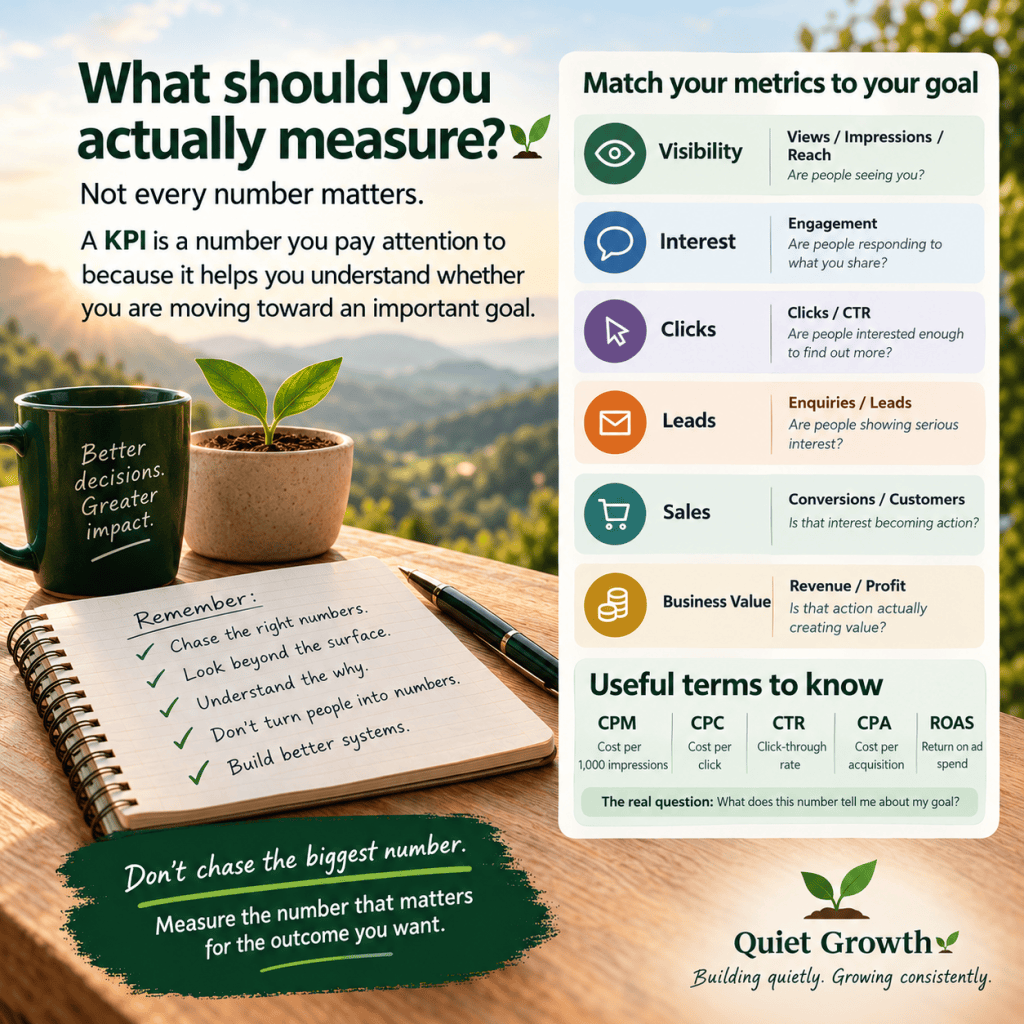
    The simplest way to answer this question is to start with your goal.

    Goal 1: Increase visibility

    Before people can become customers, they generally need an opportunity to discover your business.

    You might measure:

    • Impressions
    • Reach
    • Website visits
    • Relevant audience growth

    These metrics help you understand whether your message is reaching people.

    But visibility alone does not guarantee interest or sales.

    Goal 2: Understand interest and engagement

    Once people see your content, you may want to understand whether it attracts attention and encourages interaction.

    You might measure:

    • Comments and shares
    • Meaningful engagement
    • Link clicks
    • Click-through rate

    Click-through rate (CTR) measures the percentage of eligible impressions or other defined opportunities that result in clicks, depending on the platform and reporting method.

    For example, if an advertisement receives 1,000 impressions and 30 clicks, its impression-based CTR is:

    30 Γ· 1,000 Γ— 100 = 3%

    This tells you how often an impression resulted in a click. It does not, by itself, tell you whether those clicks produced valuable customers.

    Goal 3: Generate enquiries and leads

    If you offer a service, such as marketing support, consulting, cleaning, or catering, you may want people to contact you.

    You might measure:

    • Enquiries received
    • Qualified leads
    • Bookings requested
    • Consultation appointments

    However, not every enquiry represents a suitable customer.

    A qualified lead is a potential customer who meets relevant criteria for your offer. Tracking qualified leads can help you distinguish genuine opportunities from enquiries that are unlikely to progress.

    Goal 4: Turn interest into customers

    When your goal is sales, you need to understand whether potential customers are taking the final steps.

    You might measure:

    • Purchases
    • Conversion rate
    • Number of new customers
    • Average order value

    Conversion rate measures the percentage of a defined group of visitors or users who complete a desired action.

    For example, if 200 website visitors result in 10 purchases, the purchase conversion rate is:

    10 Γ· 200 Γ— 100 = 5%

    This calculation assumes those 200 visitors are the relevant measurement group and the 10 purchases are attributable to that group.

    Goal 5: Understand business value

    A business needs more than attention and activity. It needs to create value and manage its costs.

    You might measure:

    • Revenue
    • Profit
    • Customer acquisition cost
    • Return on advertising spend
    • Customer retention

    Revenue is the money generated through sales. Profit is what remains after the relevant costs are deducted.

    A business can increase revenue without increasing profit if its costs rise even faster.

    That is why the number that looks most impressive is not always the number that matters most.

    5. Five marketing terms worth understanding

    As you explore digital marketing, you will encounter several abbreviations. Here are five common ones.

    CTR β€” Click-Through Rate

    The percentage of impressions or other defined opportunities that result in clicks.

    CPC β€” Cost Per Click

    The amount spent on advertising divided by the number of billable clicks, according to the advertising platform’s reporting rules.

    CPM β€” Cost Per Thousand Impressions

    The cost of generating 1,000 ad impressions. CPM is calculated by dividing the relevant advertising cost by impressions and multiplying by 1,000.

    CPA β€” Cost Per Acquisition or Action

    The cost of generating a defined acquisition or action. The exact meaning depends on what the campaign counts as an acquisition or action.

    ROAS β€” Return on Advertising Spend

    The advertising-attributed revenue divided by the advertising spend.

    For example, if you spend €100 on advertising and generate €400 in attributed revenue, your ROAS is 4:1.

    That means €4 in attributed revenue for every €1 spent on advertising.

    It does not mean you made €300 in profit. You still need to account for product costs, operating expenses, and other relevant costs.

    Understanding these terms is useful, but memorising abbreviations is not the real objective.

    The real objective is knowing when a measurement is useful and what it can tell you.

    6. Follow the journey from attention to business results

    Marketing metrics become more useful when you connect them.

    Consider a small business that offers a service online.

    Its customer journey might look like this:

    Attention β†’ Engagement β†’ Click β†’ Enquiry β†’ Customer β†’ Revenue

    At each stage, different measurements help answer different questions.

    StageQuestionPossible measurement
    AttentionAre people seeing us?Reach or impressions
    EngagementAre people responding?Comments, shares or other interactions
    ClickAre people exploring further?Clicks and CTR
    EnquiryAre potential customers contacting us?Enquiries and qualified leads
    CustomerAre enquiries becoming sales?New customers and conversion rate
    Business resultIs the activity creating value?Revenue, profit and acquisition cost

    Not every customer follows this exact journey. Some people discover a business through a recommendation, visit its website later, and contact it directly.

    The purpose of the journey is not to force every person into one path. It is to help you understand where opportunities are appearing and where potential customers may be dropping away.

    For example, if many people click an advertisement but few contact the business, you might investigate the landing page, the offer, the contact process, or whether the audience is suitable.

    The numbers can help you identify where to investigate.

    They do not automatically reveal the cause.

    7. Why bigger numbers are not always better

    Imagine two small businesses publishing content online.

    Business A receives 10,000 impressions and two enquiries.

    Business B receives 1,000 impressions and 15 enquiries.

    If the goal is visibility, Business A has reached more people.

    If the goal is generating enquiries, Business B has produced more enquiries from less visibility.

    Neither result tells us everything about the businesses. We would still need to examine the quality of the enquiries, the costs involved, the customers acquired, and the wider business objectives.

    But the comparison illustrates an important principle:

    A bigger number is not automatically a better result.

    The right interpretation depends on the goal.

    This is why businesses should avoid judging their entire performance using likes, impressions, followers, or any other single metric.

    A useful measurement is one that helps answer a relevant question.

    8. Numbers tell you what happened. Investigation helps you understand why.

    Suppose your website receives fewer visitors this month than last month.

    The number tells you that traffic decreased. It does not explain why.

    Possible explanations might include:

    • You published less content.
    • Your advertising budget changed.
    • Search interest declined.
    • Your audience’s behaviour changed.
    • A technical issue affected the website.
    • A campaign that previously generated traffic ended.

    These are possibilities to investigate, not conclusions to assume.

    You can compare time periods, review campaign activity, examine traffic sources, and check for technical problems.

    You can also speak to customers and ask questions.

    Good measurement supports good investigation. It does not replace it.

    Data gives you clues. Critical thinking helps you interpret them.

    9. Behind every number is a person

    It is easy to look at a dashboard and see nothing but numbers.

    But every click comes from an interaction. Every enquiry represents someone who took the time to contact you. Every customer made a decision, often after considering their needs, trust, budget, and alternatives.

    This matters because marketing is not simply a process of moving numbers upwards.

    It is also about understanding people.

    If your content receives few clicks, perhaps the message is unclear. Perhaps the offer is not relevant. Perhaps the audience needs more information before taking the next step.

    If people enquire but do not buy, perhaps they need a different offer, clearer pricing, more confidence in your service, or a better explanation of the value you provide.

    Measurement helps you ask better questions about these experiences.

    It should help you serve people better, not reduce them to statistics.

    10. A simple measurement system for a small business

    You do not need an expensive analytics platform or dozens of dashboards to begin.

    Start with a simple process.

    Step 1: Choose one important goal.

    For example, generate 10 qualified enquiries next month.

    Step 2: Select a few relevant measurements.

    You might track website visits, enquiry numbers, qualified leads, and the number of customers acquired.

    Step 3: Record your starting point.

    Write down your current results so you have something to compare against.

    Step 4: Review the results consistently.

    Compare relevant periods and account for changes in advertising spend, seasonality, and other factors that could affect performance.

    Step 5: Ask what the numbers suggest.

    Are people seeing your offer? Are they responding? Are they contacting you? Are the enquiries suitable?

    Step 6: Decide what to change.

    You might improve your message, simplify your website, adjust your audience, strengthen your offer, or follow up more effectively.

    Step 7: Measure again.

    Observe what happens after the change. Keep what works, question what does not, and continue learning.

    For a small business, this simple habit can be more useful than collecting dozens of numbers without acting on them.

    Conclusion: Measure what matters

    Growth does not come from measuring everything.

    It comes from understanding what deserves your attention.

    Start with your goal. Choose measurements that help you evaluate progress. Look beyond the surface. Investigate what the numbers suggest, and use what you learn to make better decisions.

    Remember:

    • Visibility is not the same as interest.
    • Interest is not the same as a qualified lead.
    • A lead is not the same as a customer.
    • Revenue is not the same as profit.
    • Measurement is not the same as understanding.

    Each stage tells you something different about your business.

    And the better you understand those differences, the better equipped you are to make informed decisions.

    At Quiet Growth, we believe that sustainable progress comes from thoughtful action, consistent learning, and a willingness to improve.

    You do not have to chase every number.

    You need to understand the numbers that matter to the outcome you want.

    Don’t just count what is happening. Understand what it means.

    Quiet Growth 🌱
    Building quietly. Growing consistently.


    What is one number you currently measure in your business or marketing, and what does it actually tell you? Share your thoughts in the comments.

  • SWOT Beyond the Four Boxes: How to Turn Business Analysis Into Better Decisions

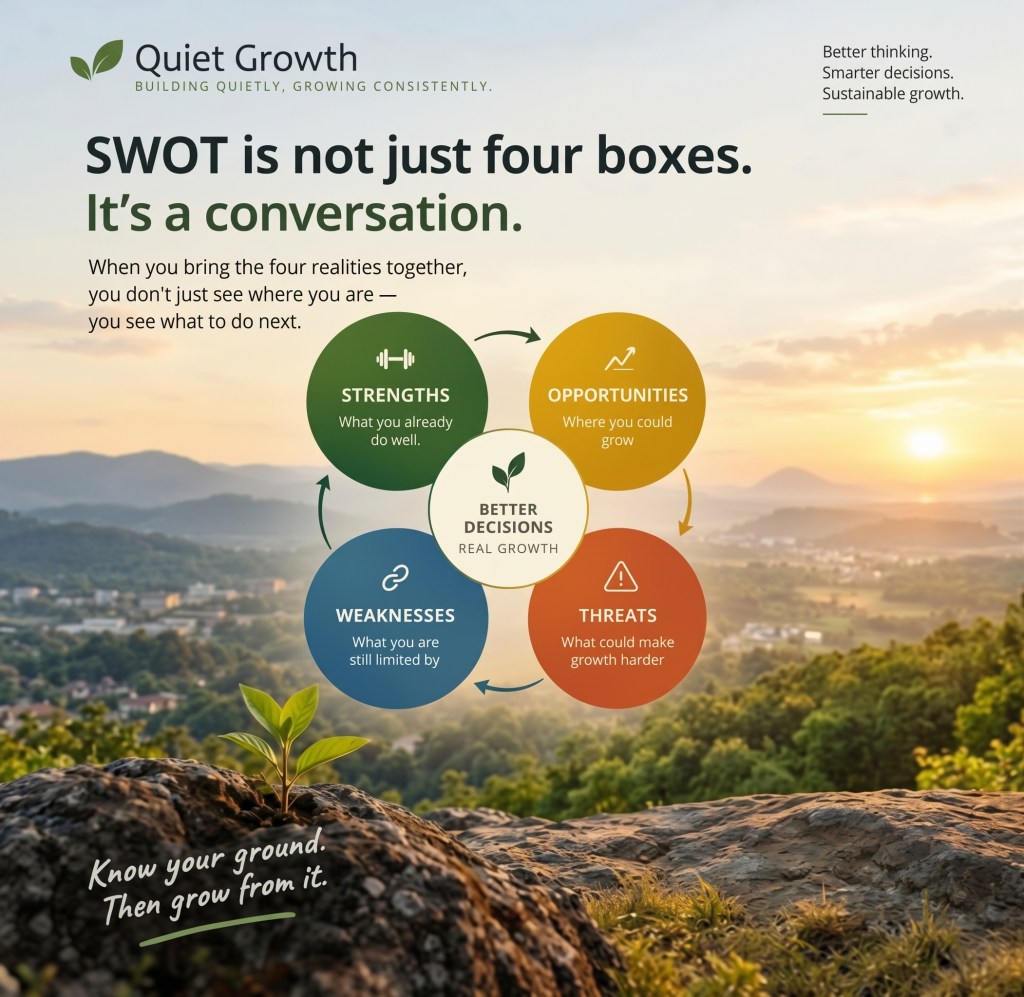
    SWOT analysis is often taught as four boxes:

    Strengths.
    Weaknesses.
    Opportunities.
    Threats.

    Fill in the boxes. Read them. Move on.

    But that is also where many businesses miss the real value of SWOT.

    The boxes are not the strategy.

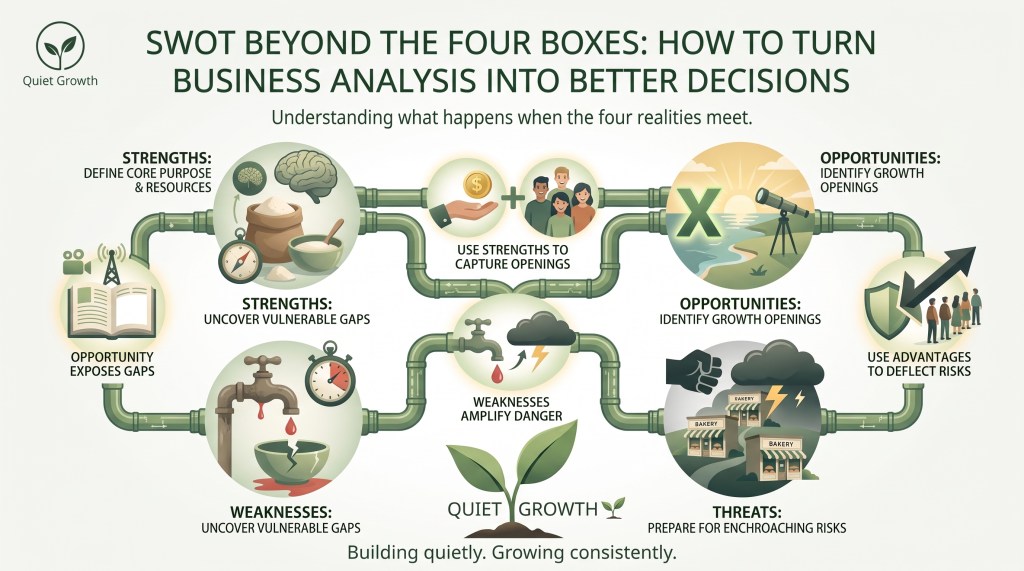
    The value comes from understanding what happens when the four realities meet.

    A strength can help you take advantage of an opportunity.

    The same strength can protect you from a threat.

    An opportunity can expose a weakness.

    And a weakness can make an existing threat much more dangerous.

    That is where SWOT becomes more than an exercise.

    It becomes a way of thinking about what to do next.

    A simple example: a local catering business

    Imagine a small catering business.

    The food is excellent.

    Customers who have tried it are happy with the quality, the service and the experience.

    But there is a problem.

    Very few people know the business exists.

    There is little online presence. There are few public reviews. Most new customers come through personal recommendations.

    Now imagine a local event appears and the organiser is looking for a caterer.

    Suddenly, the business has an opportunity.

    But there is another catering company competing for the same event.

    That company has more visibility, a stronger online presence and a reputation that already reaches a much larger audience.

    Now we have all four parts of SWOT in one situation.

    Strength

    The small caterer has excellent food and good customer experiences.

    That is something they already possess.

    Weakness

    Very few people know about the business.

    Its visibility and digital presence are limited.

    Opportunity

    A local event could put the business in front of new customers.

    Threat

    A larger, more established competitor wants the same opportunity.

    If we stop here, we simply have four observations.

    But SWOT becomes much more useful when we ask:

    What happens when these realities interact?


    Strength + Opportunity: Use what already works

    The event creates a chance to put the caterer’s strongest asset in front of more people.

    The obvious goal is to win the event.

    But there could be a bigger opportunity hidden inside it.

    A successful event can create:

    • new customers
    • referrals
    • testimonials
    • photographs and content
    • local recognition
    • new conversations
    • repeat business

    The opportunity is not only the event itself.

    It is what the event can create afterwards.

    This is an important growth principle.

    Sometimes the first opportunity is not the final goal.

    It is the door that leads to the next one.


    Strength + Threat: Compete with what you actually have

    The larger competitor may have more followers, more visibility and more resources.

    That does not automatically mean the smaller business has nothing to offer.

    The smaller caterer may have advantages that are much harder to copy:

    Personal service.

    Local knowledge.

    Closer relationships.

    Flexibility.

    A food experience customers genuinely remember.

    This changes the question.

    Instead of asking:

    β€œHow do we become bigger than them?”

    the business can ask:

    β€œWhat can we offer that makes our position valuable?”

    That is a very different strategic question.

    Not every competitor needs to be beaten everywhere.

    Sometimes you need to become clearly valuable somewhere.


    Weakness + Opportunity: Let the opportunity expose the gap

    The event could also reveal the business’s biggest weakness.

    People may love the food.

    But what happens the week after the event?

    Can they find the business online?

    Can they see the menu?

    Can they read customer reviews?

    Can they contact the caterer easily?

    Can they remember the name?

    Can they recommend the business to someone else?

    An opportunity can therefore do something very useful:

    It can show you what is missing.

    Perhaps the caterer needs a simple website or business profile.

    Perhaps it needs better photographs.

    Perhaps it needs customer reviews.

    Perhaps it needs a clearer way for people to stay connected.

    Perhaps it simply needs to make it easier for someone who enjoyed the food to find them again.

    The opportunity is therefore not only something to capture.

    It is also something that can diagnose the business.


    Weakness + Threat: Understand what could make the situation harder

    Now put the weakness beside the threat.

    The larger competitor already has visibility.

    The smaller caterer does not.

    The competitor has a stronger reputation.

    The smaller business is still building its public proof.

    The competitor may already have established relationships with event organisers.

    The smaller business is trying to create them.

    The same weakness now matters much more because there is a strong competitor sitting beside it.

    This is why SWOT should not be treated as four independent lists.

    A weakness becomes more important when it interacts with a threat.

    And an opportunity becomes more valuable when it can also help strengthen a weakness.

    That is where the real thinking begins.


    SWOT is a conversation, not a checklist

    This is the part I think businesses often miss.

    You can complete a SWOT table in fifteen minutes and still learn almost nothing.

    The better questions are:

    What does this strength allow us to do?

    Which opportunity fits that strength?

    Which weakness could prevent us from taking advantage of it?

    Which threat makes that weakness more urgent?

    What can we improve before the threat becomes bigger?

    Now the four boxes are talking to each other.

    And that conversation can lead to a decision.


    What should the caterer actually do?

    There may not be one perfect answer.

    The business could:

    • focus on winning the local event
    • improve its online presence
    • collect more customer reviews
    • strengthen local relationships
    • create a simple way for customers to find and contact the business
    • use the event to generate content and proof
    • differentiate itself from the larger competitor
    • combine several of these actions

    The important thing is that the business is no longer guessing.

    It has looked at the situation from several angles.

    That is what makes SWOT useful.

    It does not make the decision for you.

    It helps you understand the situation well enough to make the decision yourself.


    Start where you can stand firmly

    There is another lesson hidden inside this example.

    A small business does not always need to begin by fighting for the entire market.

    A local caterer can start locally.

    Serve the people nearby.

    Create good experiences.

    Build relationships.

    Collect proof.

    Let satisfied customers talk about the business.

    Then build on what already works.

    By the time that business expands its digital presence, it is not starting from zero.

    It already has:

    experience

    customers

    stories

    reviews

    relationships

    proof

    That is a foundation.

    And foundations matter because growth puts pressure on whatever you build underneath it.


    Visibility is useful. But visibility alone is not the foundation.

    A business can become more visible without becoming more trusted.

    People can see your content.

    They can see your business.

    They can see your products.

    But visibility does not automatically create understanding.

    A customer who discovers the caterer through an event still needs a reason to remember the business.

    That is where relationships, reputation and consistent experiences become important.

    Growth is not simply getting more people to notice you.

    It is building something worth remembering when they do.


    A simple SWOT process you can use

    You do not need a complicated strategy workshop to begin.

    Take a real situation and ask four groups of questions.

    1. Strengths

    What do we already do well?

    What do customers value?

    What resources or capabilities do we already have?

    2. Weaknesses

    Where are we limited?

    What are we missing?

    Where do customers experience friction?

    3. Opportunities

    What is changing around us?

    Where is there demand?

    What new situation could create growth?

    4. Threats

    Who or what could make growth harder?

    What could reduce our advantage?

    What weakness could become more serious under pressure?

    Then take the next step.

    Connect them.

    Ask:

    Strength + Opportunity:
    How can what we already do well help us take advantage of this opportunity?

    Strength + Threat:
    How can our existing advantage protect us?

    Weakness + Opportunity:
    What does this opportunity reveal that we need to improve?

    Weakness + Threat:
    What should we strengthen before the threat becomes more difficult?

    That is where SWOT starts becoming actionable.


    The Quiet Growth approach

    At Quiet Growth, I believe growth should not be confused with movement.

    Doing more does not automatically mean growing better.

    Sometimes the smarter move is to pause, understand the ground and identify what actually deserves attention.

    SWOT can help with that.

    It gives you a way to step back from the noise and look at the situation as a whole.

    What do you already have?

    What is missing?

    Where is the opening?

    What could make it harder?

    And most importantly:

    What does all of that mean for your next move?

    You do not always need to build faster.

    Sometimes you need to understand better.

    Because when you know what you are standing on, you can decide where to place the next step.

    Know your ground. Then grow from it.

    Quiet Growth 🌱
    Building quietly. Growing consistently.

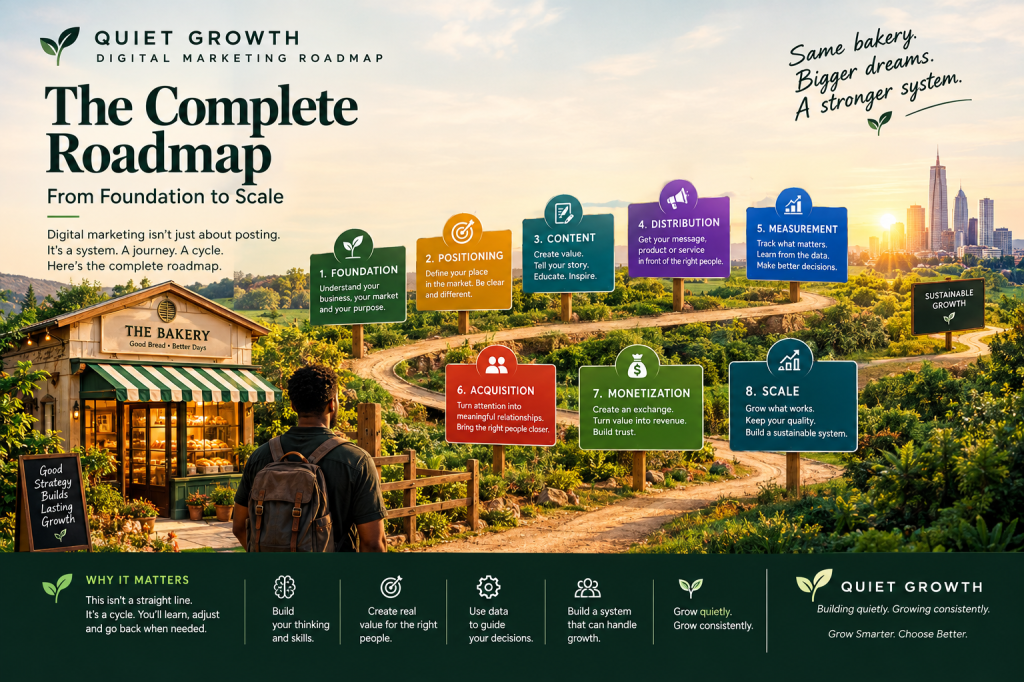
  • The Complete Roadmap

    The digital marketing journey we have been walking through, one step at a time.

    For the past few weeks, we have been talking about a bakery.

    We talked about the baker.

    We talked about positioning.

    We talked about bread, stories and content.

    We followed the bread into the market.

    We looked at what the numbers were telling us.

    We asked who was actually walking into the bakery.

    We talked about turning value into revenue.

    And finally, we asked whether the bakery could grow without breaking the system that built it.

    There was a reason for all of this.

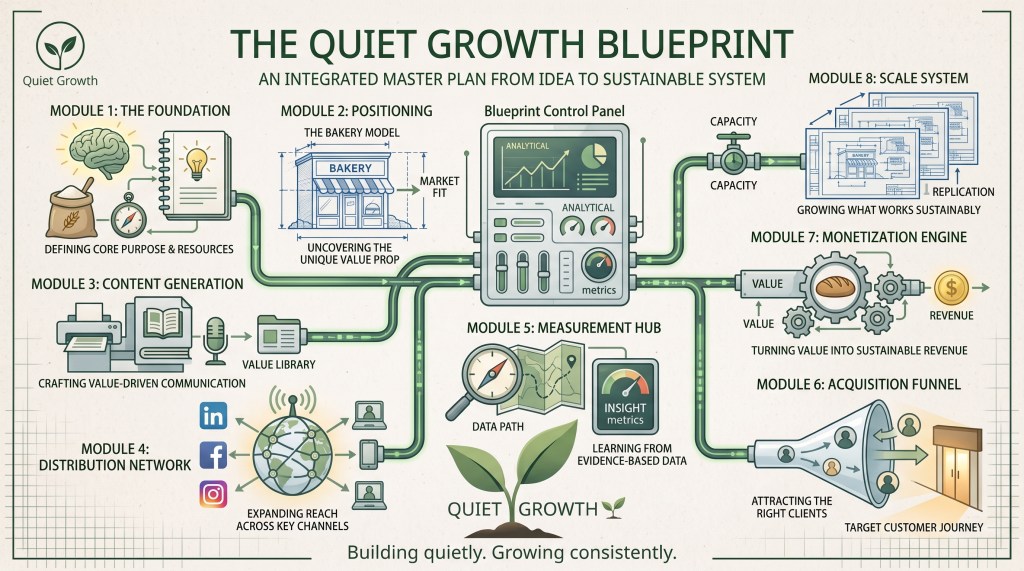
    We were walking through a complete digital marketing roadmap.

    You may not have noticed it at first.

    And that was intentional.

    Instead of starting with a complicated diagram, we started with something simple:

    A bakery.

    Because digital marketing can sound complicated when we turn it into too many terms.

    But underneath the terminology, the principles are surprisingly simple.

    You need a foundation.

    You need to know where you stand.

    You need to know who you are serving.

    You need something valuable to offer.

    You need a way to reach people.

    You need to understand what is happening.

    You need to bring the right people closer.

    You need to turn value into revenue.

    And eventually, you need a system that can grow.

    That is the roadmap.


    1. Foundation

    Everything starts here.

    Before marketing anything, you need to understand what you are building.

    Imagine opening a bakery.

    Before worrying about Instagram, advertising or viral videos, you need to understand the business itself.

    What are you selling?

    Who are you serving?

    What problem or need are you addressing?

    What resources do you have?

    What makes the business possible?

    The same applies to digital marketing.

    You cannot build a strong marketing system around something you do not understand.

    The foundation gives everything else something to stand on.

    Without it, the rest can become activity without direction.

    Foundation asks:

    What are we building, and why does it exist?


    2. Positioning

    Now imagine there are ten bakeries on the same street.

    Why should someone choose yours?

    This is where positioning begins.

    Positioning is about creating a clear place in the mind of the people you want to reach.

    It is not simply about having a logo.

    It is not simply about choosing brand colours.

    It is about answering questions such as:

    Who are we for?

    What do we want to be known for?

    What makes our offer meaningful or different?

    What problem do we solve?

    Why should someone remember us?

    In a crowded market, being good is not always enough.

    People need to understand what you represent and why it matters to them.

    Positioning gives your marketing direction.


    3. Content

    Once you understand what you are building and how you want to be positioned, you need something to communicate.

    That is where content comes in.

    The bakery has bread.

    But the bakery can also tell people about the ingredients.

    The process.

    The story.

    The people behind the business.

    The reason the bread exists.

    The problem it solves.

    The experience of eating it.

    Digital marketing works in the same way.

    Content can educate.

    It can demonstrate expertise.

    It can tell stories.

    It can answer questions.

    It can create awareness.

    It can help people understand your value.

    But content should not simply exist because someone said:

    β€œWe need to post three times this week.”

    Good content has a job.

    It should connect what you offer with the people you want to reach.

    Content gives your value something to communicate.


    4. Distribution

    Creating something valuable does not automatically mean people will see it.

    Our bakery makes excellent bread.

    But if the bread stays inside the bakery, its reach is limited.

    This is where distribution comes in.

    Distribution is about getting your content, product or message into places where people can encounter it.

    That could include:

    • Social media
    • Search
    • Email
    • Communities
    • Partnerships
    • Websites
    • Word of mouth
    • Advertising
    • Other relevant channels

    But there is an important lesson here:

    Distribution is not the same as acquisition.

    Putting the bread into the market means it is available.

    It does not automatically mean the right customer will walk into the bakery.

    Distribution creates access.

    Acquisition moves the right people closer.


    5. Measurement

    Once the system is running, we need to understand what is happening.

    This is where measurement enters the picture.

    How many people saw the content?

    How many engaged?

    How many visited?

    How many subscribed?

    How many made an enquiry?

    How many became customers?

    What worked?

    What did not?

    Where did people drop off?

    Measurement gives us evidence.

    But there is an important warning:

    Numbers need context.

    10,000 views can sound impressive.

    But who viewed them?

    1,000 website visitors can sound impressive.

    But what did they do after arriving?

    More leads can sound positive.

    But are they qualified?

    More revenue can sound exciting.

    But what did it cost to generate?

    Measurement is not about collecting numbers simply because we can.

    It is about understanding what those numbers are telling us.

    Measurement helps us learn from the system.


    6. Acquisition

    Now we ask a different question.

    Who actually walks into the bakery?

    This is acquisition.

    Someone can see your content.

    They can follow you.

    They can visit your website.

    They can subscribe.

    They can send an enquiry.

    They can eventually become a customer.

    These are different stages of a relationship.

    Acquisition is about creating a path for the right people to move closer to the business.

    And this is why:

    Attention is not acquisition.

    You can have a large audience and still have very few people who actually need what you offer.

    The goal is not simply to attract everyone.

    It is to attract people who have a reason to care.

    Acquisition turns attention into meaningful movement toward the business.


    7. Monetization

    Eventually, value has to become an exchange.

    The bakery sells the bread.

    The customer receives something valuable.

    The bakery receives revenue.

    That is monetization.

    But monetization does not begin with:

    β€œHow can I make money?”

    It begins much earlier.

    You understand the market.

    You create value.

    You communicate that value.

    You reach the right people.

    You build trust.

    You make the offer clear.

    Then someone decides:

    β€œI want this.”

    The transaction happens.

    That is why monetization is a process, not a starting point.

    You are not simply trying to extract money from attention.

    You are creating an exchange around value.

    Value comes first.


    8. Scale

    And then we arrive at the final question:

    What happens when the business starts working?

    Imagine the bakery becomes successful.

    10 customers become 100.

    100 become 1,000.

    Orders increase.

    Revenue increases.

    The team grows.

    The workload grows.

    Now the business has a new problem.

    Can the system handle the growth?

    Can the bakery maintain its quality?

    Can it serve customers properly?

    Can it control its costs?

    Can it remain profitable?

    Can the team handle the additional workload?

    This is where scale becomes different from simply getting bigger.

    Scale is increasing what works without allowing the system to break.

    More traffic is not automatically scale.

    More followers are not automatically scale.

    More customers are not automatically scale.

    More revenue is not automatically scale.

    Growth needs a system that can carry the additional weight.

    Otherwise, you are simply making a bigger version of the same problem.

    Scale asks:

    Can we grow while protecting the value that made the growth possible?


    The Complete Roadmap

    Now we can see the whole picture:

    Foundation
    ↓
    Positioning
    ↓
    Content
    ↓
    Distribution
    ↓
    Measurement
    ↓
    Acquisition
    ↓
    Monetization
    ↓
    Scale

    But there is something important to understand.

    This is not a staircase where you complete one step and never return to it.

    Real businesses are more like a cycle.

    You scale and discover a problem.

    That problem may force you to improve your foundation.

    You acquire customers and discover that your positioning is unclear.

    You measure your content and discover that the message needs to change.

    You monetize and discover that the offer needs improvement.

    You grow and discover that the system cannot handle the demand.

    So you go back.

    You learn.

    You adjust.

    You build again.

    The roadmap gives you direction, not a reason to stop thinking.


    Why We Used the Bakery

    You might be wondering why we spent so much time talking about bread.

    Because sometimes a simple example can teach a complicated system better than a complicated diagram.

    Think about what happens in a bakery.

    You need a foundation.

    You need to know what makes your bakery different.

    You need something worth communicating.

    You need to get it into the market.

    You need to understand what is happening.

    You need the right customers to come through the door.

    You need to turn the value into revenue.

    And if the business grows, you need a system capable of carrying that growth.

    That is not only a bakery lesson.

    That is business.

    And it is also the foundation of how we can understand digital marketing.


    Digital Marketing Is Bigger Than Posting

    This is one of the biggest lessons I wanted this series to communicate.

    Digital marketing is not simply:

    β€œPost on LinkedIn.”

    It is not:

    β€œGet followers.”

    It is not:

    β€œGo viral.”

    It is not:

    β€œRun an advert.”

    It is not even simply:

    β€œMake content.”

    Those are individual activities.

    The bigger question is how those activities work together.

    Where are you starting?

    How are you positioned?

    What value are you communicating?

    How are you distributing it?

    What are you learning from the data?

    Who are you attracting?

    How does that attention become a relationship?

    How does that relationship become an exchange?

    And can the system grow sustainably?

    When you start seeing marketing this way, the individual tactics begin to make more sense.


    The Skills Hidden Inside the Roadmap

    There is another reason this roadmap matters.

    Each stage develops a different skill.

    Foundation develops understanding.

    Positioning develops clarity.

    Content develops communication.

    Distribution develops reach.

    Measurement develops analytical thinking.

    Acquisition develops customer understanding.

    Monetization develops commercial thinking.

    Scale develops systems thinking.

    Put those skills together and you begin to see something bigger.

    You are not simply learning how to post on social media.

    You are learning how to understand, build, communicate, measure and grow something.

    That is a much more useful way to think about digital marketing.


    From Noise to Systems

    The internet gives us endless tactics.

    Post more.

    Post less.

    Use this platform.

    Use that platform.

    Go viral.

    Build a funnel.

    Use AI.

    Run ads.

    Create a newsletter.

    Start a podcast.

    Build a community.

    The problem is not that these tactics are useless.

    The problem is that tactics without a system can become noise.

    A roadmap gives those tactics context.

    You can ask:

    Where does this fit?

    What problem is it solving?

    What happens before it?

    What happens after it?

    What are we trying to learn?

    What should happen next?

    That is when marketing becomes more intentional.


    You Don’t Have to Build Everything at Once

    One final lesson.

    You do not need to master every stage tomorrow.

    You do not need thousands of followers.

    You do not need a huge website.

    You do not need every AI tool.

    You do not need to be everywhere.

    Start with the foundation.

    Understand your market.

    Clarify your position.

    Create something valuable.

    Get it in front of the right people.

    Measure what happens.

    Learn.

    Adjust.

    Build trust.

    Monetize when the value and the exchange are ready.

    Then scale what actually works.

    One stage at a time.


    The Quiet Growth Way

    This is ultimately what Quiet Growth is about.

    Not chasing every new tactic.

    Not trying to make noise for the sake of attention.

    Not confusing activity with progress.

    It is about understanding the system.

    Building carefully.

    Learning from evidence.

    Creating real value.

    Choosing the right people.

    And growing in a way that does not destroy what you built in the first place.

    The bakery lesson was never really about bread.

    It was about the system behind the bread.

    And now you can see the complete picture:

    Foundation.
    Positioning.
    Content.
    Distribution.
    Measurement.
    Acquisition.
    Monetization.
    Scale.

    Eight stages.

    One connected system.

    And the journey does not end at Scale.

    Because once you grow, you learn.

    And once you learn, you build again.

    Build quietly.
    Learn continuously.
    Grow consistently.

    Grow Smarter. Choose Better.

    Quiet Growth 🌱

    Building quietly. Growing consistently.

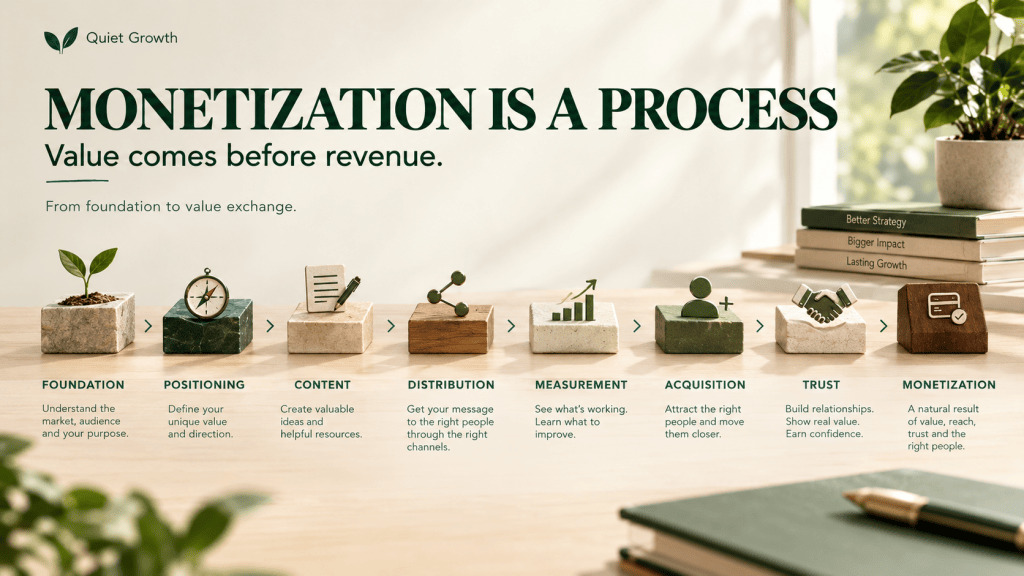
  • Monetization Is a Process, Not a Starting Point

    Why building value, reaching the right people and earning trust must come before revenue.

    Everyone wants to know:

    β€œWhen am I going to monetize?”

    Creators ask it.

    Businesses ask it.

    People starting digital marketing ask it.

    And with social media, AI tools, digital products and online businesses growing so quickly, there is often pressure to make money as quickly as possible.

    But there is something we often forget:

    Monetization is not where the journey starts.

    It is the result of several things working together.

    Think about a bakery.

    You don’t open the doors today and immediately ask:

    β€œWhere is my profit?”

    There is a process before the first sale.

    You have to understand the market.

    You have to know what people want.

    You have to create something worth buying.

    You have to let people know it exists.

    You have to reach the right people.

    You have to build trust.

    And eventually, someone decides:

    β€œI want this.”

    That is where the transaction happens.

    And that is where monetization begins.


    First, Understand the Market

    Before creating something, you need to understand who you are creating it for.

    A bakery cannot simply make 500 loaves of bread without considering what people in the area actually want.

    What kind of bread do they buy?

    What price are they comfortable with?

    When do they usually buy?

    What problem are they trying to solve?

    Are they looking for everyday bread, something special for an occasion, or something they cannot easily find elsewhere?

    Digital marketing works the same way.

    Before creating endless posts, products or services, ask:

    Who am I trying to help?

    What do they need?

    What problem are they trying to solve?

    What would make them pay attention?

    Understanding the market gives your work direction.

    Without that understanding, you can create a lot and still create very little value.


    Then, Create Something Valuable

    Once you understand the need, you can create.

    For a bakery, that could be bread, cakes, pastries or catering.

    For a digital business, it could be:

    • Educational content
    • A digital product
    • A service
    • A course
    • A consultation
    • A useful tool
    • A resource
    • A solution to a specific problem

    The important question is not:

    β€œWhat can I sell?”

    A better question is:

    β€œWhat value can I create?”

    Because people don’t usually pay simply because something exists.

    They pay because they believe the thing has value to them.


    Creating Value Is Not Enough

    You can have the best bread in the neighbourhood.

    But if nobody knows where your bakery is, the bread may remain on the shelf.

    This is where distribution becomes important.

    Your content, product or service needs a path to the people who may actually need it.

    That could happen through:

    • Social media
    • Search
    • Email
    • Communities
    • Partnerships
    • Word of mouth
    • A website
    • Other distribution channels

    But there is an important distinction:

    Being everywhere is not the same as reaching the right people.

    You can have thousands of views from people who have no interest in what you offer.

    You can have hundreds of followers who never need your product.

    You can have traffic that never becomes a meaningful conversation.

    So the question is not only:

    β€œHow many people saw me?”

    It is also:

    β€œDid the right people see me?”


    From Attention to Trust

    Someone sees your content.

    They might like it.

    Maybe they follow you.

    Maybe they visit your website.

    Maybe they come back another day.

    Then they read something else.

    They begin to understand what you know.

    They see how you think.

    They start to trust your work.

    This process matters.

    People don’t always buy the first time they see something.

    Sometimes they need time.

    They need more information.

    They need to understand the value.

    They need to feel that the person or business behind the offer understands their needs.

    That is why content is more than simply filling a social media calendar.

    Good content can help people move from attention to understanding, and from understanding to trust.


    Then Comes the Transaction

    Eventually, the customer reaches a point where the value is clear enough to act.

    The bakery sells the bread.

    The customer receives the bread.

    The bakery receives revenue.

    The exchange is simple.

    In digital business, the exchange might look different.

    Someone might buy a product.

    Someone might book a service.

    Someone might subscribe.

    Someone might pay for a course.

    Someone might hire a consultant.

    But the principle remains the same:

    Value is exchanged for money.

    That is monetization.

    Not simply putting a price on something.

    Not simply asking people to buy.

    But creating enough value, reaching the right people and making the exchange clear.


    Don’t Confuse Attention With Revenue

    This is where things can become misleading.

    A post can receive thousands of views.

    A video can get thousands of plays.

    A website can receive visitors.

    An email can be sent to thousands of people.

    Those numbers matter.

    But numbers need context.

    A large number does not automatically mean a healthy business.

    For example:

    1,000 views are not the same as 1,000 potential customers.

    10,000 followers are not the same as 10,000 buyers.

    1,000 emails sent are not the same as 1,000 people who actually received and engaged with the message.

    And website traffic alone does not tell you whether people found what they needed.

    The number is only the beginning.

    You have to understand what the number represents.

    That is why good marketing does not simply collect statistics.

    It learns from them.


    Monetization Takes Preparation

    This is why rushing to monetize can sometimes create the wrong question.

    Instead of asking:

    β€œHow quickly can I make money?”

    Ask:

    β€œHave I built something worth paying for?”

    Have I understood the market?

    Have I created real value?

    Am I reaching the right people?

    Am I building trust?

    Is the offer clear?

    Can people easily understand the next step?

    When these pieces begin to work together, monetization becomes much more natural.

    You are no longer trying to force money out of attention.

    You are creating an exchange around value.


    The Bakery Lesson

    Let’s go back to the bakery.

    The baker doesn’t begin with profit.

    The baker begins with understanding.

    Then comes the product.

    Then comes the story.

    Then comes the market.

    Then comes the customer.

    Then comes the sale.

    And the sale creates revenue.

    The same principle applies to digital marketing.

    You don’t have to rush every stage.

    You have to build each stage properly.

    Because if you skip important steps, you may eventually discover that you have plenty of activity but very little business.


    Don’t Rush the Harvest

    There is nothing wrong with wanting to make money from your work.

    That is part of building a sustainable business.

    But monetization should not become an obsession that makes you skip the work that creates the value in the first place.

    A farmer does not plant a seed in the morning and dig it up in the afternoon asking why there is no harvest.

    The work takes time.

    The soil needs preparation.

    The seed needs care.

    The plant needs the right conditions.

    Then comes the harvest.

    Business is not exactly the same as farming, of course.

    But the principle is useful:

    Don’t rush the harvest. Build something worth harvesting.

    Monetization is not the first step.

    It is what happens when value, people, trust and a clear exchange come together.

    Build well.

    Reach the right people.

    Create real value.

    Then let the revenue follow the value.


    Quiet Growth 🌱

    Building quietly. Growing consistently.

    The goal is not to make noise about making money.

    The goal is to build something useful enough that people are willing to pay for it.

    Grow Smarter. Choose Better.

  • Distribution: The Right Message Still Needs the Right Path

    You can create something valuable.

    You can explain it clearly.

    You can even build content that people genuinely appreciate.

    But there is another challenge:

    How does it reach the people who need it?

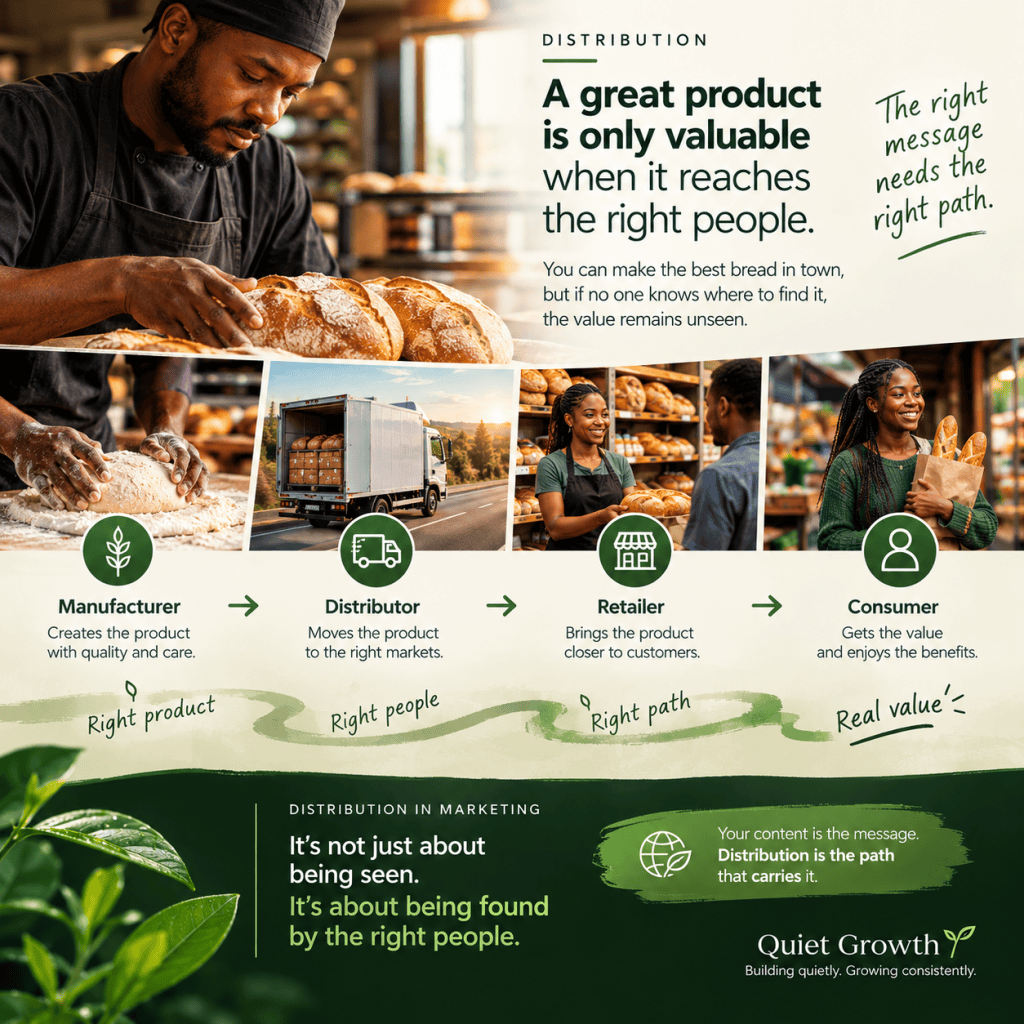
    Imagine a baker who has just made the best bread in town.

    The bread is fresh.

    The ingredients are good.

    The story behind it is authentic.

    Customers who try it love it.

    But there is one problem.

    The bakery is hidden down a street where nobody passes.

    The baker can keep making better bread.

    They can improve the recipe.

    They can tell a better story.

    But if the right people never discover the bakery, the value remains unseen.

    This is where distribution matters.

    Distribution is not simply about posting more.

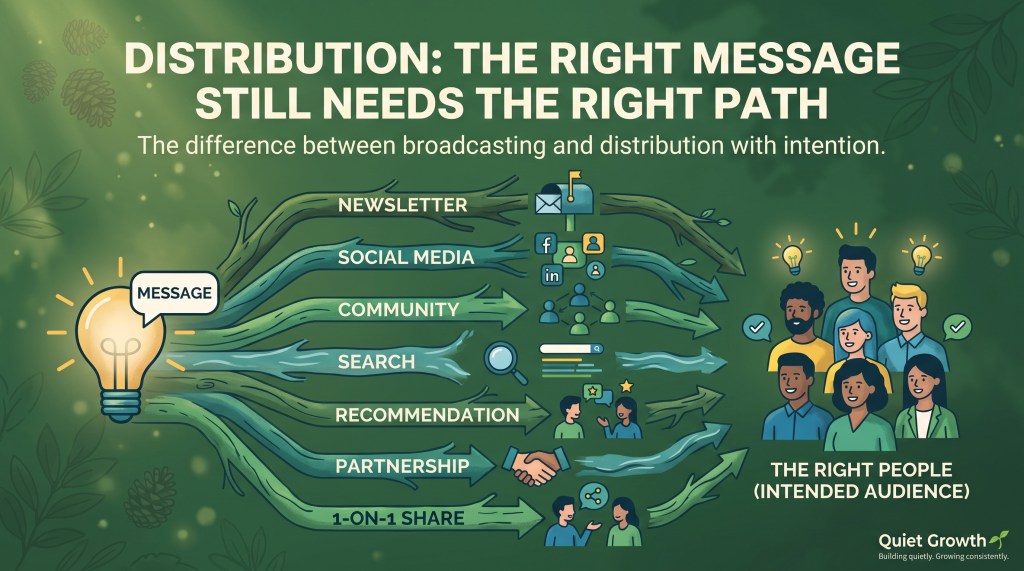
    It is about creating a path between your message and the people it is meant for.

    That path could be:

    A social media platform.

    A newsletter.

    A search engine.

    A community.

    A conversation.

    A recommendation.

    A partnership.

    Or even one person sharing your message with another.

    The platform is not the strategy.

    The audience is.

    Before asking:

    β€œWhere should I post this?”

    Ask:

    β€œWhere does the person I want to reach already pay attention?”

    Because being everywhere isn’t necessarily effective.

    You can publish excellent content on ten different platforms and still reach the wrong people.

    Or you can communicate consistently in one place where the right people are already listening.

    That’s the difference between broadcasting and distribution with intention.

    And this is where content and distribution connect.

    Your content is the message.

    Distribution is the path that carries the message.

    You need both.

    A great message with no path may remain invisible.

    A powerful distribution system carrying a weak message may simply create more noise.

    So don’t measure distribution only by how far something travels.

    Ask:

    Did it reach the right people?

    Did they understand it?

    Did it create interest?

    Did it start a conversation?

    Because the goal isn’t simply to be seen.

    The goal is to be seen by the people for whom your message matters.

    You don’t need to be everywhere.

    You need to be where the right people can find you.

    And once your message starts reaching them, another question naturally follows:

    How do you know whether it’s actually working?

    That’s where we go next.

    Quiet Growth 🌱
    Building quietly. Growing consistently.

  • Strategy Is Not About Making the Loudest Noise

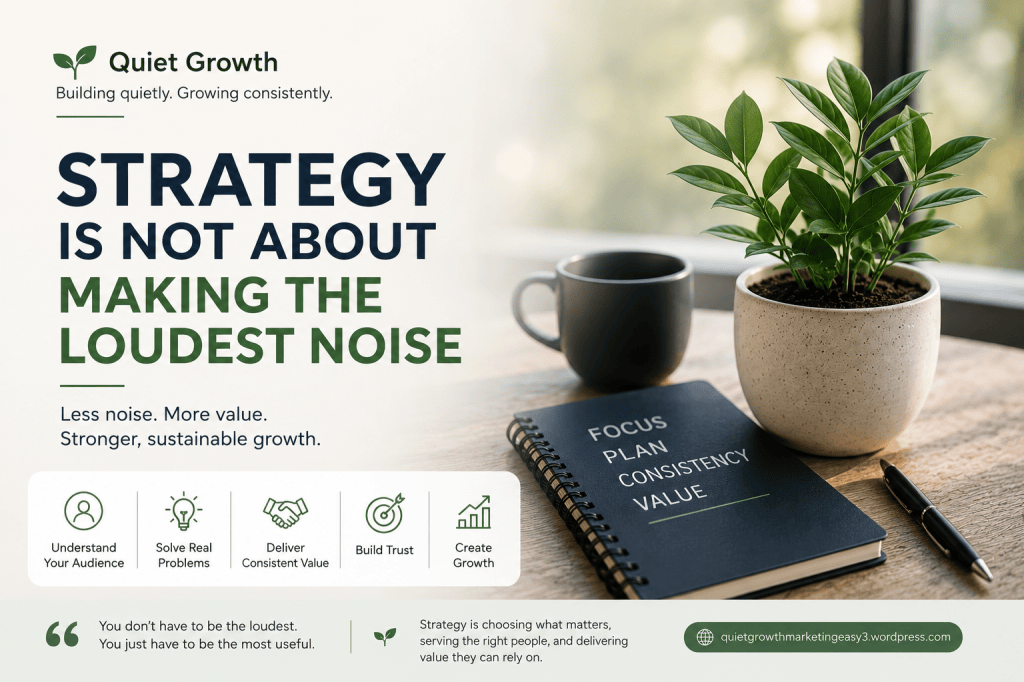
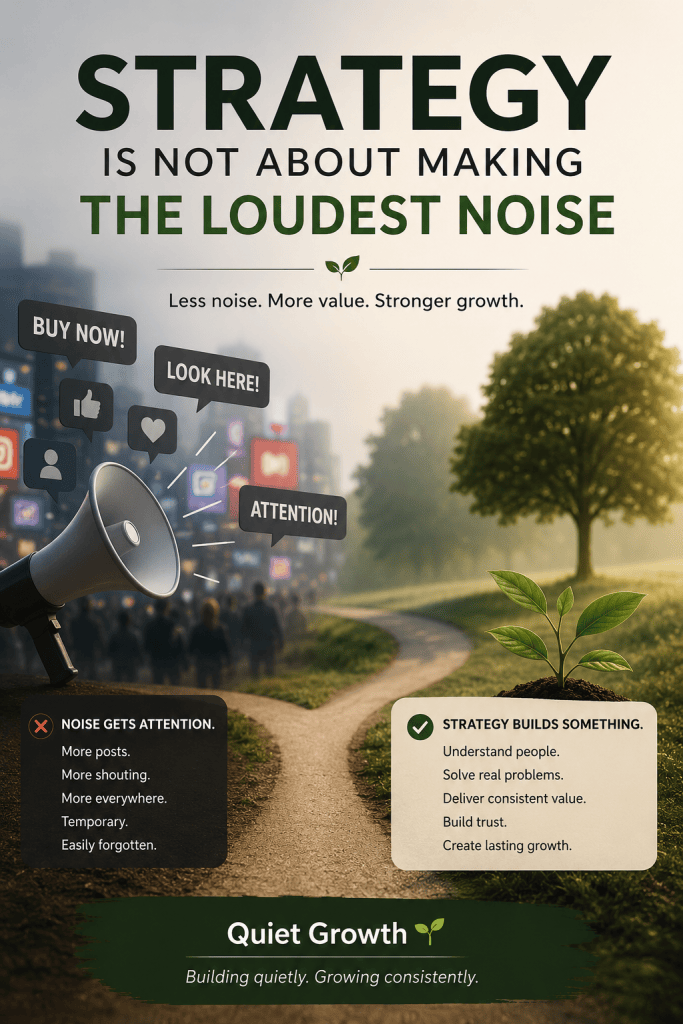
    There is a common idea that if you want to grow, you need to make more noise.

    Post more.

    Talk louder.

    Be everywhere.

    Get more attention.

    And there is some truth to it.

    If nobody knows you exist, it is difficult to grow.

    But attention alone is not a strategy.

    You can make a lot of noise and attract thousands of people, but what happens when they arrive?

    Can you give them something useful?

    Can you solve a problem for them?

    Can you consistently deliver what you promised?

    Can you give them a reason to trust you and come back?

    That is where strategy begins.

    What Is Strategy?

    In simple terms, strategy is deciding where you want to go, who you want to reach, and how you are going to get there.

    It is not about doing everything.

    It is about knowing what matters and choosing what to do β€” and sometimes what not to do.

    Think about a small shop.

    Imagine a shop owner standing outside every morning shouting:

    β€œCome and see what we have!”

    People might stop.

    Some might walk inside.

    But if the shopkeeper does not understand what people in the area actually need, the noise outside will not build a successful business.

    Now imagine another shopkeeper.

    They understand their customers.

    They know what people are looking for.

    They keep the products people need.

    They explain the value clearly.

    They treat customers well.

    And they consistently deliver what they promise.

    That shop may not be the loudest.

    But people know what to expect.

    And when people know what to expect, trust begins to develop.

    That is strategy.

    Attention Is Not the Same as Growth

    Attention is valuable.

    It can introduce people to your brand, your product, your service, or your ideas.

    But attention is only the beginning.

    Imagine someone sees your social media post and becomes interested.

    They visit your website.

    Then what?

    Is the message clear?

    Can they understand what you offer?

    Does your content answer their questions?

    Can they see how your product or service helps them?

    Is the experience consistent?

    If the answer is no, attracting more people will not necessarily solve the problem.

    You may simply be sending more people into a system that isn’t ready for them.

    More attention does not automatically create more value.

    Sometimes, the real problem is not that you need a bigger audience.

    You need a better strategy for serving the audience you already have.

    Strategy Starts With the Person You Are Trying to Help

    Before asking:

    β€œHow can I get more people?”

    Ask:

    β€œWho am I trying to help?”

    This changes the way you think.

    You start looking at your audience as people rather than numbers.

    What are they struggling with?

    What are they trying to achieve?

    What questions do they have?

    What do they need to understand before they can make a decision?

    What would make your solution genuinely useful to them?

    When you understand these things, your marketing becomes more intentional.

    Your content has a purpose.

    Your message becomes clearer.

    Your channels become easier to choose.

    And your efforts begin to work together instead of becoming a collection of random activities.

    A Good Strategy Creates Reliability

    One of the most underrated parts of growth is reliability.

    People return to things they can rely on.

    A customer returns to a business because they know what to expect.

    A reader returns to a creator because they consistently find something useful.

    A client recommends a professional because that person repeatedly delivers value.

    Reliability is not created by one impressive moment.

    It is created through repetition.

    You make a promise.

    You deliver.

    You do it again.

    And again.

    Over time, people begin to believe:

    β€œI know what I can expect from this person.”

    That is powerful.

    Because trust is not built simply by telling people that you are trustworthy.

    It is built by giving them evidence.

    You Don’t Have to Be Everywhere

    Another misunderstanding about strategy is that you need to be everywhere.

    LinkedIn.

    Instagram.

    TikTok.

    Facebook.

    YouTube.

    Email.

    A website.

    A podcast.

    And whatever new platform appears next month.

    But being everywhere does not necessarily mean being effective.

    If you are trying to serve everyone, everywhere, with everything, you can quickly become inconsistent.

    A better approach is to understand where the people you want to reach actually spend their time and what kind of communication works there.

    Then build a system you can realistically maintain.

    You do not need to win every platform.

    You need to be useful where it matters.

    Strategy Also Means Saying No

    This is one of the hardest parts.

    Every opportunity can look attractive.

    Every new trend can make you feel like you are falling behind.

    Every new platform can make you wonder whether you should be there too.

    But strategy requires choices.

    If everything is important, nothing is.

    Sometimes the strategic decision is:

    Not yet.

    Not because something is bad.

    But because it does not support the goal you are working toward right now.

    Growth requires focus.

    And focus requires saying no to some things so you can do the important things well.

    So, What Does Good Strategy Look Like?

    A simple way to think about it is:

    Know who you want to reach.

    Understand what they need.

    Know the value you can provide.

    Choose the right way to reach them.

    Create an experience that delivers on your promise.

    Keep doing what works.

    Learn and adjust when things change.

    That is strategy.

    It does not have to be complicated.

    And it certainly does not have to be loud.

    Noise Gets Attention. Strategy Builds Something.

    You can attract attention with noise.

    But attention alone does not create a relationship.

    A relationship requires value.

    Value creates trust.

    Trust creates reliability.

    And reliability gives people a reason to stay.

    That is why I believe sustainable growth is less about asking:

    β€œHow can I get more attention?”

    And more about asking:

    β€œWhat will I do with the attention I already have?”

    Because the goal is not simply to attract people.

    The goal is to become useful to the right people.

    And when you consistently meet a real need, you don’t have to keep shouting for attention.

    People begin to remember you.

    They begin to trust you.

    They begin to return.

    That is a different kind of growth.

    A quieter one.

    But often, a stronger one.


    A Simple Strategy Check

    Before your next marketing campaign, content plan, business decision, or growth experiment, ask yourself:

    Who am I trying to reach?

    What do they need?

    What problem am I helping them solve?

    Why should they choose me?

    Can I consistently deliver what I promise?

    What am I doing simply because everyone else is doing it?

    What should I stop doing?

    You may discover that you don’t need more noise.

    You may simply need a clearer direction.

    Quiet Growth 🌱

    Building quietly. Growing consistently.

  • When Preparation Becomes Avoidance: Why Action Creates Clarity

    There is a difference between preparing for something and hiding inside the preparation.

    At first, the difference can be difficult to see.

    Both can look productive.

    You can spend hours improving your idea.

    You can rewrite your offer.

    Redesign your website.

    Take another course.

    Watch more videos.

    Research your audience.

    Build a better strategy.

    Prepare for the moment when you finally feel ready.

    And sometimes, all of that preparation is necessary.

    But sometimes, something else is happening.

    Avoidance is disguising itself as preparation.

    Why Preparation Feels So Safe

    Preparation gives us the feeling of progress without requiring us to face the uncertainty of reality.

    While you are preparing, nobody can reject your idea.

    Nobody can tell you your offer is unclear.

    Nobody can ignore your content.

    Nobody can say no.

    Your idea is still protected because it has not yet been tested.

    You can continue believing that it might work.

    The moment you put something into the world, that changes.

    People can react.

    They can ask questions you did not expect.

    They can misunderstand your message.

    They can ignore it completely.

    That can feel uncomfortable.

    So preparation becomes a comfortable place to stay.

    But eventually, the question changes.

    You are no longer asking:

    β€œAm I preparing for the work?”

    You are asking:

    β€œAm I avoiding the moment when the work becomes real?”

    You Cannot Refine What You Have Not Tested

    This is where many people get stuck.

    They try to improve something before they have enough information to know what actually needs improvement.

    You can spend months building what you think people want.

    But until real people see it, use it, ignore it or respond to it, much of your work is still based on assumptions.

    The market has information you do not have.

    Your audience has questions you did not predict.

    Your first customer may show you a problem you never considered.

    Your first piece of content may reveal that people understand your message differently from the way you intended.

    That is not failure.

    That is feedback.

    And feedback is difficult to receive in private.

    The First Version Is Supposed to Teach You

    We often expect our first version to prove that we are ready.

    But perhaps that is not its real purpose.

    Maybe your first version exists to show you what needs to grow.

    Your first website might look imperfect.

    Your first offer might not be clear enough.

    Your first video might make you uncomfortable.

    Your first client conversation might reveal gaps in your knowledge.

    Good.

    Now you know something you did not know before.

    Action has revealed the next step.

    This is one of the reasons clarity often does not come before movement.

    Clarity comes because you started moving.

    You do not always need the entire map.

    Sometimes, you need to take the next step before the next part of the path becomes visible.

    Action Creates Information

    There are things you can only learn by doing.

    You can study how to write content.

    But publishing teaches you what your audience responds to.

    You can study how to build a website.

    But launching teaches you where people become confused.

    You can study how to sell.

    But speaking with potential customers teaches you what questions they actually have.

    Experience creates information.

    And information helps you make better decisions.

    That means action is not the opposite of learning.

    Action is one of the ways we learn.

    Every attempt gives you something.

    A result.

    A response.

    A mistake.

    A question.

    A new understanding.

    Even an unsuccessful attempt can move you forward if you pay attention to what it is teaching you.

    You Don’t Need to Have Everything Figured Out

    One of the biggest reasons people delay action is the belief that they need complete clarity first.

    They want to know exactly what will happen.

    Exactly who their customer is.

    Exactly how the business will grow.

    Exactly what career path to follow.

    Exactly who they will become.

    But life rarely gives us that kind of certainty.

    Many important decisions are made with incomplete information.

    You learn while moving.

    You adjust while building.

    You discover what works by seeing what does not.

    This does not mean preparation is unnecessary.

    Preparation matters.

    Planning matters.

    Learning matters.

    The problem begins when preparation has no relationship with action.

    At some point, you have to test what you have prepared.

    Otherwise, preparation can continue forever.

    The Difference Between Preparation and Avoidance

    Preparation moves you closer to reality.

    Avoidance keeps you safely away from it.

    Preparation has a purpose.

    It leads somewhere.

    You research so you can make a decision.

    You learn so you can apply what you learned.

    You build so you can launch.

    You plan so you can act.

    Avoidance looks similar from the outside.

    But it has no clear point of transition.

    There is always one more thing to improve.

    One more course to take.

    One more video to watch.

    One more change to make.

    One more reason to wait.

    That is why avoidance can be so sophisticated.

    It can look exactly like ambition.

    How to Know When It Is Time to Move

    You may never feel completely ready.

    That is normal.

    But you can ask yourself a few honest questions:

    Have I learned enough to test this?

    Am I still gathering information, or am I avoiding a decision?

    What could I learn by putting this in front of a real person?

    What is the smallest version I can test?

    Am I improving this because it needs improvement, or because I am afraid of being seen?

    These questions can help separate useful preparation from fear disguised as productivity.

    You do not need to launch everything at once.

    You can start small.

    Have one conversation.

    Publish one post.

    Create one offer.

    Send one email.

    Build one simple page.

    Ask for feedback.

    Take one visible step.

    Small action can create more clarity than weeks of private planning.

    The Quiet Growth Approach

    Quiet Growth is not about rushing.

    It is not about launching carelessly or pretending that preparation does not matter.

    Growth can be thoughtful.

    It can be slow.

    It can be intentional.

    But intentional growth still requires movement.

    You can build quietly without hiding forever.

    You can move slowly without standing still.

    You can prepare without using preparation as a permanent place to hide.

    Sometimes, the next step will not reveal the whole future.

    It will simply reveal the next lesson.

    And sometimes, that is enough.

    Because growth does not require you to know everything before you begin.

    It asks you to remain willing to learn as you move.

    Final Thought

    Your first version might be ugly.

    Your first conversation might be awkward.

    Your first offer might need improvement.

    Your first attempt might not work.

    That does not mean you started too early.

    It may simply mean you have finally reached the part where real learning begins.

    You cannot refine what does not exist.

    You cannot receive feedback on something nobody has seen.

    You cannot learn from a market you refuse to enter.

    So prepare.

    Learn.

    Think.

    Plan.

    But eventually, move.

    Because sometimes the clarity you are waiting for is not waiting somewhere ahead of you.

    Sometimes, it is waiting on the other side of action.

    Quiet Growth 🌱

    Building quietly. Growing consistently.

  • When Growth Requires You to Outgrow Yourself

    There is a strange part of personal growth that nobody talks about enough.

    Sometimes, the thing standing between you and your next chapter isn’t a lack of knowledge.

    It’s an old version of yourself.

    The habits that once protected you.

    The identity that once made you successful.

    The behaviours people came to depend on.

    The version of you that knew exactly how to survive.

    Those things may have served you well.

    But growth changes the environment.

    And when the environment changes, sometimes you have to change too.

    The identity that helped you can eventually limit you

    Maybe you became the person who always had the answer.

    So people started depending on you.

    That made you valuable.

    But eventually, you may discover that constantly having the answer prevents other people from developing their own.

    Maybe you became a perfectionist.

    It helped you produce excellent work.

    But now you’re spending three hours improving something that needed thirty minutes.

    Maybe you became extremely independent.

    You learned how to handle things yourself.

    You stopped asking for help.

    You became strong.

    But eventually, independence can become isolation if you never allow anyone to contribute to your journey.

    This is where growth becomes uncomfortable.

    Because you’re not necessarily being asked to become better.

    You’re being asked to become different.

    Success can create its own limitations

    One of the easiest traps in life is assuming:

    “Because this worked before, it must continue working.”

    But yesterday’s strategy isn’t automatically tomorrow’s strategy.

    A skill that made you valuable in one environment may not be enough in another.

    A leadership style that worked with a small team may fail with a larger one.

    A habit that helped you build discipline may eventually become rigidity.

    A mindset that helped you survive difficult circumstances may become a barrier when life finally becomes more stable.

    That’s why growth requires reflection.

    Not everything needs to be discarded.

    But everything deserves to be questioned.

    Ask yourself better questions

    Instead of asking:

    “What else should I add?”

    Try asking:

    “What am I holding onto that I no longer need?”

    Instead of:

    “How can I become more productive?”

    Ask:

    “What am I doing that doesn’t need to be done anymore?”

    Instead of:

    “How can I prove myself?”

    Ask:

    “Why do I still feel like I need to prove myself?”

    And perhaps the most important question:

    “Is this identity still serving the person I’m becoming?”

    That question can reveal a lot.

    Growth isn’t always about adding more

    We live in a culture that constantly tells us to add.

    Learn another skill.

    Build another habit.

    Read another book.

    Take another course.

    Work harder.

    Become more productive.

    Do more.

    But sometimes growth happens through subtraction.

    Letting go of the need to control everything.

    Letting go of perfection.

    Letting go of relationships that no longer align with who you’re becoming.

    Letting go of the need to be understood by everyone.

    Letting go of the belief that you have to have everything figured out.

    Letting go of an identity you built during a completely different chapter of your life.

    Sometimes the next version of you has less baggage, not more.

    Don’t hate the person you used to be

    This part matters.

    When you recognise that an old behaviour is holding you back, it’s easy to look back and judge yourself.

    Don’t.

    That version of you had a reason for becoming that way.

    The perfectionist may have been protecting you from failure.

    The controller may have been protecting you from disappointment.

    The person who never asked for help may have learned early that nobody was coming to help.

    The person who always said yes may have been trying to prove that they were valuable.

    Understanding your old identity doesn’t mean you have to keep it.

    It simply allows you to release it without resentment.

    Thank the old version of yourself for getting you here.

    Then give yourself permission to grow beyond it.

    Quiet Growth is not always visible

    Sometimes growth looks like a promotion.

    Sometimes it looks like building a business.

    Sometimes it looks like learning a new skill.

    But sometimes nobody sees it.

    Sometimes growth is saying no where you previously said yes.

    Asking for help when you previously stayed silent.

    Delegating something you would normally control.

    Publishing something before it feels perfect.

    Admitting, “I don’t know.”

    Changing your mind.

    Starting again.

    Walking away.

    Resting.

    Or simply becoming comfortable with the fact that you don’t have to remain the person everyone remembers.

    That is still growth.

    Maybe even some of the most important growth.

    Your next chapter may require a different version of you

    You don’t have to abandon everything you’ve learned.

    Take the wisdom.

    Take the discipline.

    Take the resilience.

    Take the lessons.

    But don’t assume every old behaviour deserves a permanent place in your future.

    Some identities are chapters.

    Not destinations.

    So this weekend, take a few quiet minutes and ask yourself:

    What part of me helped me get here but may be holding me back from where I want to go?

    Don’t rush the answer.

    Sit with it.

    Growth doesn’t always announce itself.

    Sometimes it happens quietly.

    One decision.

    One realisation.

    One thing released.

    One new way of thinking.

    And then, slowly, you become someone different.

    Quiet Growth 🌱

    Building quietly. Growing consistently.

  • You Don’t Need to Keep Up With AI. You Need to Learn How to Work With It.

    AI is moving fast.

    Every week, there seems to be a new tool, a new model, a new feature, or a new prediction about how artificial intelligence will change our jobs.

    And if you’re trying to build a career in the digital world, it can feel like you’re already behind.

    You learn one tool today.

    Tomorrow, someone tells you there’s a better one.

    You finally understand one AI workflow, and suddenly there are ten more tutorials telling you how to work faster.

    It can become exhausting.

    But here’s something worth remembering:

    You don’t need to keep up with everything. You need to learn how to work with what matters.

    The AI race is not your race

    One of the biggest mistakes people make with AI is treating it like a competition.

    They chase every new tool.

    They collect subscriptions.

    They watch endless tutorials.

    They try to learn every new feature.

    But knowledge without direction can quickly become noise.

    The goal isn’t to become the person who knows every AI tool.

    The goal is to become the person who knows when, why, and how to use AI effectively.

    That’s a very different skill.

    AI should increase your ability, not replace your thinking

    AI can help you research faster.

    It can help you generate ideas.

    It can organize information, analyze data, improve drafts, automate repetitive tasks, and help you explore possibilities that might have taken hours before.

    But there is still something AI cannot replace for you:

    Your judgment.

    You decide what matters.

    You decide what is useful.

    You decide what is ethical.

    You decide whether an idea actually makes sense.

    And you decide what deserves to be published, shared, built, or ignored.

    That is why becoming AI-fluent is more valuable than simply becoming AI-dependent.

    Learn the fundamentals first

    There is a temptation to believe that AI means we no longer need traditional skills.

    The opposite may be true.

    If you understand marketing, AI can make you a more capable marketer.

    If you understand writing, AI can help you become a more efficient writer.

    If you understand data, AI can help you analyze it more effectively.

    If you understand business, AI can help you identify opportunities and solve problems faster.

    But without the foundation, you may simply produce more content without understanding whether it is good.

    AI amplifies your capabilities. It doesn’t automatically give you capabilities.

    That’s why learning the fundamentals still matters.

    You don’t need 50 AI tools

    You probably don’t need another list of 50 AI tools.

    You need a small collection of tools that solve real problems for you.

    Maybe one tool helps you research.

    Another helps you write.

    Another helps you organize your work.

    Another helps you create visual content.

    That’s enough to begin.

    Learn those tools deeply.

    Build workflows around them.

    Understand their strengths and limitations.

    Then add something new when you have a genuine reason to do so.

    This is where Quiet Growth becomes practical.

    Build slowly. Learn deeply. Improve consistently.

    Give yourself permission to learn slowly

    There is nothing wrong with being a beginner.

    You don’t have to understand every AI development happening around you.

    You don’t have to know the newest model on the day it launches.

    You don’t have to post about every major AI announcement.

    You can take your time.

    Learn one concept.

    Practice it.

    Use it in your work.

    Make mistakes.

    Improve.

    Then move to the next thing.

    That may feel slow compared with the internet.

    But slow learning can create something that fast consumption often doesn’t:

    real understanding.

    The future belongs to adaptable people

    AI will continue changing.

    Some tools will disappear.

    New tools will emerge.

    Jobs will evolve.

    Workflows will change.

    The people who remain valuable won’t necessarily be those who memorized today’s tools.

    They will be people who can learn, adapt, think critically, and keep improving.

    That is a much more sustainable approach to the future.

    Instead of asking:

    β€œHow do I keep up with AI?”

    Try asking:

    β€œWhat problem am I trying to solve, and how can AI help me solve it better?”

    That question changes everything.

    Quiet Growth in the AI era

    Quiet Growth isn’t about rejecting technology.

    It is about using technology intentionally.

    We don’t need to chase every trend.

    We don’t need to work ourselves into exhaustion.

    We don’t need to become obsessed with productivity.

    We need to build useful skills, make thoughtful decisions, and keep moving forward.

    AI is a tool.

    Your judgment is the compass.

    And your growth doesn’t have to be loud to be meaningful.

    You don’t need to keep up with everything.

    You need to keep growing.

    Quiet Growth 🌱 Building quietly. Growing consistently.

  • Why Quiet Growth Beats Hustle Culture: A Better Way to Build Your Career in the AI Era

    Published by Quiet Growth 🌱

    Everyone Is Telling You to Move Faster

    Open LinkedIn, Instagram, or YouTube, and you’ll see the same message everywhere:

    “Wake up at 5 a.m.”

    “Work 16 hours a day.”

    “Sleep less.”

    “If you’re not grinding, you’re falling behind.”

    For a while, many of us believed it.

    We thought success belonged to the loudest people, the busiest schedules, and the longest working hours.

    But something has changed.

    People are exhausted. Burnout has become normal. Endless productivity hacks haven’t delivered the fulfilment many were promised. And now, artificial intelligence is transforming the way we work, learn, and build careers.

    In this new era, working harder isn’t enough.

    Working smarter, intentionally, and consistently matters more than ever.

    That’s where Quiet Growth begins.


    What Is Quiet Growth?

    Quiet Growth is the belief that meaningful success doesn’t happen overnight.

    It grows through thoughtful decisions, continuous learning, and small actions repeated consistently.

    Quiet Growth doesn’t reject ambition.

    It rejects unnecessary pressure.

    It values learning over rushing, systems over chaos, and long-term progress over short-term attention.

    Instead of asking,

    “How can I do more today?”

    Quiet Growth asks,

    “How can I become a little better than yesterday?”

    That small shift changes everything.


    The Problem with Hustle Culture

    Hustle culture often measures success by activity instead of impact.

    Being busy has become a status symbol.

    But being busy doesn’t always mean you’re moving forward.

    Many professionals spend entire days switching between meetings, emails, and notifications without making meaningful progress on the work that actually matters.

    The result?

    • Constant stress
    • Mental fatigue
    • Lower creativity
    • Poor decision-making
    • Burnout

    Working longer hours doesn’t automatically produce better results.

    In many cases, it produces poorer ones.


    AI Has Changed the Rules

    Artificial intelligence isn’t replacing human potential.

    It’s changing where human value comes from.

    Tasks that once took hours can now be completed in minutes.

    Writing first drafts.

    Organizing research.

    Creating presentations.

    Generating ideas.

    Analysing data.

    The people who thrive won’t necessarily be the people who work the longest hours.

    They’ll be the people who know how to combine human judgment with intelligent tools.

    The future belongs to people who continue learning.

    Learning has become one of the highest-return investments you can make.


    Quiet Growth Is About Building Systems

    Many people rely on motivation.

    Motivation comes and goes.

    Systems stay.

    A simple reading habit.

    Thirty minutes of learning each day.

    Publishing one useful article every week.

    Improving one skill every month.

    These small systems may not look impressive today.

    But after a year, they create remarkable results.

    Consistency compounds.


    The Five Quiet Growth Principles

    1. Build with Purpose

    Don’t chase every trend.

    Choose work that aligns with your goals and values.

    Purpose creates direction.

    Direction creates momentum.


    2. Learn Continuously

    Technology changes quickly.

    Your greatest competitive advantage isn’t knowing everything.

    It’s being willing to keep learning.

    Read books.

    Take courses.

    Experiment with AI tools.

    Stay curious.

    Curiosity ages well.


    3. Create Genuine Connections

    Networking isn’t about collecting contacts.

    It’s about building trust.

    Share ideas.

    Help people.

    Celebrate others.

    Relationships built with authenticity often create opportunities that no job application ever will.


    4. Improve Consistently

    You don’t need dramatic overnight transformations.

    Improve your writing.

    Improve your communication.

    Improve your decision-making.

    Improve your systems.

    Small improvements repeated over months become extraordinary.


    5. Think Long-Term

    The internet rewards speed.

    Life rewards patience.

    Many successful businesses were built over years, not weeks.

    Quiet Growth is about planting seeds today that continue producing value tomorrow.


    What Quiet Growth Looks Like in Practice

    Imagine two professionals.

    The first spends every day chasing the newest trend.

    The second spends one focused hour every day improving valuable skills.

    Six months later, the first person has consumed endless content.

    The second person has built expertise.

    One year later, the difference becomes obvious.

    Consistency quietly beats intensity.


    My Own Journey

    Quiet Growth wasn’t created because everything came easily.

    It was created through learning, adapting, and starting over more than once.

    Building a new career in digital marketing while embracing AI has taught me that progress rarely happens in giant leaps.

    It happens in small, deliberate steps.

    One completed course.

    One published article.

    One meaningful conversation.

    One better decision than yesterday.

    Those moments may seem ordinary, but together they shape extraordinary outcomes.


    Your Quiet Growth Plan

    You don’t need to change your life overnight.

    Start with one intentional action today.

    • Read for 20 minutes.
    • Learn one new AI tool.
    • Improve one professional skill.
    • Publish one helpful idea.
    • Reach out to one person you admire.
    • Reflect on what worked this week.

    Repeat.

    Not perfectly.

    Consistently.


    The Future Belongs to Intentional Learners

    The AI era rewards people who stay adaptable.

    Not the loudest voices.

    Not the busiest schedules.

    The learners.

    The thinkers.

    The builders.

    The people who understand that meaningful success is created quietly before it’s recognised publicly.

    That is the heart of Quiet Growth.


    Final Thoughts

    The world doesn’t need more noise.

    It needs more thoughtful builders.

    People who are willing to learn, improve, and create lasting value.

    If you’ve been feeling pressure to keep up with everyone else, remember this:

    You don’t have to grow loudly to grow successfully.

    Grow intentionally.

    Grow consistently.

    Grow quietly.

    Welcome to Quiet Growth 🌱

    If this article encouraged you, bookmark Quiet Growth and visit us every Friday for practical insights on AI, digital marketing, productivity, business tools, and intentional career growth.

    The future isn’t built overnight.

    It’s built one thoughtful step at a time.

Is this your new site? Log in to activate admin features and dismiss this message
Log In