AI is moving fast.
Every week, there seems to be a new tool, a new model, a new feature, or a new prediction about how artificial intelligence will change our jobs.
And if you’re trying to build a career in the digital world, it can feel like you’re already behind.
You learn one tool today.
Tomorrow, someone tells you there’s a better one.
You finally understand one AI workflow, and suddenly there are ten more tutorials telling you how to work faster.
It can become exhausting.
But here’s something worth remembering:
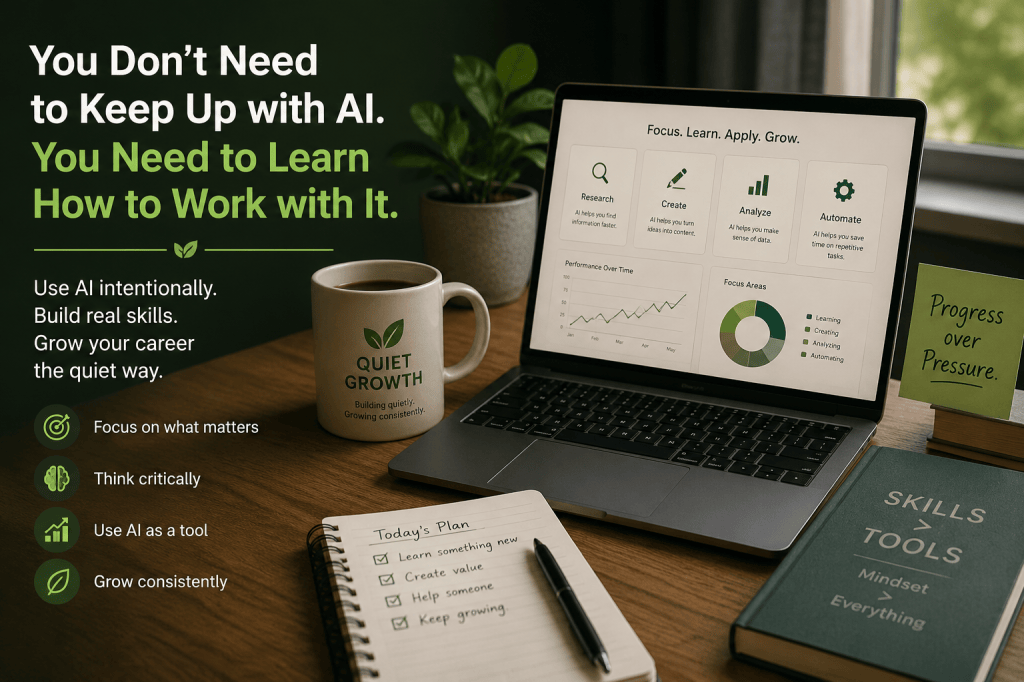
You don’t need to keep up with everything. You need to learn how to work with what matters.
The AI race is not your race
One of the biggest mistakes people make with AI is treating it like a competition.
They chase every new tool.
They collect subscriptions.
They watch endless tutorials.
They try to learn every new feature.
But knowledge without direction can quickly become noise.
The goal isn’t to become the person who knows every AI tool.
The goal is to become the person who knows when, why, and how to use AI effectively.
That’s a very different skill.
AI should increase your ability, not replace your thinking
AI can help you research faster.
It can help you generate ideas.
It can organize information, analyze data, improve drafts, automate repetitive tasks, and help you explore possibilities that might have taken hours before.
But there is still something AI cannot replace for you:
Your judgment.
You decide what matters.
You decide what is useful.
You decide what is ethical.
You decide whether an idea actually makes sense.
And you decide what deserves to be published, shared, built, or ignored.
That is why becoming AI-fluent is more valuable than simply becoming AI-dependent.
Learn the fundamentals first
There is a temptation to believe that AI means we no longer need traditional skills.
The opposite may be true.
If you understand marketing, AI can make you a more capable marketer.
If you understand writing, AI can help you become a more efficient writer.
If you understand data, AI can help you analyze it more effectively.
If you understand business, AI can help you identify opportunities and solve problems faster.
But without the foundation, you may simply produce more content without understanding whether it is good.
AI amplifies your capabilities. It doesn’t automatically give you capabilities.
That’s why learning the fundamentals still matters.
You don’t need 50 AI tools
You probably don’t need another list of 50 AI tools.
You need a small collection of tools that solve real problems for you.
Maybe one tool helps you research.
Another helps you write.
Another helps you organize your work.
Another helps you create visual content.
That’s enough to begin.
Learn those tools deeply.
Build workflows around them.
Understand their strengths and limitations.
Then add something new when you have a genuine reason to do so.
This is where Quiet Growth becomes practical.
Build slowly. Learn deeply. Improve consistently.
Give yourself permission to learn slowly
There is nothing wrong with being a beginner.
You don’t have to understand every AI development happening around you.
You don’t have to know the newest model on the day it launches.
You don’t have to post about every major AI announcement.
You can take your time.
Learn one concept.
Practice it.
Use it in your work.
Make mistakes.
Improve.
Then move to the next thing.
That may feel slow compared with the internet.
But slow learning can create something that fast consumption often doesn’t:
real understanding.
The future belongs to adaptable people
AI will continue changing.
Some tools will disappear.
New tools will emerge.
Jobs will evolve.
Workflows will change.
The people who remain valuable won’t necessarily be those who memorized today’s tools.
They will be people who can learn, adapt, think critically, and keep improving.
That is a much more sustainable approach to the future.
Instead of asking:
“How do I keep up with AI?”
Try asking:
“What problem am I trying to solve, and how can AI help me solve it better?”
That question changes everything.
Quiet Growth in the AI era
Quiet Growth isn’t about rejecting technology.
It is about using technology intentionally.
We don’t need to chase every trend.
We don’t need to work ourselves into exhaustion.
We don’t need to become obsessed with productivity.
We need to build useful skills, make thoughtful decisions, and keep moving forward.
AI is a tool.
Your judgment is the compass.
And your growth doesn’t have to be loud to be meaningful.
You don’t need to keep up with everything.
You need to keep growing.
Quiet Growth 🌱 Building quietly. Growing consistently.


Leave a Reply