Tag: writing

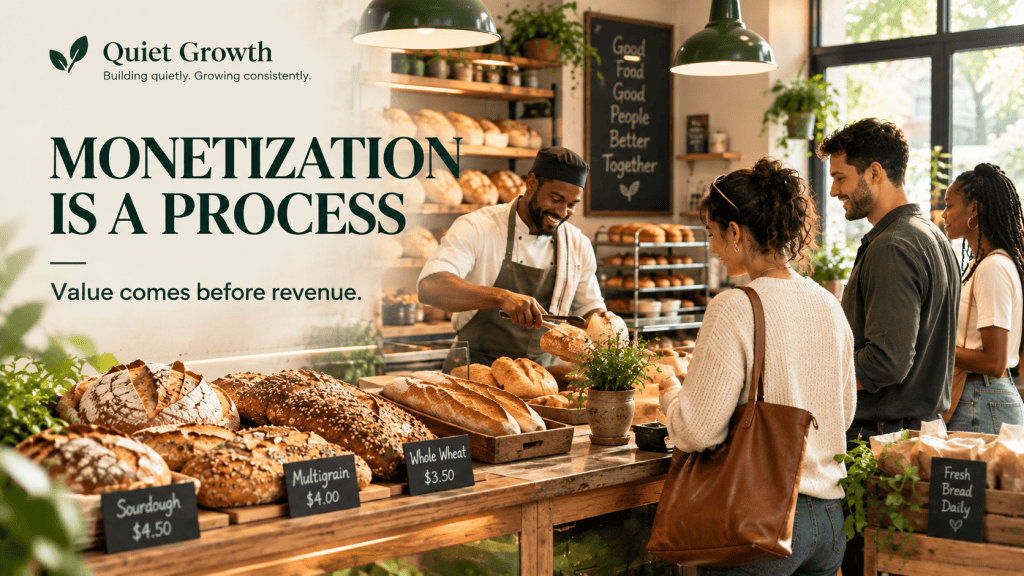
  • Monetization Is a Process, Not a Starting Point

    Why building value, reaching the right people and earning trust must come before revenue.

    Everyone wants to know:

    “When am I going to monetize?”

    Creators ask it.

    Businesses ask it.

    People starting digital marketing ask it.

    And with social media, AI tools, digital products and online businesses growing so quickly, there is often pressure to make money as quickly as possible.

    But there is something we often forget:

    Monetization is not where the journey starts.

    It is the result of several things working together.

    Think about a bakery.

    You don’t open the doors today and immediately ask:

    “Where is my profit?”

    There is a process before the first sale.

    You have to understand the market.

    You have to know what people want.

    You have to create something worth buying.

    You have to let people know it exists.

    You have to reach the right people.

    You have to build trust.

    And eventually, someone decides:

    “I want this.”

    That is where the transaction happens.

    And that is where monetization begins.


    First, Understand the Market

    Before creating something, you need to understand who you are creating it for.

    A bakery cannot simply make 500 loaves of bread without considering what people in the area actually want.

    What kind of bread do they buy?

    What price are they comfortable with?

    When do they usually buy?

    What problem are they trying to solve?

    Are they looking for everyday bread, something special for an occasion, or something they cannot easily find elsewhere?

    Digital marketing works the same way.

    Before creating endless posts, products or services, ask:

    Who am I trying to help?

    What do they need?

    What problem are they trying to solve?

    What would make them pay attention?

    Understanding the market gives your work direction.

    Without that understanding, you can create a lot and still create very little value.


    Then, Create Something Valuable

    Once you understand the need, you can create.

    For a bakery, that could be bread, cakes, pastries or catering.

    For a digital business, it could be:

    • Educational content
    • A digital product
    • A service
    • A course
    • A consultation
    • A useful tool
    • A resource
    • A solution to a specific problem

    The important question is not:

    “What can I sell?”

    A better question is:

    “What value can I create?”

    Because people don’t usually pay simply because something exists.

    They pay because they believe the thing has value to them.


    Creating Value Is Not Enough

    You can have the best bread in the neighbourhood.

    But if nobody knows where your bakery is, the bread may remain on the shelf.

    This is where distribution becomes important.

    Your content, product or service needs a path to the people who may actually need it.

    That could happen through:

    • Social media
    • Search
    • Email
    • Communities
    • Partnerships
    • Word of mouth
    • A website
    • Other distribution channels

    But there is an important distinction:

    Being everywhere is not the same as reaching the right people.

    You can have thousands of views from people who have no interest in what you offer.

    You can have hundreds of followers who never need your product.

    You can have traffic that never becomes a meaningful conversation.

    So the question is not only:

    “How many people saw me?”

    It is also:

    “Did the right people see me?”


    From Attention to Trust

    Someone sees your content.

    They might like it.

    Maybe they follow you.

    Maybe they visit your website.

    Maybe they come back another day.

    Then they read something else.

    They begin to understand what you know.

    They see how you think.

    They start to trust your work.

    This process matters.

    People don’t always buy the first time they see something.

    Sometimes they need time.

    They need more information.

    They need to understand the value.

    They need to feel that the person or business behind the offer understands their needs.

    That is why content is more than simply filling a social media calendar.

    Good content can help people move from attention to understanding, and from understanding to trust.


    Then Comes the Transaction

    Eventually, the customer reaches a point where the value is clear enough to act.

    The bakery sells the bread.

    The customer receives the bread.

    The bakery receives revenue.

    The exchange is simple.

    In digital business, the exchange might look different.

    Someone might buy a product.

    Someone might book a service.

    Someone might subscribe.

    Someone might pay for a course.

    Someone might hire a consultant.

    But the principle remains the same:

    Value is exchanged for money.

    That is monetization.

    Not simply putting a price on something.

    Not simply asking people to buy.

    But creating enough value, reaching the right people and making the exchange clear.


    Don’t Confuse Attention With Revenue

    This is where things can become misleading.

    A post can receive thousands of views.

    A video can get thousands of plays.

    A website can receive visitors.

    An email can be sent to thousands of people.

    Those numbers matter.

    But numbers need context.

    A large number does not automatically mean a healthy business.

    For example:

    1,000 views are not the same as 1,000 potential customers.

    10,000 followers are not the same as 10,000 buyers.

    1,000 emails sent are not the same as 1,000 people who actually received and engaged with the message.

    And website traffic alone does not tell you whether people found what they needed.

    The number is only the beginning.

    You have to understand what the number represents.

    That is why good marketing does not simply collect statistics.

    It learns from them.


    Monetization Takes Preparation
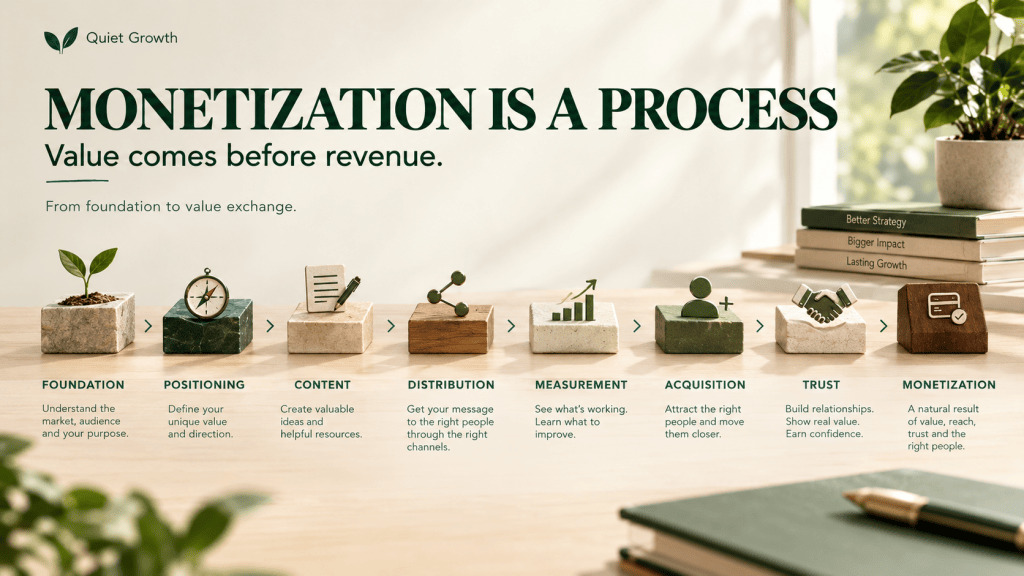
    This is why rushing to monetize can sometimes create the wrong question.

    Instead of asking:

    “How quickly can I make money?”

    Ask:

    “Have I built something worth paying for?”

    Have I understood the market?

    Have I created real value?

    Am I reaching the right people?

    Am I building trust?

    Is the offer clear?

    Can people easily understand the next step?

    When these pieces begin to work together, monetization becomes much more natural.

    You are no longer trying to force money out of attention.

    You are creating an exchange around value.


    The Bakery Lesson

    Let’s go back to the bakery.

    The baker doesn’t begin with profit.

    The baker begins with understanding.

    Then comes the product.

    Then comes the story.

    Then comes the market.

    Then comes the customer.

    Then comes the sale.

    And the sale creates revenue.

    The same principle applies to digital marketing.

    You don’t have to rush every stage.

    You have to build each stage properly.

    Because if you skip important steps, you may eventually discover that you have plenty of activity but very little business.


    Don’t Rush the Harvest

    There is nothing wrong with wanting to make money from your work.

    That is part of building a sustainable business.

    But monetization should not become an obsession that makes you skip the work that creates the value in the first place.

    A farmer does not plant a seed in the morning and dig it up in the afternoon asking why there is no harvest.

    The work takes time.

    The soil needs preparation.

    The seed needs care.

    The plant needs the right conditions.

    Then comes the harvest.

    Business is not exactly the same as farming, of course.

    But the principle is useful:

    Don’t rush the harvest. Build something worth harvesting.

    Monetization is not the first step.

    It is what happens when value, people, trust and a clear exchange come together.

    Build well.

    Reach the right people.

    Create real value.

    Then let the revenue follow the value.


    Quiet Growth 🌱

    Building quietly. Growing consistently.

    The goal is not to make noise about making money.

    The goal is to build something useful enough that people are willing to pay for it.

    Grow Smarter. Choose Better.
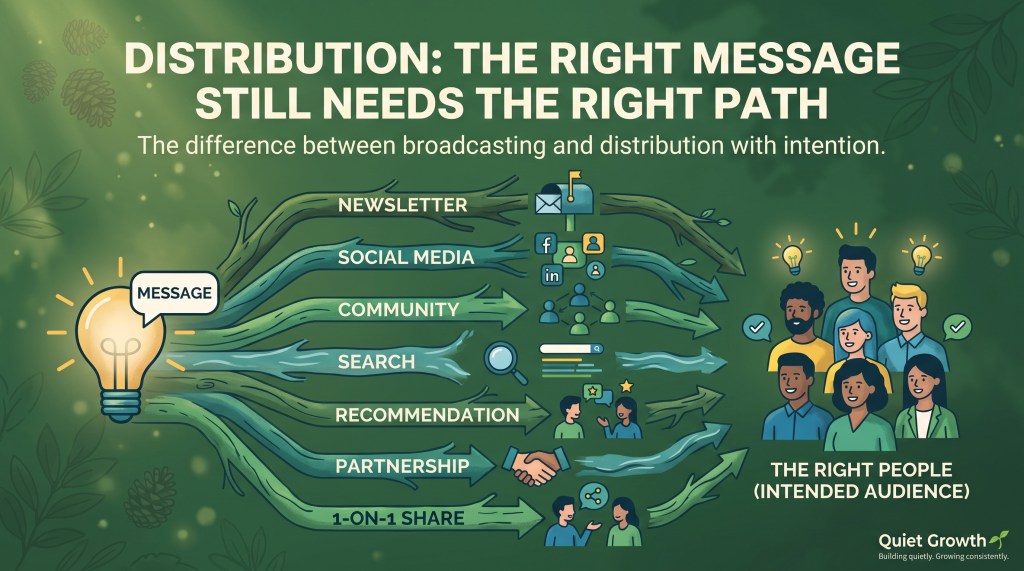
  • Distribution: The Right Message Still Needs the Right Path

    You can create something valuable.

    You can explain it clearly.

    You can even build content that people genuinely appreciate.

    But there is another challenge:

    How does it reach the people who need it?

    Imagine a baker who has just made the best bread in town.

    The bread is fresh.

    The ingredients are good.

    The story behind it is authentic.

    Customers who try it love it.

    But there is one problem.

    The bakery is hidden down a street where nobody passes.

    The baker can keep making better bread.

    They can improve the recipe.

    They can tell a better story.

    But if the right people never discover the bakery, the value remains unseen.

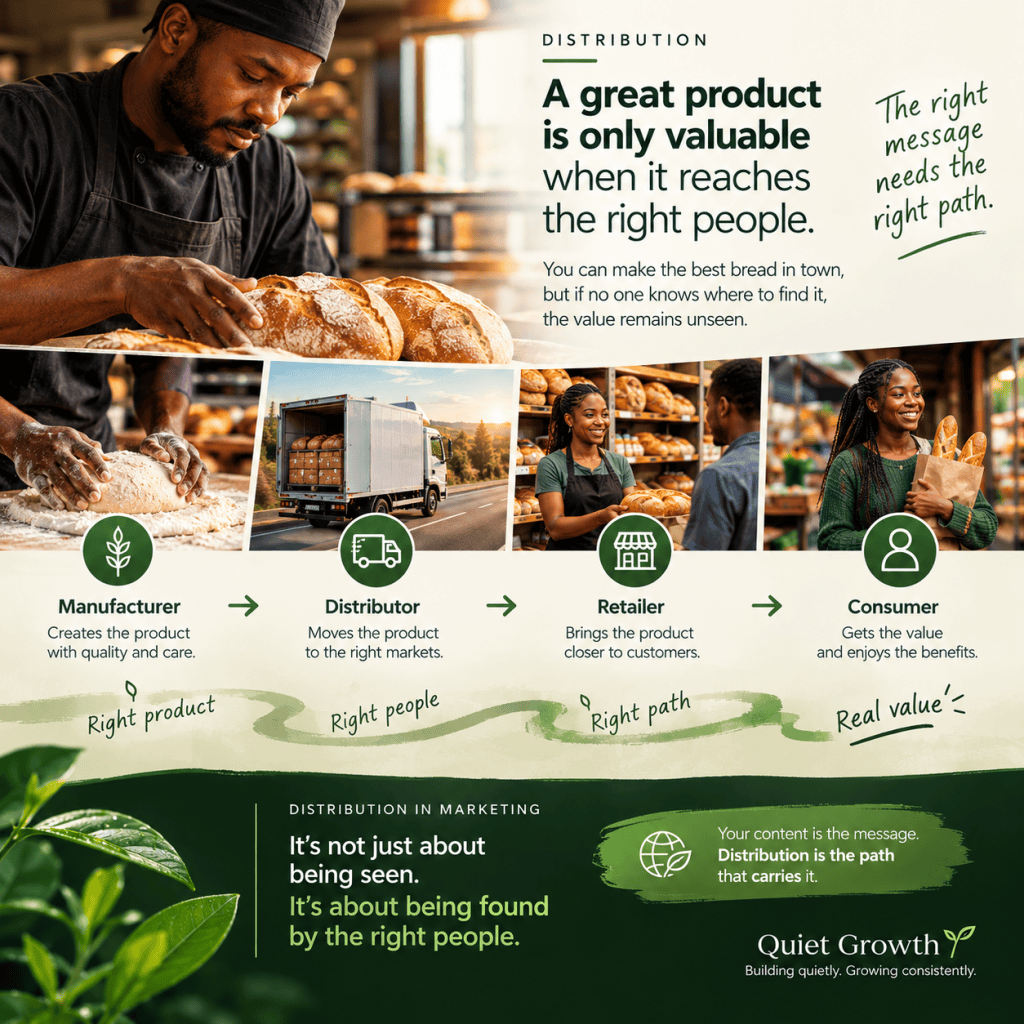
    This is where distribution matters.

    Distribution is not simply about posting more.

    It is about creating a path between your message and the people it is meant for.

    That path could be:

    A social media platform.

    A newsletter.

    A search engine.

    A community.

    A conversation.

    A recommendation.

    A partnership.

    Or even one person sharing your message with another.

    The platform is not the strategy.

    The audience is.

    Before asking:

    “Where should I post this?”

    Ask:

    “Where does the person I want to reach already pay attention?”

    Because being everywhere isn’t necessarily effective.

    You can publish excellent content on ten different platforms and still reach the wrong people.

    Or you can communicate consistently in one place where the right people are already listening.

    That’s the difference between broadcasting and distribution with intention.

    And this is where content and distribution connect.

    Your content is the message.

    Distribution is the path that carries the message.

    You need both.

    A great message with no path may remain invisible.

    A powerful distribution system carrying a weak message may simply create more noise.

    So don’t measure distribution only by how far something travels.

    Ask:

    Did it reach the right people?

    Did they understand it?

    Did it create interest?

    Did it start a conversation?

    Because the goal isn’t simply to be seen.

    The goal is to be seen by the people for whom your message matters.

    You don’t need to be everywhere.

    You need to be where the right people can find you.

    And once your message starts reaching them, another question naturally follows:

    How do you know whether it’s actually working?

    That’s where we go next.

    Quiet Growth 🌱
    Building quietly. Growing consistently.

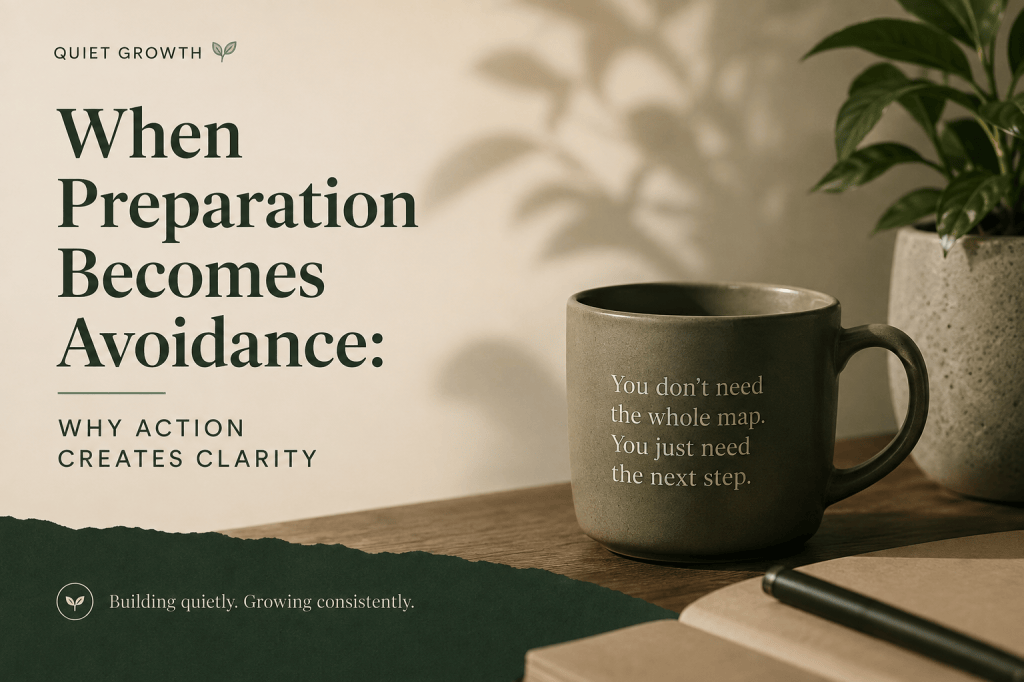
  • When Preparation Becomes Avoidance: Why Action Creates Clarity

    There is a difference between preparing for something and hiding inside the preparation.

    At first, the difference can be difficult to see.

    Both can look productive.

    You can spend hours improving your idea.

    You can rewrite your offer.

    Redesign your website.

    Take another course.

    Watch more videos.

    Research your audience.

    Build a better strategy.

    Prepare for the moment when you finally feel ready.

    And sometimes, all of that preparation is necessary.

    But sometimes, something else is happening.

    Avoidance is disguising itself as preparation.

    Why Preparation Feels So Safe

    Preparation gives us the feeling of progress without requiring us to face the uncertainty of reality.

    While you are preparing, nobody can reject your idea.

    Nobody can tell you your offer is unclear.

    Nobody can ignore your content.

    Nobody can say no.

    Your idea is still protected because it has not yet been tested.

    You can continue believing that it might work.

    The moment you put something into the world, that changes.

    People can react.

    They can ask questions you did not expect.

    They can misunderstand your message.

    They can ignore it completely.

    That can feel uncomfortable.

    So preparation becomes a comfortable place to stay.

    But eventually, the question changes.

    You are no longer asking:

    “Am I preparing for the work?”

    You are asking:

    “Am I avoiding the moment when the work becomes real?”

    You Cannot Refine What You Have Not Tested

    This is where many people get stuck.

    They try to improve something before they have enough information to know what actually needs improvement.

    You can spend months building what you think people want.

    But until real people see it, use it, ignore it or respond to it, much of your work is still based on assumptions.

    The market has information you do not have.

    Your audience has questions you did not predict.

    Your first customer may show you a problem you never considered.

    Your first piece of content may reveal that people understand your message differently from the way you intended.

    That is not failure.

    That is feedback.

    And feedback is difficult to receive in private.

    The First Version Is Supposed to Teach You

    We often expect our first version to prove that we are ready.

    But perhaps that is not its real purpose.

    Maybe your first version exists to show you what needs to grow.

    Your first website might look imperfect.

    Your first offer might not be clear enough.

    Your first video might make you uncomfortable.

    Your first client conversation might reveal gaps in your knowledge.

    Good.

    Now you know something you did not know before.

    Action has revealed the next step.

    This is one of the reasons clarity often does not come before movement.

    Clarity comes because you started moving.

    You do not always need the entire map.

    Sometimes, you need to take the next step before the next part of the path becomes visible.

    Action Creates Information

    There are things you can only learn by doing.

    You can study how to write content.

    But publishing teaches you what your audience responds to.

    You can study how to build a website.

    But launching teaches you where people become confused.

    You can study how to sell.

    But speaking with potential customers teaches you what questions they actually have.

    Experience creates information.

    And information helps you make better decisions.

    That means action is not the opposite of learning.

    Action is one of the ways we learn.

    Every attempt gives you something.

    A result.

    A response.

    A mistake.

    A question.

    A new understanding.

    Even an unsuccessful attempt can move you forward if you pay attention to what it is teaching you.

    You Don’t Need to Have Everything Figured Out

    One of the biggest reasons people delay action is the belief that they need complete clarity first.

    They want to know exactly what will happen.

    Exactly who their customer is.

    Exactly how the business will grow.

    Exactly what career path to follow.

    Exactly who they will become.

    But life rarely gives us that kind of certainty.

    Many important decisions are made with incomplete information.

    You learn while moving.

    You adjust while building.

    You discover what works by seeing what does not.

    This does not mean preparation is unnecessary.

    Preparation matters.

    Planning matters.

    Learning matters.

    The problem begins when preparation has no relationship with action.

    At some point, you have to test what you have prepared.

    Otherwise, preparation can continue forever.

    The Difference Between Preparation and Avoidance

    Preparation moves you closer to reality.

    Avoidance keeps you safely away from it.

    Preparation has a purpose.

    It leads somewhere.

    You research so you can make a decision.

    You learn so you can apply what you learned.

    You build so you can launch.

    You plan so you can act.

    Avoidance looks similar from the outside.

    But it has no clear point of transition.

    There is always one more thing to improve.

    One more course to take.

    One more video to watch.

    One more change to make.

    One more reason to wait.

    That is why avoidance can be so sophisticated.

    It can look exactly like ambition.

    How to Know When It Is Time to Move

    You may never feel completely ready.

    That is normal.

    But you can ask yourself a few honest questions:

    Have I learned enough to test this?

    Am I still gathering information, or am I avoiding a decision?

    What could I learn by putting this in front of a real person?

    What is the smallest version I can test?

    Am I improving this because it needs improvement, or because I am afraid of being seen?

    These questions can help separate useful preparation from fear disguised as productivity.

    You do not need to launch everything at once.

    You can start small.

    Have one conversation.

    Publish one post.

    Create one offer.

    Send one email.

    Build one simple page.

    Ask for feedback.

    Take one visible step.

    Small action can create more clarity than weeks of private planning.

    The Quiet Growth Approach

    Quiet Growth is not about rushing.

    It is not about launching carelessly or pretending that preparation does not matter.

    Growth can be thoughtful.

    It can be slow.

    It can be intentional.

    But intentional growth still requires movement.

    You can build quietly without hiding forever.

    You can move slowly without standing still.

    You can prepare without using preparation as a permanent place to hide.

    Sometimes, the next step will not reveal the whole future.

    It will simply reveal the next lesson.

    And sometimes, that is enough.

    Because growth does not require you to know everything before you begin.

    It asks you to remain willing to learn as you move.

    Final Thought

    Your first version might be ugly.

    Your first conversation might be awkward.

    Your first offer might need improvement.

    Your first attempt might not work.

    That does not mean you started too early.

    It may simply mean you have finally reached the part where real learning begins.

    You cannot refine what does not exist.

    You cannot receive feedback on something nobody has seen.

    You cannot learn from a market you refuse to enter.

    So prepare.

    Learn.

    Think.

    Plan.

    But eventually, move.

    Because sometimes the clarity you are waiting for is not waiting somewhere ahead of you.

    Sometimes, it is waiting on the other side of action.

    Quiet Growth 🌱

    Building quietly. Growing consistently.

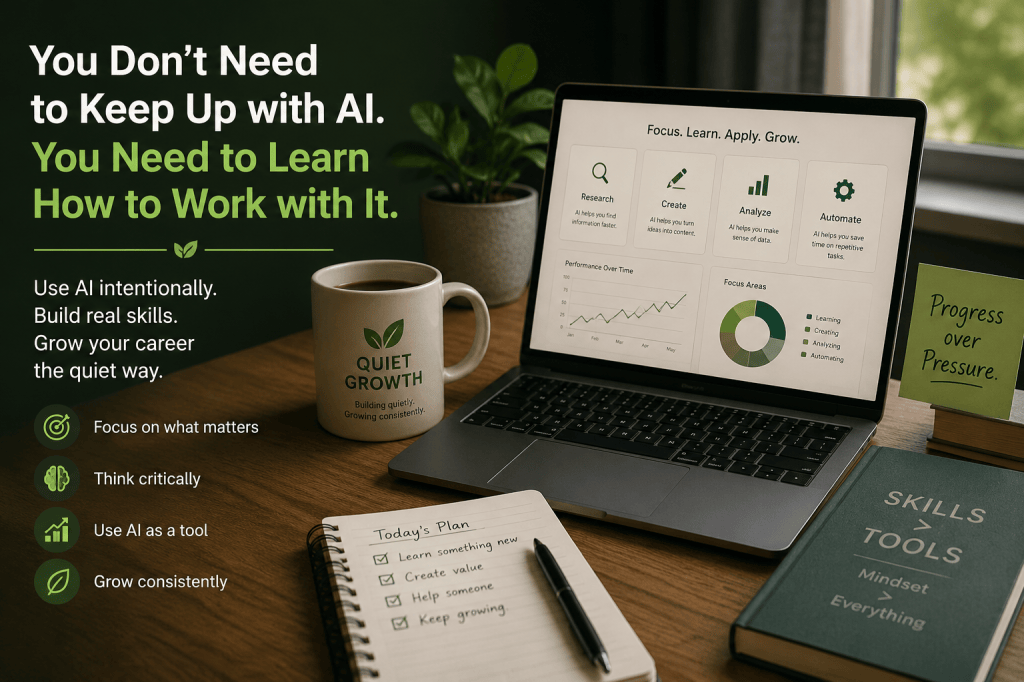
  • You Don’t Need to Keep Up With AI. You Need to Learn How to Work With It.

    AI is moving fast.

    Every week, there seems to be a new tool, a new model, a new feature, or a new prediction about how artificial intelligence will change our jobs.

    And if you’re trying to build a career in the digital world, it can feel like you’re already behind.

    You learn one tool today.

    Tomorrow, someone tells you there’s a better one.

    You finally understand one AI workflow, and suddenly there are ten more tutorials telling you how to work faster.

    It can become exhausting.

    But here’s something worth remembering:

    You don’t need to keep up with everything. You need to learn how to work with what matters.

    The AI race is not your race

    One of the biggest mistakes people make with AI is treating it like a competition.

    They chase every new tool.

    They collect subscriptions.

    They watch endless tutorials.

    They try to learn every new feature.

    But knowledge without direction can quickly become noise.

    The goal isn’t to become the person who knows every AI tool.

    The goal is to become the person who knows when, why, and how to use AI effectively.

    That’s a very different skill.

    AI should increase your ability, not replace your thinking

    AI can help you research faster.

    It can help you generate ideas.

    It can organize information, analyze data, improve drafts, automate repetitive tasks, and help you explore possibilities that might have taken hours before.

    But there is still something AI cannot replace for you:

    Your judgment.

    You decide what matters.

    You decide what is useful.

    You decide what is ethical.

    You decide whether an idea actually makes sense.

    And you decide what deserves to be published, shared, built, or ignored.

    That is why becoming AI-fluent is more valuable than simply becoming AI-dependent.

    Learn the fundamentals first

    There is a temptation to believe that AI means we no longer need traditional skills.

    The opposite may be true.

    If you understand marketing, AI can make you a more capable marketer.

    If you understand writing, AI can help you become a more efficient writer.

    If you understand data, AI can help you analyze it more effectively.

    If you understand business, AI can help you identify opportunities and solve problems faster.

    But without the foundation, you may simply produce more content without understanding whether it is good.

    AI amplifies your capabilities. It doesn’t automatically give you capabilities.

    That’s why learning the fundamentals still matters.

    You don’t need 50 AI tools

    You probably don’t need another list of 50 AI tools.

    You need a small collection of tools that solve real problems for you.

    Maybe one tool helps you research.

    Another helps you write.

    Another helps you organize your work.

    Another helps you create visual content.

    That’s enough to begin.

    Learn those tools deeply.

    Build workflows around them.

    Understand their strengths and limitations.

    Then add something new when you have a genuine reason to do so.

    This is where Quiet Growth becomes practical.

    Build slowly. Learn deeply. Improve consistently.

    Give yourself permission to learn slowly

    There is nothing wrong with being a beginner.

    You don’t have to understand every AI development happening around you.

    You don’t have to know the newest model on the day it launches.

    You don’t have to post about every major AI announcement.

    You can take your time.

    Learn one concept.

    Practice it.

    Use it in your work.

    Make mistakes.

    Improve.

    Then move to the next thing.

    That may feel slow compared with the internet.

    But slow learning can create something that fast consumption often doesn’t:

    real understanding.

    The future belongs to adaptable people

    AI will continue changing.

    Some tools will disappear.

    New tools will emerge.

    Jobs will evolve.

    Workflows will change.

    The people who remain valuable won’t necessarily be those who memorized today’s tools.

    They will be people who can learn, adapt, think critically, and keep improving.

    That is a much more sustainable approach to the future.

    Instead of asking:

    “How do I keep up with AI?”

    Try asking:

    “What problem am I trying to solve, and how can AI help me solve it better?”

    That question changes everything.

    Quiet Growth in the AI era

    Quiet Growth isn’t about rejecting technology.

    It is about using technology intentionally.

    We don’t need to chase every trend.

    We don’t need to work ourselves into exhaustion.

    We don’t need to become obsessed with productivity.

    We need to build useful skills, make thoughtful decisions, and keep moving forward.

    AI is a tool.

    Your judgment is the compass.

    And your growth doesn’t have to be loud to be meaningful.

    You don’t need to keep up with everything.

    You need to keep growing.

    Quiet Growth 🌱 Building quietly. Growing consistently.

  • How AI and ChatGPT Are Changing the Way I Think, Work, and Create

    🌍 Meta Description (for SEO):

    In this personal post, I share how artificial intelligence — especially ChatGPT — is transforming my daily work, creativity, and perspective on what’s possible in the digital age.


    Introduction

    If someone had told me a few years ago that I’d be collaborating with an AI to brainstorm, write, and even plan my day, I probably would’ve laughed. But here we are — AI has become a part of my creative routine.

    Artificial intelligence, especially tools like ChatGPT, isn’t just a trend anymore; it’s a quiet revolution. It’s changing the way I work, learn, and even think. Every day, I discover something new that makes me realize — the future isn’t coming; it’s already here.


    1. How AI Became My Creative Sidekick

    At first, I used ChatGPT out of curiosity — just to test what it could do. I asked it to write a few sentences, summarize articles, or explain concepts I was struggling with.
    Then I realized something bigger: AI wasn’t replacing my creativity — it was expanding it.

    Now, when I write, ChatGPT helps me:

    • Break through writer’s block
    • Generate blog ideas in seconds
    • Rephrase sentences for clarity and flow
    • See my own thoughts from a new angle

    It’s like having a brainstorming partner who never runs out of ideas and doesn’t judge my messy drafts.


    2. The Magic of Collaboration Between Human and Machine

    One of my favorite things about using AI is how it turns solo work into teamwork.
    When I’m writing a blog post, I’ll throw my rough ideas into ChatGPT and let it build structure around them. Then I go back and add my voice, my experience, my human touch.

    It’s not “AI writing my content” — it’s me co-creating with AI.
    That’s where the real magic happens.


    3. How AI Changes the Way We Work

    I’ve noticed something fascinating: AI doesn’t just save time — it changes how we think about time.

    Tasks that used to take hours — researching, drafting, rewriting — now take minutes. That leaves me with more time for strategy, reflection, and creativity.

    I use ChatGPT to:

    • Summarize complex research for me
    • Create outlines for new projects
    • Generate marketing ideas
    • Even help draft replies to clients or collaborators

    It’s like having a digital assistant who always understands my tone and goals.


    4. What AI Can’t Replace (and Shouldn’t)

    Of course, AI isn’t perfect. It doesn’t feel what I feel. It doesn’t know my audience like I do.
    That’s why I always remind myself: AI is a tool, not a voice.

    It helps me express my ideas — but it can’t have them.
    The heart of what I write still comes from human experience, emotion, and curiosity.
    AI just helps me bring those ideas to life faster and in new ways.


    5. My Vision for the Future of AI

    I truly believe the future belongs to those who know how to collaborate with AI, not compete against it.

    Imagine:

    • Teachers using AI to personalize lessons.
    • Entrepreneurs using AI to test ideas instantly.
    • Artists creating with AI as their digital brush.

    We’re not losing our creative edge — we’re evolving it.

    AI doesn’t take away our humanity; it highlights it. Because when machines handle the routine, humans can focus on what only we can do — dream, connect, and create.


    Conclusion: My Ongoing AI Journey

    For me, AI isn’t just a tool; it’s a mirror that reflects what’s possible when curiosity meets technology.

    Every blog I write, every idea I test with ChatGPT, reminds me of one simple truth:

    The most powerful thing about AI isn’t that it can think — it’s that it helps us think better.

    So here’s to the next chapter — where humans and AI don’t compete, but create together.

  • Are People Who Use AI the “Least Intelligent”?

    Here’s Why That’s a Myth.

    Every few months, a familiar claim resurfaces online:
    “People who use AI the most are actually the least intelligent.”

    It’s a catchy statement — but it doesn’t hold up. In fact, it misses what intelligence looks like in a world where technology evolves daily.

    Let’s break it down.


    Using AI Isn’t a Sign of Low Intelligence — It’s a Sign of Strategic Thinking

    We don’t consider someone unintelligent because they use a calculator, GPS, Grammarly, or Google.
    We see them as using tools that make life easier and work smarter.

    AI is simply the next step in that evolution.

    People who choose to use AI tend to show:

    1. Strategic thinking

    They recognize opportunities to save time, increase efficiency, and gain new skills.

    2. Curiosity

    They explore new technologies rather than resisting change.

    3. Adaptability

    In a world that shifts quickly, adapting is one of the strongest forms of intelligence.

    4. A growth mindset

    AI users don’t assume they “should” know everything — they seek ways to learn faster and work better.

    These aren’t traits of low intelligence.
    These are traits of highly capable, forward-thinking people.


    AI Isn’t a Replacement for Intelligence — It’s a Multiplier

    AI doesn’t make decisions for you.
    It doesn’t define your perspective, shape your values, or replace your thinking.

    Instead, AI helps you:

    • Learn faster
    • Generate ideas you might not think of on your own
    • Improve communication
    • Automate repetitive tasks
    • Focus on creative, strategic work

    In other words, AI amplifies your abilities — it doesn’t diminish them.

    The smartest professionals in the world — engineers, marketers, researchers, doctors, writers, designers — all use AI to accelerate their work.
    Not because they’re “less intelligent,”
    but because they understand leverage.


    The Truth: Intelligence Has Always Included Knowing Which Tools to Use

    Throughout history, every major innovation has been criticized at first:

    • Calculators were once seen as “cheating.”
    • Spell check was considered “lazy.”
    • Search engines were called “crutches.”

    Today, not using those tools would be seen as inefficient.

    AI is no different.

    Choosing not to use AI doesn’t make you more intelligent.
    Choosing to use it wisely makes you more effective.


    The Bottom Line

    Using AI isn’t a shortcut for the less intelligent.
    It’s a strategic advantage used by people who:

    • value their time
    • want to grow
    • embrace innovation
    • push their potential further

    AI doesn’t replace intelligence.
    It multiplies it.

    And the people who understand that?
    They’re not the least intelligent — they’re the ones shaping the future.

  • 🌟 AI and Human Emotions — Can Machines Understand How We Feel?

    By Spike Evolution

    Artificial Intelligence has made incredible progress — it can recognize faces, translate languages, drive cars, and write meaningful text.
    But one question still fascinates (and scares) many people:

    Can AI understand human emotions?

    Emotion is what makes us human. It shapes our decisions, relationships, and daily experiences.
    For years, computers could not “feel” anything — they were logical but emotionally blind.

    Today, that is slowly changing.

    AI is beginning to recognize, interpret, and respond to emotions in ways that once seemed impossible.

    Let’s look at how it works, why it matters, and whether it is a blessing… or a possible danger.


    ❤️ 1. What Emotional AI Actually Means

    “Emotional AI” (also called Affective Computing) is technology designed to:

    • Read emotions
    • Interpret emotional signals
    • Respond in a human-like way

    It doesn’t truly “feel,” but it analyzes:

    🎙 tone of voice
    🙂 facial expressions
    💬 choice of words
    ⏱ typing speed
    😮‍💨 breathing patterns (in advanced systems)

    From these signals, AI can detect emotions like:

    • Happiness
    • Stress
    • Anger
    • Confusion
    • Sadness
    • Fear
    • Excitement

    And it can adjust its response accordingly.


    🔍 2. How AI Detects Our Emotions

    AI systems use different methods to read human feelings:

    1. Voice Emotion Analysis

    AI listens to changes in:

    • pitch
    • speed
    • pauses
    • trembling
    • volume

    It can tell if someone is anxious, angry, or excited.

    2. Facial Expression Recognition

    AI can identify:

    • smiles
    • frowns
    • fear
    • disgust
    • surprise
    • fake versus real emotion

    This is used in airports, customer service, and even therapy apps.

    3. Text Emotion Detection

    AI models like ChatGPT analyze:

    • sentiment
    • emotional tone
    • intention
    • politeness
    • frustration
    • empathy markers

    This is widely used in customer support and mental health chatbots.


    🤝 3. Can AI Be Empathetic?

    Short answer: AI can simulate empathy — but not feel it.

    It doesn’t experience emotions.
    But it can recognize them and respond in ways that feel supportive.

    For example:

    You write:
    “I’m having a difficult day.”

    AI responds:
    “I’m sorry you’re going through a hard time. Would you like to talk about it or find a solution together?”

    It is not feeling compassion — but it is learning to behave compassionately.

    This is already useful in:

    • mental health support apps
    • coaching tools
    • elder care
    • customer service
    • education

    ⚠️ 4. The Risks of Emotional AI

    Like all powerful technology, emotional AI has dangers if misused.

    1. Manipulation Risk

    If an AI knows when you’re sad, angry, or lonely…
    Someone could use that information to influence your decisions.

    2. Privacy Issues

    Do people want cameras or voice devices reading their emotions all day?

    3. Misinterpretation

    AI can get emotions wrong — especially with cultural differences or unique personalities.

    4. Dependence on AI “Comfort”

    People may start relying on machines for emotional support more than humans.

    We must build emotional AI carefully and ethically.


    🌈 5. The Benefits — When Emotional AI Helps Humanity

    When used responsibly, emotional AI has enormous potential.

    🌱 Mental Health Support

    AI can detect early signs of depression, stress, or burnout before it becomes severe.

    🏫 Better Education

    AI tutors can see when a student is confused or overwhelmed and adapt teaching style.

    🏥 Healthcare

    AI can help doctors understand a patient’s emotional condition better.

    🛎 Customer Service

    AI can respond more politely, calmly, and kindly — reducing frustration.

    🌍 A More Understanding Digital World

    Imagine technology that adapts to how you feel, not just what you type.

    Emotional AI could make online spaces safer, kinder, and more human-centered.


    🔮 The Future: Will AI Ever Truly Feel?

    Most experts agree:

    👉 AI will become better at recognizing emotions
    👉 AI will become more human-like in response
    👉 But AI will never truly feel emotions like humans

    It can mimic emotion — but not experience it.

    However, even without real feelings, emotional AI can still help us:

    • make better decisions
    • build safer communities
    • reduce conflict
    • support mental wellness
    • improve communication

    This is the future Spike Evolution stands for:
    A future where AI understands humans better — not to control us, but to help us be the best version of ourselves.

Is this your new site? Log in to activate admin features and dismiss this message
Log In