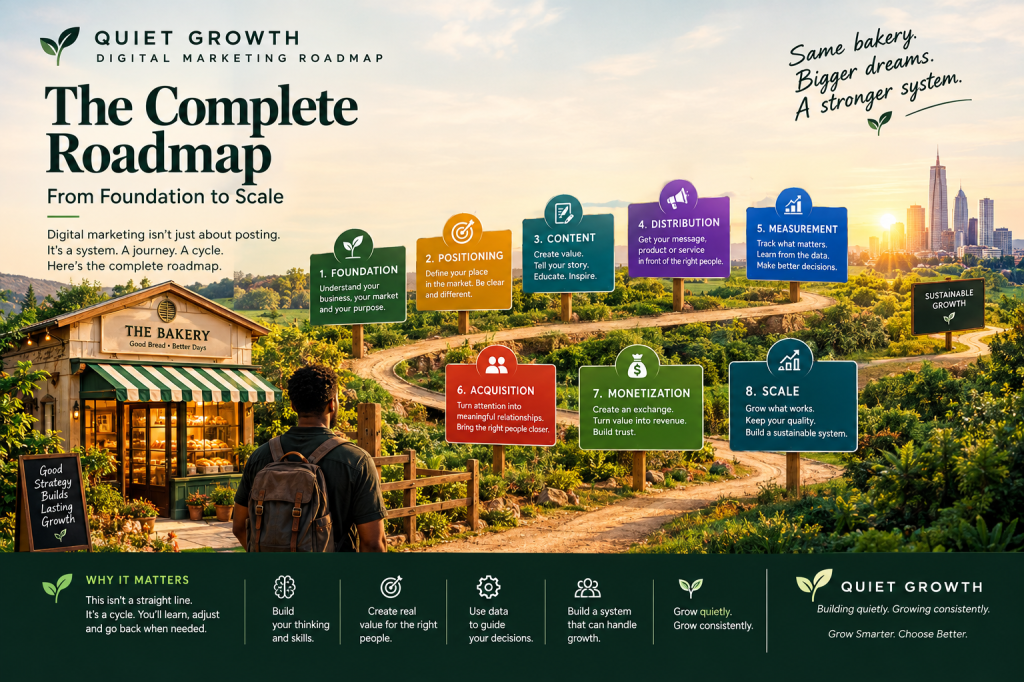
The digital marketing journey we have been walking through, one step at a time.
For the past few weeks, we have been talking about a bakery.
We talked about the baker.
We talked about positioning.
We talked about bread, stories and content.
We followed the bread into the market.
We looked at what the numbers were telling us.
We asked who was actually walking into the bakery.
We talked about turning value into revenue.
And finally, we asked whether the bakery could grow without breaking the system that built it.
There was a reason for all of this.
We were walking through a complete digital marketing roadmap.
You may not have noticed it at first.
And that was intentional.
Instead of starting with a complicated diagram, we started with something simple:
A bakery.
Because digital marketing can sound complicated when we turn it into too many terms.
But underneath the terminology, the principles are surprisingly simple.
You need a foundation.
You need to know where you stand.
You need to know who you are serving.
You need something valuable to offer.
You need a way to reach people.
You need to understand what is happening.
You need to bring the right people closer.
You need to turn value into revenue.
And eventually, you need a system that can grow.
That is the roadmap.
1. Foundation
Everything starts here.
Before marketing anything, you need to understand what you are building.
Imagine opening a bakery.
Before worrying about Instagram, advertising or viral videos, you need to understand the business itself.
What are you selling?
Who are you serving?
What problem or need are you addressing?
What resources do you have?
What makes the business possible?
The same applies to digital marketing.
You cannot build a strong marketing system around something you do not understand.
The foundation gives everything else something to stand on.
Without it, the rest can become activity without direction.
Foundation asks:
What are we building, and why does it exist?
2. Positioning
Now imagine there are ten bakeries on the same street.
Why should someone choose yours?
This is where positioning begins.
Positioning is about creating a clear place in the mind of the people you want to reach.
It is not simply about having a logo.
It is not simply about choosing brand colours.
It is about answering questions such as:
Who are we for?
What do we want to be known for?
What makes our offer meaningful or different?
What problem do we solve?
Why should someone remember us?
In a crowded market, being good is not always enough.
People need to understand what you represent and why it matters to them.
Positioning gives your marketing direction.
3. Content
Once you understand what you are building and how you want to be positioned, you need something to communicate.
That is where content comes in.
The bakery has bread.
But the bakery can also tell people about the ingredients.
The process.
The story.
The people behind the business.
The reason the bread exists.
The problem it solves.
The experience of eating it.
Digital marketing works in the same way.
Content can educate.
It can demonstrate expertise.
It can tell stories.
It can answer questions.
It can create awareness.
It can help people understand your value.
But content should not simply exist because someone said:
“We need to post three times this week.”
Good content has a job.
It should connect what you offer with the people you want to reach.
Content gives your value something to communicate.
4. Distribution
Creating something valuable does not automatically mean people will see it.
Our bakery makes excellent bread.
But if the bread stays inside the bakery, its reach is limited.
This is where distribution comes in.
Distribution is about getting your content, product or message into places where people can encounter it.
That could include:
- Social media
- Search
- Communities
- Partnerships
- Websites
- Word of mouth
- Advertising
- Other relevant channels
But there is an important lesson here:
Distribution is not the same as acquisition.
Putting the bread into the market means it is available.
It does not automatically mean the right customer will walk into the bakery.
Distribution creates access.
Acquisition moves the right people closer.
5. Measurement
Once the system is running, we need to understand what is happening.
This is where measurement enters the picture.
How many people saw the content?
How many engaged?
How many visited?
How many subscribed?
How many made an enquiry?
How many became customers?
What worked?
What did not?
Where did people drop off?
Measurement gives us evidence.
But there is an important warning:
Numbers need context.
10,000 views can sound impressive.
But who viewed them?
1,000 website visitors can sound impressive.
But what did they do after arriving?
More leads can sound positive.
But are they qualified?
More revenue can sound exciting.
But what did it cost to generate?
Measurement is not about collecting numbers simply because we can.
It is about understanding what those numbers are telling us.
Measurement helps us learn from the system.
6. Acquisition
Now we ask a different question.
Who actually walks into the bakery?
This is acquisition.
Someone can see your content.
They can follow you.
They can visit your website.
They can subscribe.
They can send an enquiry.
They can eventually become a customer.
These are different stages of a relationship.
Acquisition is about creating a path for the right people to move closer to the business.
And this is why:
Attention is not acquisition.
You can have a large audience and still have very few people who actually need what you offer.
The goal is not simply to attract everyone.
It is to attract people who have a reason to care.
Acquisition turns attention into meaningful movement toward the business.
7. Monetization
Eventually, value has to become an exchange.
The bakery sells the bread.
The customer receives something valuable.
The bakery receives revenue.
That is monetization.
But monetization does not begin with:
“How can I make money?”
It begins much earlier.
You understand the market.
You create value.
You communicate that value.
You reach the right people.
You build trust.
You make the offer clear.
Then someone decides:
“I want this.”
The transaction happens.
That is why monetization is a process, not a starting point.
You are not simply trying to extract money from attention.
You are creating an exchange around value.
Value comes first.
8. Scale
And then we arrive at the final question:
What happens when the business starts working?
Imagine the bakery becomes successful.
10 customers become 100.
100 become 1,000.
Orders increase.
Revenue increases.
The team grows.
The workload grows.
Now the business has a new problem.
Can the system handle the growth?
Can the bakery maintain its quality?
Can it serve customers properly?
Can it control its costs?
Can it remain profitable?
Can the team handle the additional workload?
This is where scale becomes different from simply getting bigger.
Scale is increasing what works without allowing the system to break.
More traffic is not automatically scale.
More followers are not automatically scale.
More customers are not automatically scale.
More revenue is not automatically scale.
Growth needs a system that can carry the additional weight.
Otherwise, you are simply making a bigger version of the same problem.
Scale asks:
Can we grow while protecting the value that made the growth possible?
The Complete Roadmap
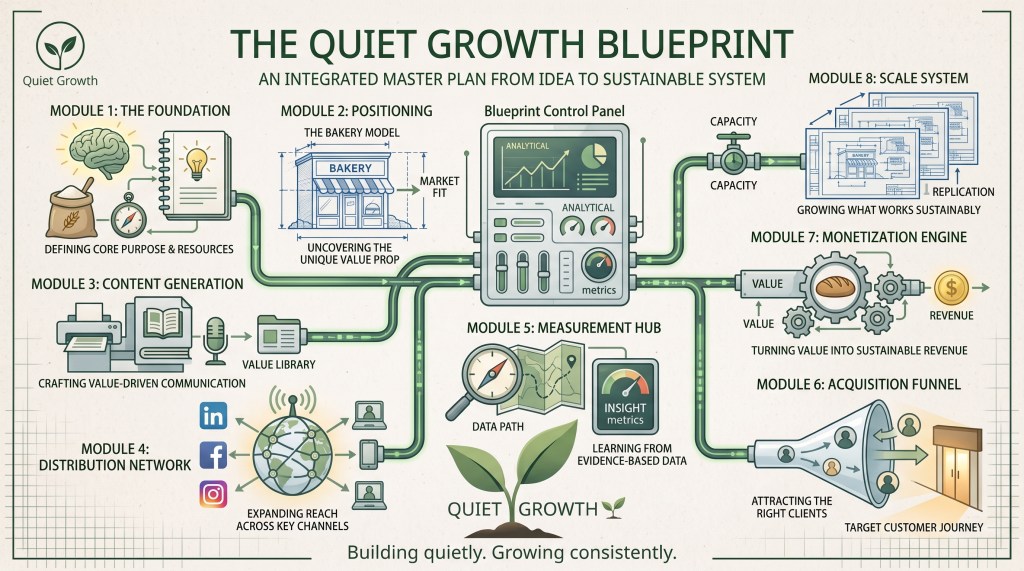
Now we can see the whole picture:
Foundation
↓
Positioning
↓
Content
↓
Distribution
↓
Measurement
↓
Acquisition
↓
Monetization
↓
Scale
But there is something important to understand.
This is not a staircase where you complete one step and never return to it.
Real businesses are more like a cycle.
You scale and discover a problem.
That problem may force you to improve your foundation.
You acquire customers and discover that your positioning is unclear.
You measure your content and discover that the message needs to change.
You monetize and discover that the offer needs improvement.
You grow and discover that the system cannot handle the demand.
So you go back.
You learn.
You adjust.
You build again.
The roadmap gives you direction, not a reason to stop thinking.
Why We Used the Bakery
You might be wondering why we spent so much time talking about bread.
Because sometimes a simple example can teach a complicated system better than a complicated diagram.
Think about what happens in a bakery.
You need a foundation.
You need to know what makes your bakery different.
You need something worth communicating.
You need to get it into the market.
You need to understand what is happening.
You need the right customers to come through the door.
You need to turn the value into revenue.
And if the business grows, you need a system capable of carrying that growth.
That is not only a bakery lesson.
That is business.
And it is also the foundation of how we can understand digital marketing.
Digital Marketing Is Bigger Than Posting
This is one of the biggest lessons I wanted this series to communicate.
Digital marketing is not simply:
“Post on LinkedIn.”
It is not:
“Get followers.”
It is not:
“Go viral.”
It is not:
“Run an advert.”
It is not even simply:
“Make content.”
Those are individual activities.
The bigger question is how those activities work together.
Where are you starting?
How are you positioned?
What value are you communicating?
How are you distributing it?
What are you learning from the data?
Who are you attracting?
How does that attention become a relationship?
How does that relationship become an exchange?
And can the system grow sustainably?
When you start seeing marketing this way, the individual tactics begin to make more sense.
The Skills Hidden Inside the Roadmap
There is another reason this roadmap matters.
Each stage develops a different skill.
Foundation develops understanding.
Positioning develops clarity.
Content develops communication.
Distribution develops reach.
Measurement develops analytical thinking.
Acquisition develops customer understanding.
Monetization develops commercial thinking.
Scale develops systems thinking.
Put those skills together and you begin to see something bigger.
You are not simply learning how to post on social media.
You are learning how to understand, build, communicate, measure and grow something.
That is a much more useful way to think about digital marketing.
From Noise to Systems
The internet gives us endless tactics.
Post more.
Post less.
Use this platform.
Use that platform.
Go viral.
Build a funnel.
Use AI.
Run ads.
Create a newsletter.
Start a podcast.
Build a community.
The problem is not that these tactics are useless.
The problem is that tactics without a system can become noise.
A roadmap gives those tactics context.
You can ask:
Where does this fit?
What problem is it solving?
What happens before it?
What happens after it?
What are we trying to learn?
What should happen next?
That is when marketing becomes more intentional.
You Don’t Have to Build Everything at Once
One final lesson.
You do not need to master every stage tomorrow.
You do not need thousands of followers.
You do not need a huge website.
You do not need every AI tool.
You do not need to be everywhere.
Start with the foundation.
Understand your market.
Clarify your position.
Create something valuable.
Get it in front of the right people.
Measure what happens.
Learn.
Adjust.
Build trust.
Monetize when the value and the exchange are ready.
Then scale what actually works.
One stage at a time.
The Quiet Growth Way
This is ultimately what Quiet Growth is about.
Not chasing every new tactic.
Not trying to make noise for the sake of attention.
Not confusing activity with progress.
It is about understanding the system.
Building carefully.
Learning from evidence.
Creating real value.
Choosing the right people.
And growing in a way that does not destroy what you built in the first place.
The bakery lesson was never really about bread.
It was about the system behind the bread.
And now you can see the complete picture:
Foundation.
Positioning.
Content.
Distribution.
Measurement.
Acquisition.
Monetization.
Scale.
Eight stages.
One connected system.
And the journey does not end at Scale.
Because once you grow, you learn.
And once you learn, you build again.
Build quietly.
Learn continuously.
Grow consistently.
Grow Smarter. Choose Better.
Quiet Growth 🌱
Building quietly. Growing consistently.

