Growth is not just about doing more. It is about understanding what your actions are producing.
A business can be busy every day and still struggle to grow.
You publish content. You gain followers. People like your posts. Your website receives visitors. Your advertising reaches thousands of people.
Everything appears to be moving.
But are you getting closer to your goal?
Are people becoming interested in what you offer? Are they contacting your business? Are those enquiries turning into customers? And is your business creating real value?
These are important questions because activity and progress are not always the same thing.
At Quiet Growth, we believe that understanding what works is just as important as taking action.
That is where measurement comes in.
1. Why measuring your progress matters
Imagine driving a car without knowing your speed, how much fuel you have left, or whether you are getting closer to your destination.
The car is moving, but you have limited information about your journey.
Running a business without measuring results can feel the same way.
You might spend hours creating content without knowing whether it reaches the right people. You might invest money in advertising without understanding whether it generates useful enquiries. You might gain followers without knowing whether any of them are interested in your products or services.
Without measurement, you are relying heavily on assumptions.
Measurement gives you information that helps you make better decisions.
It can help you understand what is working, what needs attention, and where you may need to change your approach.
The purpose of measurement is not simply to collect numbers. It is to use those numbers to make better decisions.
2. What is a metric?
A metric is a measurement that helps you understand something about your activity or performance.
In digital marketing, common metrics include:
- Impressions: how many times your content or advertisement was displayed.
- Reach: how many unique people saw your content, where the platform provides that measurement.
- Engagement: interactions such as likes, comments, shares, and other platform-defined actions.
- Clicks: how many times people clicked a link or advertisement.
- Website visits: how many visits your website received.
- Leads: potential customers who have shown interest by taking a relevant action.
- Sales: purchases made by customers.
- Revenue: the money generated from sales.
Each metric tells you something different.
Impressions can help you understand visibility. Clicks can indicate interest in finding out more. Leads can indicate potential demand. Sales and revenue can help you assess commercial results.
However, no single metric tells the entire story.
For example, 10,000 impressions may be an excellent result for a campaign designed to increase awareness. But if the campaign was intended to generate sales, you need to examine what happened after people saw the advertisement.
Did anyone click? Did anyone enquire? Did anyone buy?
The meaning of a number depends on the question you are trying to answer.
3. What is a KPI?
KPI stands for Key Performance Indicator.
In simple terms, a KPI is a measurement you choose because it helps you understand whether you are making progress toward an important goal.
The key word is important.
You can measure dozens of things in your business, but you do not need to give every number the same attention.
Suppose your goal is to attract more potential customers. You might track qualified leads or enquiries.
If your goal is to increase online sales, you might track purchases, conversion rate, and revenue.
If your goal is to improve the profitability of your advertising, you might track customer acquisition cost and return on advertising spend.
The right KPI depends on the outcome you want.
Think of it this way:
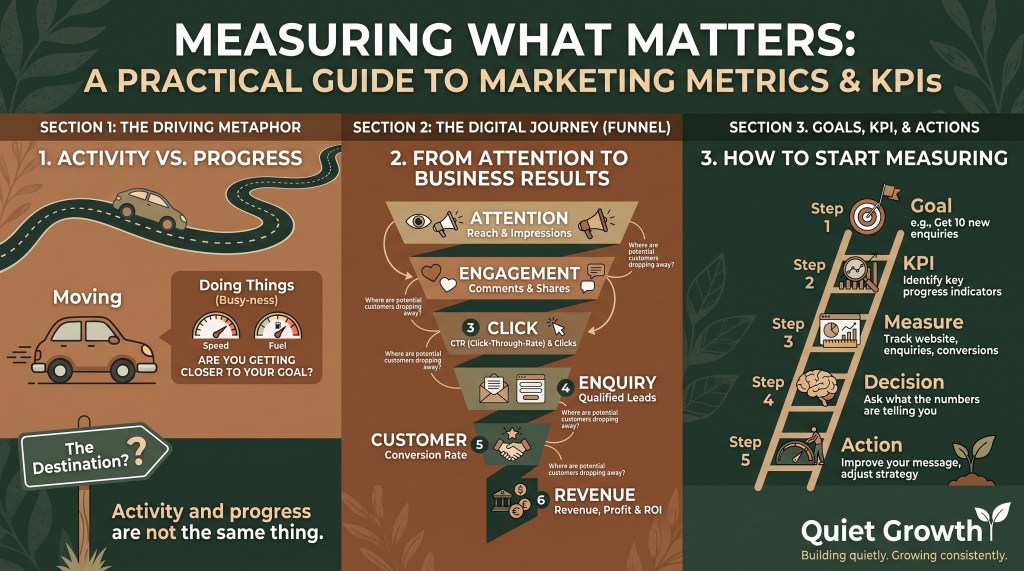
Goal → KPI → Measurement → Decision → Action
First, decide what you want to achieve. Then choose the measurements that help you assess progress. Study the results, decide what they mean, and take appropriate action.
This keeps measurement connected to a purpose instead of becoming a collection of interesting but unhelpful numbers.
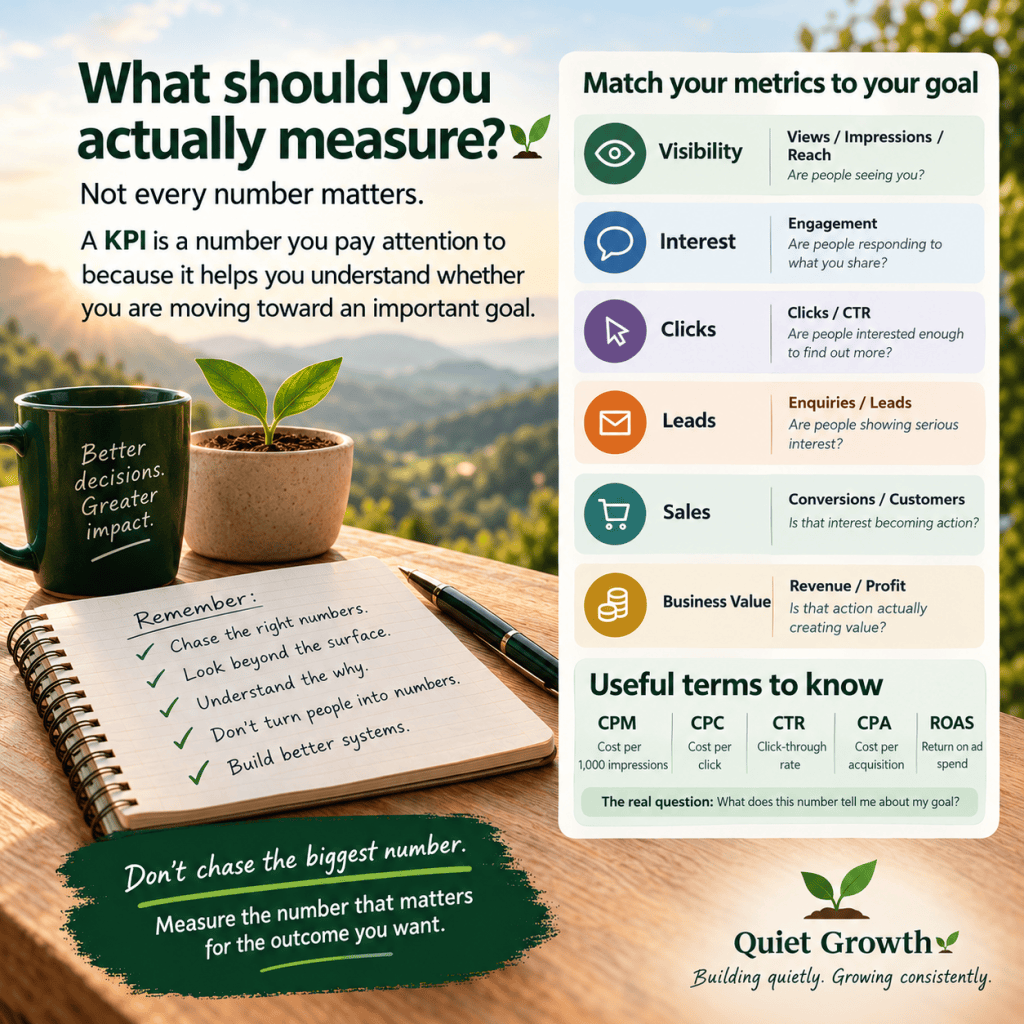
4. What should you actually measure?
The simplest way to answer this question is to start with your goal.
Goal 1: Increase visibility
Before people can become customers, they generally need an opportunity to discover your business.
You might measure:
- Impressions
- Reach
- Website visits
- Relevant audience growth
These metrics help you understand whether your message is reaching people.
But visibility alone does not guarantee interest or sales.
Goal 2: Understand interest and engagement
Once people see your content, you may want to understand whether it attracts attention and encourages interaction.
You might measure:
- Comments and shares
- Meaningful engagement
- Link clicks
- Click-through rate
Click-through rate (CTR) measures the percentage of eligible impressions or other defined opportunities that result in clicks, depending on the platform and reporting method.
For example, if an advertisement receives 1,000 impressions and 30 clicks, its impression-based CTR is:
30 ÷ 1,000 × 100 = 3%
This tells you how often an impression resulted in a click. It does not, by itself, tell you whether those clicks produced valuable customers.
Goal 3: Generate enquiries and leads
If you offer a service, such as marketing support, consulting, cleaning, or catering, you may want people to contact you.
You might measure:
- Enquiries received
- Qualified leads
- Bookings requested
- Consultation appointments
However, not every enquiry represents a suitable customer.
A qualified lead is a potential customer who meets relevant criteria for your offer. Tracking qualified leads can help you distinguish genuine opportunities from enquiries that are unlikely to progress.
Goal 4: Turn interest into customers
When your goal is sales, you need to understand whether potential customers are taking the final steps.
You might measure:
- Purchases
- Conversion rate
- Number of new customers
- Average order value
Conversion rate measures the percentage of a defined group of visitors or users who complete a desired action.
For example, if 200 website visitors result in 10 purchases, the purchase conversion rate is:
10 ÷ 200 × 100 = 5%
This calculation assumes those 200 visitors are the relevant measurement group and the 10 purchases are attributable to that group.
Goal 5: Understand business value
A business needs more than attention and activity. It needs to create value and manage its costs.
You might measure:
- Revenue
- Profit
- Customer acquisition cost
- Return on advertising spend
- Customer retention
Revenue is the money generated through sales. Profit is what remains after the relevant costs are deducted.
A business can increase revenue without increasing profit if its costs rise even faster.
That is why the number that looks most impressive is not always the number that matters most.
5. Five marketing terms worth understanding
As you explore digital marketing, you will encounter several abbreviations. Here are five common ones.
CTR — Click-Through Rate
The percentage of impressions or other defined opportunities that result in clicks.
CPC — Cost Per Click
The amount spent on advertising divided by the number of billable clicks, according to the advertising platform’s reporting rules.
CPM — Cost Per Thousand Impressions
The cost of generating 1,000 ad impressions. CPM is calculated by dividing the relevant advertising cost by impressions and multiplying by 1,000.
CPA — Cost Per Acquisition or Action
The cost of generating a defined acquisition or action. The exact meaning depends on what the campaign counts as an acquisition or action.
ROAS — Return on Advertising Spend
The advertising-attributed revenue divided by the advertising spend.
For example, if you spend €100 on advertising and generate €400 in attributed revenue, your ROAS is 4:1.
That means €4 in attributed revenue for every €1 spent on advertising.
It does not mean you made €300 in profit. You still need to account for product costs, operating expenses, and other relevant costs.
Understanding these terms is useful, but memorising abbreviations is not the real objective.
The real objective is knowing when a measurement is useful and what it can tell you.
6. Follow the journey from attention to business results
Marketing metrics become more useful when you connect them.
Consider a small business that offers a service online.
Its customer journey might look like this:
Attention → Engagement → Click → Enquiry → Customer → Revenue
At each stage, different measurements help answer different questions.
| Stage | Question | Possible measurement |
|---|---|---|
| Attention | Are people seeing us? | Reach or impressions |
| Engagement | Are people responding? | Comments, shares or other interactions |
| Click | Are people exploring further? | Clicks and CTR |
| Enquiry | Are potential customers contacting us? | Enquiries and qualified leads |
| Customer | Are enquiries becoming sales? | New customers and conversion rate |
| Business result | Is the activity creating value? | Revenue, profit and acquisition cost |
Not every customer follows this exact journey. Some people discover a business through a recommendation, visit its website later, and contact it directly.
The purpose of the journey is not to force every person into one path. It is to help you understand where opportunities are appearing and where potential customers may be dropping away.
For example, if many people click an advertisement but few contact the business, you might investigate the landing page, the offer, the contact process, or whether the audience is suitable.
The numbers can help you identify where to investigate.
They do not automatically reveal the cause.
7. Why bigger numbers are not always better
Imagine two small businesses publishing content online.
Business A receives 10,000 impressions and two enquiries.
Business B receives 1,000 impressions and 15 enquiries.
If the goal is visibility, Business A has reached more people.
If the goal is generating enquiries, Business B has produced more enquiries from less visibility.
Neither result tells us everything about the businesses. We would still need to examine the quality of the enquiries, the costs involved, the customers acquired, and the wider business objectives.
But the comparison illustrates an important principle:
A bigger number is not automatically a better result.
The right interpretation depends on the goal.
This is why businesses should avoid judging their entire performance using likes, impressions, followers, or any other single metric.
A useful measurement is one that helps answer a relevant question.
8. Numbers tell you what happened. Investigation helps you understand why.
Suppose your website receives fewer visitors this month than last month.
The number tells you that traffic decreased. It does not explain why.
Possible explanations might include:
- You published less content.
- Your advertising budget changed.
- Search interest declined.
- Your audience’s behaviour changed.
- A technical issue affected the website.
- A campaign that previously generated traffic ended.
These are possibilities to investigate, not conclusions to assume.
You can compare time periods, review campaign activity, examine traffic sources, and check for technical problems.
You can also speak to customers and ask questions.
Good measurement supports good investigation. It does not replace it.
Data gives you clues. Critical thinking helps you interpret them.
9. Behind every number is a person
It is easy to look at a dashboard and see nothing but numbers.
But every click comes from an interaction. Every enquiry represents someone who took the time to contact you. Every customer made a decision, often after considering their needs, trust, budget, and alternatives.
This matters because marketing is not simply a process of moving numbers upwards.
It is also about understanding people.
If your content receives few clicks, perhaps the message is unclear. Perhaps the offer is not relevant. Perhaps the audience needs more information before taking the next step.
If people enquire but do not buy, perhaps they need a different offer, clearer pricing, more confidence in your service, or a better explanation of the value you provide.
Measurement helps you ask better questions about these experiences.
It should help you serve people better, not reduce them to statistics.
10. A simple measurement system for a small business
You do not need an expensive analytics platform or dozens of dashboards to begin.
Start with a simple process.
Step 1: Choose one important goal.
For example, generate 10 qualified enquiries next month.
Step 2: Select a few relevant measurements.
You might track website visits, enquiry numbers, qualified leads, and the number of customers acquired.
Step 3: Record your starting point.
Write down your current results so you have something to compare against.
Step 4: Review the results consistently.
Compare relevant periods and account for changes in advertising spend, seasonality, and other factors that could affect performance.
Step 5: Ask what the numbers suggest.
Are people seeing your offer? Are they responding? Are they contacting you? Are the enquiries suitable?
Step 6: Decide what to change.
You might improve your message, simplify your website, adjust your audience, strengthen your offer, or follow up more effectively.
Step 7: Measure again.
Observe what happens after the change. Keep what works, question what does not, and continue learning.
For a small business, this simple habit can be more useful than collecting dozens of numbers without acting on them.
Conclusion: Measure what matters
Growth does not come from measuring everything.
It comes from understanding what deserves your attention.
Start with your goal. Choose measurements that help you evaluate progress. Look beyond the surface. Investigate what the numbers suggest, and use what you learn to make better decisions.
Remember:
- Visibility is not the same as interest.
- Interest is not the same as a qualified lead.
- A lead is not the same as a customer.
- Revenue is not the same as profit.
- Measurement is not the same as understanding.
Each stage tells you something different about your business.
And the better you understand those differences, the better equipped you are to make informed decisions.
At Quiet Growth, we believe that sustainable progress comes from thoughtful action, consistent learning, and a willingness to improve.
You do not have to chase every number.
You need to understand the numbers that matter to the outcome you want.
Don’t just count what is happening. Understand what it means.
Quiet Growth 🌱
Building quietly. Growing consistently.
What is one number you currently measure in your business or marketing, and what does it actually tell you? Share your thoughts in the comments.

