There is a strange part of personal growth that nobody talks about enough.
Sometimes, the thing standing between you and your next chapter isn’t a lack of knowledge.
It’s an old version of yourself.
The habits that once protected you.
The identity that once made you successful.
The behaviours people came to depend on.
The version of you that knew exactly how to survive.
Those things may have served you well.
But growth changes the environment.
And when the environment changes, sometimes you have to change too.
The identity that helped you can eventually limit you
Maybe you became the person who always had the answer.
So people started depending on you.
That made you valuable.
But eventually, you may discover that constantly having the answer prevents other people from developing their own.
Maybe you became a perfectionist.
It helped you produce excellent work.
But now you’re spending three hours improving something that needed thirty minutes.
Maybe you became extremely independent.
You learned how to handle things yourself.
You stopped asking for help.
You became strong.
But eventually, independence can become isolation if you never allow anyone to contribute to your journey.
This is where growth becomes uncomfortable.
Because you’re not necessarily being asked to become better.
You’re being asked to become different.
Success can create its own limitations
One of the easiest traps in life is assuming:
“Because this worked before, it must continue working.”
But yesterday’s strategy isn’t automatically tomorrow’s strategy.
A skill that made you valuable in one environment may not be enough in another.
A leadership style that worked with a small team may fail with a larger one.
A habit that helped you build discipline may eventually become rigidity.
A mindset that helped you survive difficult circumstances may become a barrier when life finally becomes more stable.
That’s why growth requires reflection.
Not everything needs to be discarded.
But everything deserves to be questioned.
Ask yourself better questions
Instead of asking:
“What else should I add?”
Try asking:
“What am I holding onto that I no longer need?”
Instead of:
“How can I become more productive?”
Ask:
“What am I doing that doesn’t need to be done anymore?”
Instead of:
“How can I prove myself?”
Ask:
“Why do I still feel like I need to prove myself?”
And perhaps the most important question:
“Is this identity still serving the person I’m becoming?”
That question can reveal a lot.
Growth isn’t always about adding more
We live in a culture that constantly tells us to add.
Learn another skill.
Build another habit.
Read another book.
Take another course.
Work harder.
Become more productive.
Do more.
But sometimes growth happens through subtraction.
Letting go of the need to control everything.
Letting go of perfection.
Letting go of relationships that no longer align with who you’re becoming.
Letting go of the need to be understood by everyone.
Letting go of the belief that you have to have everything figured out.
Letting go of an identity you built during a completely different chapter of your life.
Sometimes the next version of you has less baggage, not more.
Don’t hate the person you used to be
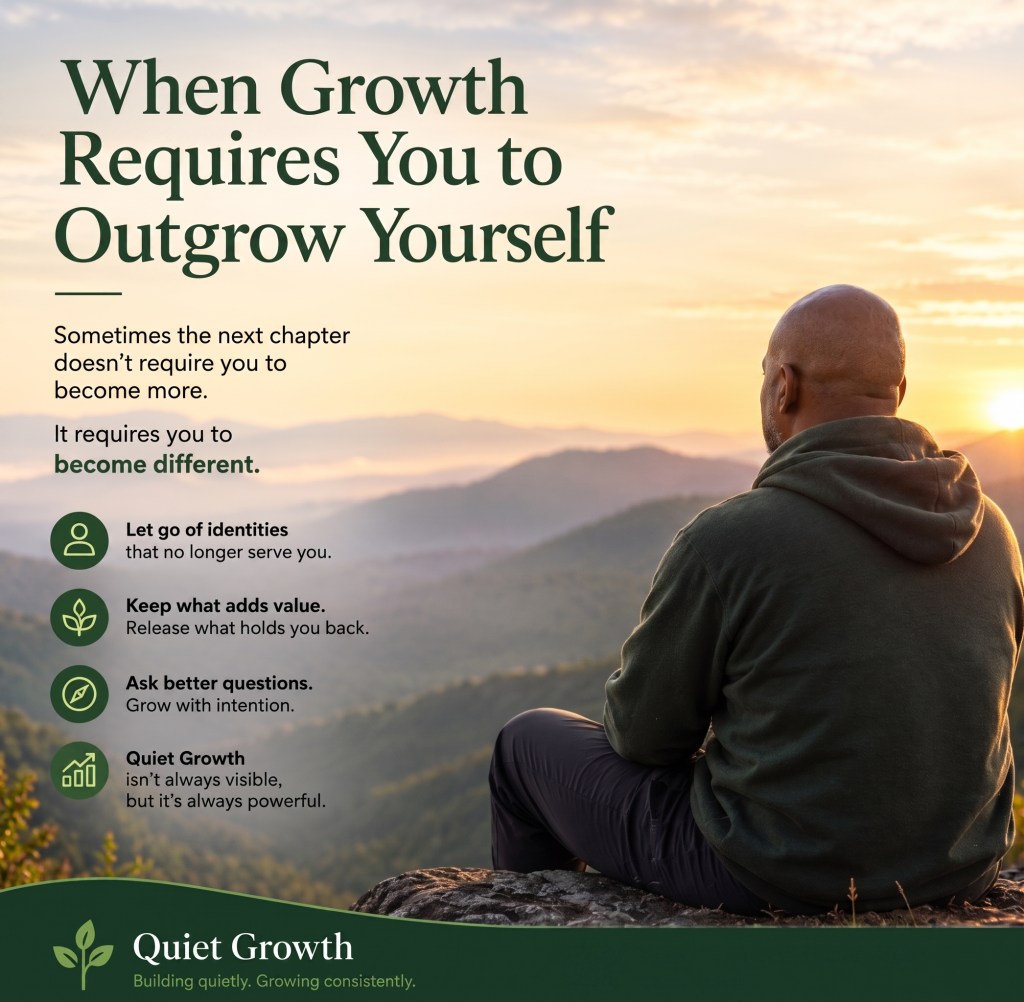
This part matters.
When you recognise that an old behaviour is holding you back, it’s easy to look back and judge yourself.
Don’t.
That version of you had a reason for becoming that way.
The perfectionist may have been protecting you from failure.
The controller may have been protecting you from disappointment.
The person who never asked for help may have learned early that nobody was coming to help.
The person who always said yes may have been trying to prove that they were valuable.
Understanding your old identity doesn’t mean you have to keep it.
It simply allows you to release it without resentment.
Thank the old version of yourself for getting you here.
Then give yourself permission to grow beyond it.
Quiet Growth is not always visible
Sometimes growth looks like a promotion.
Sometimes it looks like building a business.
Sometimes it looks like learning a new skill.
But sometimes nobody sees it.
Sometimes growth is saying no where you previously said yes.
Asking for help when you previously stayed silent.
Delegating something you would normally control.
Publishing something before it feels perfect.
Admitting, “I don’t know.”
Changing your mind.
Starting again.
Walking away.
Resting.
Or simply becoming comfortable with the fact that you don’t have to remain the person everyone remembers.
That is still growth.
Maybe even some of the most important growth.
Your next chapter may require a different version of you
You don’t have to abandon everything you’ve learned.
Take the wisdom.
Take the discipline.
Take the resilience.
Take the lessons.
But don’t assume every old behaviour deserves a permanent place in your future.
Some identities are chapters.
Not destinations.
So this weekend, take a few quiet minutes and ask yourself:
What part of me helped me get here but may be holding me back from where I want to go?
Don’t rush the answer.
Sit with it.
Growth doesn’t always announce itself.
Sometimes it happens quietly.
One decision.
One realisation.
One thing released.
One new way of thinking.
And then, slowly, you become someone different.
Quiet Growth 🌱
Building quietly. Growing consistently.

