Category: Uncategorized

  • Why We Need AI in the Present Generation

    Artificial Intelligence (AI) is one of the most important technologies of our time. It is changing how we live, work, and learn every day. In today’s fast-moving world, AI is not just helpful — it’s necessary.

    1. Making Daily Life Easier

    AI helps us in many simple ways. From voice assistants like Siri and Alexa to apps that suggest music or movies we might like, AI makes our lives more convenient and personal.

    2. Helping in Healthcare

    AI is saving lives in hospitals and clinics. It helps doctors find diseases early, plan treatments, and even assist in surgeries. With AI, healthcare is becoming faster, safer, and more accurate.

    3. Improving Education

    AI-powered learning tools make education more interesting and personal. Students can learn at their own pace, and teachers can understand where students need more help. This makes learning more effective for everyone.

    4. Supporting Businesses

    Businesses use AI to save time and work more efficiently. Chatbots help customers 24/7, and smart data tools help companies make better decisions. AI helps businesses grow and serve people better.

    5. Protecting the Environment

    AI is also helping the planet. It can predict weather patterns, monitor pollution, and suggest ways to use energy wisely. AI supports a greener and more sustainable world.

    6. Building a Better Future

    AI is preparing us for the future. Learning how to use and understand AI will help people find better jobs and create new opportunities. It encourages innovation and progress in every field.

    Conclusion

    AI is not just a tool — it’s a partner in human progress. It enhances our capabilities, solves complex problems, and opens doors to new possibilities. The present generation stands at a crossroads where embracing AI means shaping a smarter, fairer, and more connected future.

  • The Evolution of Artificial Intelligence: From Rules to Generative AI

    Tracking the evolution of Artificial Intelligence

    Artificial Intelligence feels like a technology that just burst into our lives, but its journey is a decades-long saga of ambitious theory, quiet failures, and explosive breakthroughs. To truly understand the power of the AI tools we use today, we have to look back at the three distinct phases that define its evolution.

    Phase I: The Age of Logic (1950s–1980s)

    In the beginning, researchers believed they could build intelligence by programming machines with explicit rules—a method called Symbolic AI or GOFAI (Good Old-Fashioned AI).

    The foundations were laid in 1956 at the Dartmouth workshop, where the term “Artificial Intelligence” was coined. Early programs, like the simple chatbot ELIZA (1966), were designed to mimic human conversation using basic pattern matching.

    This era was great for structured problems like chess, but it couldn’t handle the messiness of the real world. When experts couldn’t define enough rules to, say, recognize a cat in a photo, funding dried up, leading to the infamous “AI Winters.”

    Phase II: Learning from Data (1990s–2000s)

    As computing power grew, the focus shifted from programming intelligence to teaching it. This was the rise of Machine Learning (ML). Instead of hard-coded rules, algorithms started using statistical methods to analyze data and make predictions.

    A monumental moment came in 1997 when IBM’s Deep Blue defeated world chess champion Garry Kasparov. It proved that machines could master complex strategy through sheer computational power. Crucially, the explosion of the internet began to provide the massive datasets needed to train these new learning systems.

    Phase III: The Deep Learning Renaissance (2010s–Present)

    The current revolution is defined by Deep Learning—neural networks with multiple layers (hence “deep”) capable of automatically extracting complex patterns. This renaissance was fueled by three things:

    1. Big Data (Finally abundant and cheap).
    2. Fast GPUs (Providing the computational muscle).
    3. New Architectures (Like the Transformer).

    This era brought the superhuman achievements we recognize today:

    • 2016: AlphaGo mastered the intuitive game of Go, surpassing human experts.
    • 2018–Present: Generative AI exploded with the development of the Transformer architecture (the ‘T’ in GPT). Models like ChatGPT and showed that AI could not only recognize but also create human-quality text, code, and images.

    We are no longer just teaching machines; we are collaborating with them.

    Don’t Just Observe the Evolution—Join In!Are you as fascinated by the digital journey as I am?

    If this post sparked your curiosity, there’s so much more to explore. Hit that subscribe button to get my next analysis sent straight to your inbox, or leave a comment below to share your earliest memory of an AI technology!

  • marketing works best when it’s personal, purposeful, and permission-based.

    I learned that crafting an engaging email goes beyond fancy visuals. It’s about:

    • Knowing your audience (segmentation is key đŸ§©)
    • Writing with intention (every word should lead to action)
    • Building trust (respecting privacy and adding real value)

    The HubSpot lessons really showed how setting SMART goals and testing continuously can turn a simple email into a conversion powerhouse.

    I’m excited to keep learning, testing, and improving — because every marketer starts somewhere, and I’m proud to be a Marketer in the Making. ✹

    #EmailMarketing #HubSpotAcademy #DigitalMarketing #LearningJourney #MarketerInTheMaking

  • How AI and ChatGPT Are Changing the Way I Think, Work, and Create

    🌍 Meta Description (for SEO):

    In this personal post, I share how artificial intelligence — especially ChatGPT — is transforming my daily work, creativity, and perspective on what’s possible in the digital age.


    Introduction

    If someone had told me a few years ago that I’d be collaborating with an AI to brainstorm, write, and even plan my day, I probably would’ve laughed. But here we are — AI has become a part of my creative routine.

    Artificial intelligence, especially tools like ChatGPT, isn’t just a trend anymore; it’s a quiet revolution. It’s changing the way I work, learn, and even think. Every day, I discover something new that makes me realize — the future isn’t coming; it’s already here.


    1. How AI Became My Creative Sidekick

    At first, I used ChatGPT out of curiosity — just to test what it could do. I asked it to write a few sentences, summarize articles, or explain concepts I was struggling with.
    Then I realized something bigger: AI wasn’t replacing my creativity — it was expanding it.

    Now, when I write, ChatGPT helps me:

    • Break through writer’s block
    • Generate blog ideas in seconds
    • Rephrase sentences for clarity and flow
    • See my own thoughts from a new angle

    It’s like having a brainstorming partner who never runs out of ideas and doesn’t judge my messy drafts.


    2. The Magic of Collaboration Between Human and Machine

    One of my favorite things about using AI is how it turns solo work into teamwork.
    When I’m writing a blog post, I’ll throw my rough ideas into ChatGPT and let it build structure around them. Then I go back and add my voice, my experience, my human touch.

    It’s not “AI writing my content” — it’s me co-creating with AI.
    That’s where the real magic happens.


    3. How AI Changes the Way We Work

    I’ve noticed something fascinating: AI doesn’t just save time — it changes how we think about time.

    Tasks that used to take hours — researching, drafting, rewriting — now take minutes. That leaves me with more time for strategy, reflection, and creativity.

    I use ChatGPT to:

    • Summarize complex research for me
    • Create outlines for new projects
    • Generate marketing ideas
    • Even help draft replies to clients or collaborators

    It’s like having a digital assistant who always understands my tone and goals.


    4. What AI Can’t Replace (and Shouldn’t)

    Of course, AI isn’t perfect. It doesn’t feel what I feel. It doesn’t know my audience like I do.
    That’s why I always remind myself: AI is a tool, not a voice.

    It helps me express my ideas — but it can’t have them.
    The heart of what I write still comes from human experience, emotion, and curiosity.
    AI just helps me bring those ideas to life faster and in new ways.


    5. My Vision for the Future of AI

    I truly believe the future belongs to those who know how to collaborate with AI, not compete against it.

    Imagine:

    • Teachers using AI to personalize lessons.
    • Entrepreneurs using AI to test ideas instantly.
    • Artists creating with AI as their digital brush.

    We’re not losing our creative edge — we’re evolving it.

    AI doesn’t take away our humanity; it highlights it. Because when machines handle the routine, humans can focus on what only we can do — dream, connect, and create.


    Conclusion: My Ongoing AI Journey

    For me, AI isn’t just a tool; it’s a mirror that reflects what’s possible when curiosity meets technology.

    Every blog I write, every idea I test with ChatGPT, reminds me of one simple truth:

    The most powerful thing about AI isn’t that it can think — it’s that it helps us think better.

    So here’s to the next chapter — where humans and AI don’t compete, but create together.

  • Are People Who Use AI the “Least Intelligent”?

    Here’s Why That’s a Myth.

    Every few months, a familiar claim resurfaces online:
    “People who use AI the most are actually the least intelligent.”

    It’s a catchy statement — but it doesn’t hold up. In fact, it misses what intelligence looks like in a world where technology evolves daily.

    Let’s break it down.


    Using AI Isn’t a Sign of Low Intelligence — It’s a Sign of Strategic Thinking

    We don’t consider someone unintelligent because they use a calculator, GPS, Grammarly, or Google.
    We see them as using tools that make life easier and work smarter.

    AI is simply the next step in that evolution.

    People who choose to use AI tend to show:

    1. Strategic thinking

    They recognize opportunities to save time, increase efficiency, and gain new skills.

    2. Curiosity

    They explore new technologies rather than resisting change.

    3. Adaptability

    In a world that shifts quickly, adapting is one of the strongest forms of intelligence.

    4. A growth mindset

    AI users don’t assume they “should” know everything — they seek ways to learn faster and work better.

    These aren’t traits of low intelligence.
    These are traits of highly capable, forward-thinking people.


    AI Isn’t a Replacement for Intelligence — It’s a Multiplier

    AI doesn’t make decisions for you.
    It doesn’t define your perspective, shape your values, or replace your thinking.

    Instead, AI helps you:

    • Learn faster
    • Generate ideas you might not think of on your own
    • Improve communication
    • Automate repetitive tasks
    • Focus on creative, strategic work

    In other words, AI amplifies your abilities — it doesn’t diminish them.

    The smartest professionals in the world — engineers, marketers, researchers, doctors, writers, designers — all use AI to accelerate their work.
    Not because they’re “less intelligent,”
    but because they understand leverage.


    The Truth: Intelligence Has Always Included Knowing Which Tools to Use

    Throughout history, every major innovation has been criticized at first:

    • Calculators were once seen as “cheating.”
    • Spell check was considered “lazy.”
    • Search engines were called “crutches.”

    Today, not using those tools would be seen as inefficient.

    AI is no different.

    Choosing not to use AI doesn’t make you more intelligent.
    Choosing to use it wisely makes you more effective.


    The Bottom Line

    Using AI isn’t a shortcut for the less intelligent.
    It’s a strategic advantage used by people who:

    • value their time
    • want to grow
    • embrace innovation
    • push their potential further

    AI doesn’t replace intelligence.
    It multiplies it.

    And the people who understand that?
    They’re not the least intelligent — they’re the ones shaping the future.

  • 🌟 AI and Human Emotions — Can Machines Understand How We Feel?

    By Spike Evolution

    Artificial Intelligence has made incredible progress — it can recognize faces, translate languages, drive cars, and write meaningful text.
    But one question still fascinates (and scares) many people:

    Can AI understand human emotions?

    Emotion is what makes us human. It shapes our decisions, relationships, and daily experiences.
    For years, computers could not “feel” anything — they were logical but emotionally blind.

    Today, that is slowly changing.

    AI is beginning to recognize, interpret, and respond to emotions in ways that once seemed impossible.

    Let’s look at how it works, why it matters, and whether it is a blessing
 or a possible danger.


    ❀ 1. What Emotional AI Actually Means

    “Emotional AI” (also called Affective Computing) is technology designed to:

    • Read emotions
    • Interpret emotional signals
    • Respond in a human-like way

    It doesn’t truly “feel,” but it analyzes:

    🎙 tone of voice
    🙂 facial expressions
    💬 choice of words
    ⏱ typing speed
    😼‍💹 breathing patterns (in advanced systems)

    From these signals, AI can detect emotions like:

    • Happiness
    • Stress
    • Anger
    • Confusion
    • Sadness
    • Fear
    • Excitement

    And it can adjust its response accordingly.


    🔍 2. How AI Detects Our Emotions

    AI systems use different methods to read human feelings:

    1. Voice Emotion Analysis

    AI listens to changes in:

    • pitch
    • speed
    • pauses
    • trembling
    • volume

    It can tell if someone is anxious, angry, or excited.

    2. Facial Expression Recognition

    AI can identify:

    • smiles
    • frowns
    • fear
    • disgust
    • surprise
    • fake versus real emotion

    This is used in airports, customer service, and even therapy apps.

    3. Text Emotion Detection

    AI models like ChatGPT analyze:

    • sentiment
    • emotional tone
    • intention
    • politeness
    • frustration
    • empathy markers

    This is widely used in customer support and mental health chatbots.


    đŸ€ 3. Can AI Be Empathetic?

    Short answer: AI can simulate empathy — but not feel it.

    It doesn’t experience emotions.
    But it can recognize them and respond in ways that feel supportive.

    For example:

    You write:
    “I’m having a difficult day.”

    AI responds:
    “I’m sorry you’re going through a hard time. Would you like to talk about it or find a solution together?”

    It is not feeling compassion — but it is learning to behave compassionately.

    This is already useful in:

    • mental health support apps
    • coaching tools
    • elder care
    • customer service
    • education

    ⚠ 4. The Risks of Emotional AI

    Like all powerful technology, emotional AI has dangers if misused.

    1. Manipulation Risk

    If an AI knows when you’re sad, angry, or lonely

    Someone could use that information to influence your decisions.

    2. Privacy Issues

    Do people want cameras or voice devices reading their emotions all day?

    3. Misinterpretation

    AI can get emotions wrong — especially with cultural differences or unique personalities.

    4. Dependence on AI “Comfort”

    People may start relying on machines for emotional support more than humans.

    We must build emotional AI carefully and ethically.


    🌈 5. The Benefits — When Emotional AI Helps Humanity

    When used responsibly, emotional AI has enormous potential.

    đŸŒ± Mental Health Support

    AI can detect early signs of depression, stress, or burnout before it becomes severe.

    đŸ« Better Education

    AI tutors can see when a student is confused or overwhelmed and adapt teaching style.

    đŸ„ Healthcare

    AI can help doctors understand a patient’s emotional condition better.

    🛎 Customer Service

    AI can respond more politely, calmly, and kindly — reducing frustration.

    🌍 A More Understanding Digital World

    Imagine technology that adapts to how you feel, not just what you type.

    Emotional AI could make online spaces safer, kinder, and more human-centered.


    🔼 The Future: Will AI Ever Truly Feel?

    Most experts agree:

    👉 AI will become better at recognizing emotions
    👉 AI will become more human-like in response
    👉 But AI will never truly feel emotions like humans

    It can mimic emotion — but not experience it.

    However, even without real feelings, emotional AI can still help us:

    • make better decisions
    • build safer communities
    • reduce conflict
    • support mental wellness
    • improve communication

    This is the future Spike Evolution stands for:
    A future where AI understands humans better — not to control us, but to help us be the best version of ourselves.

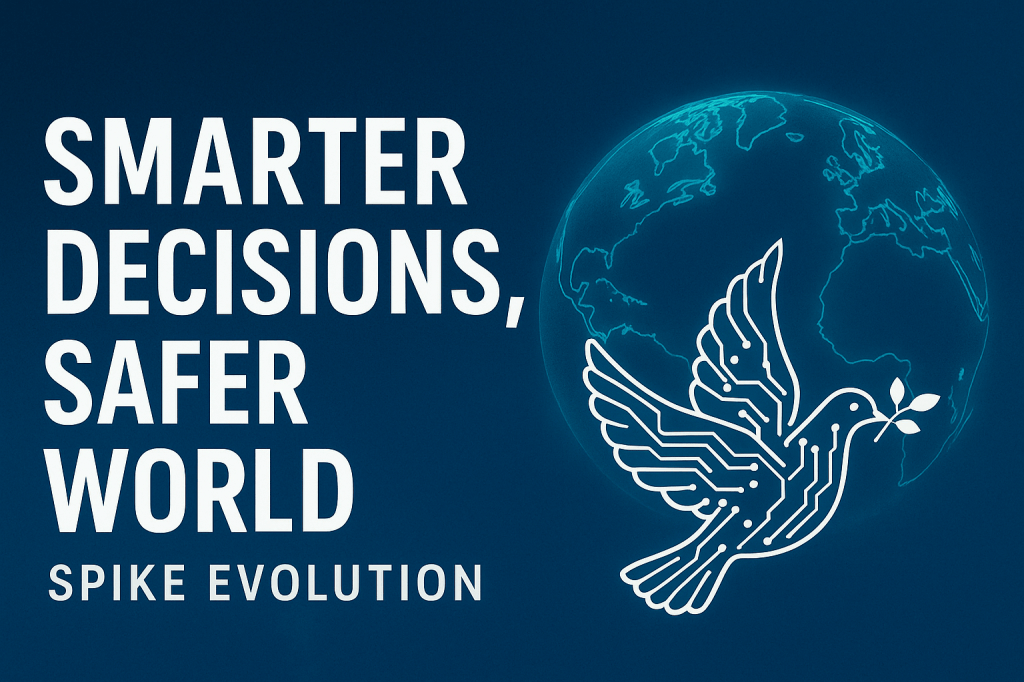
  • Smarter Decisions, Safer World: How AI Can Help Humanity Choose Peace

    “Artificial Intelligence may not feel compassion — but it can help us remember ours.”
    — Spike Evolution


    🌍 The World at a Crossroads

    Every day, humanity faces choices that define our collective future.
    From political decisions that spark wars to economic policies that divide nations, the stakes have never been higher. Yet amid all this, one truth remains: we often make emotional decisions instead of rational ones.

    But what if the next evolution of intelligence — Artificial Intelligence (AI) — could help us see beyond ego, bias, and fear?

    AI isn’t just changing technology; it’s reshaping how we think, act, and connect. It holds the potential to help us make decisions that prioritize logic, fairness, and empathy — things we often lose sight of when power and emotion collide.


    đŸ€– When Data Becomes Wisdom

    AI can process massive amounts of information in seconds — things that would take humans years to analyze.
    This ability isn’t just about speed; it’s about clarity.

    Imagine a global peace council that uses AI to:

    • Analyze communication patterns between nations and detect early signs of rising tension.
    • Simulate the outcomes of diplomatic or military actions before they happen.
    • Recommend negotiation strategies that lead to compromise instead of conflict.

    This isn’t science fiction — projects like UN Global Pulse and AI for Peace Labs are already using machine learning to identify crisis signals in social and economic data.
    AI could soon become a silent advisor to leaders, helping them make decisions grounded in facts, not fear.


    💾 The Economy of Fairness

    AI doesn’t just fight wars of weapons — it can fight wars of inequality.

    In an increasingly digital economy, AI can:

    • Detect financial fraud or corruption before it happens.
    • Optimize resource distribution so food and medicine reach those who need them most.
    • Help governments predict and prevent unemployment spikes or economic crashes.

    By improving transparency and accountability, AI helps build trust — something every stable society needs. A fairer economy often means fewer reasons for conflict.

    Imagine if every nation had access to AI systems that ensured taxes, trade, and aid were distributed honestly. That alone could change the world.


    ⚖ The Ethical Crossroad

    Still, AI isn’t magic.
    If we feed it biased data, it can make biased decisions. If used carelessly, it could deepen inequality or be weaponized for manipulation.

    That’s why humanity’s next evolution isn’t just technological — it’s ethical.
    We must teach AI to reflect our highest values, not our worst impulses.
    Initiatives like the EU AI Act and UNESCO’s AI Ethics Framework are early steps toward this global responsibility.

    The goal is not to make AI perfect — it’s to make sure we use it wisely.


    🧠 Humans + AI = Better Decisions

    AI doesn’t have emotions — and that’s exactly why it can be a great partner in decision-making.
    While we bring compassion, intuition, and morality, AI brings data, prediction, and perspective.

    Together, we can:

    • Make smarter, evidence-based political decisions.
    • Build fairer economic systems.
    • Anticipate crises before they destroy lives.

    AI will never replace human empathy. But it can amplify it — guiding us to act not out of anger, but out of understanding.


    🌅 The Future We Can Build

    At Spike Evolution, we believe the evolution of AI is not about replacing humans — it’s about reminding us how to be better ones.

    AI gives us a mirror that reflects our world without bias. The real challenge is whether we’ll have the courage to look — and to change what we see.

    So the next time someone fears AI, remind them:
    It’s not the machine that decides our fate.
    It’s what we choose to teach it.


    💬 Final Thought

    Peace is not just the absence of war — it’s the presence of understanding.
    And with AI by our side, we just might have the intelligence to finally find both.


    #AIForPeace #ArtificialIntelligence #FutureOfAI #EthicalAI #SpikeEvolution #TechnologyForGood

  • What’s New in AI Today

    1. Generative AI and Agentic AI Are Leveling Up

    One of the biggest shifts: generative-AI tools (large language models, image/video synthesis) are being combined with so-called agentic capabilities — that is, AI that doesn’t just respond, but acts, makes decisions, plans tasks, interacts autonomously. For example:

    • In contact centres, companies report that virtual agents are increasingly able to handle full tasks like order updates, appointment changes, or data retrieval, not just script-based responses. CX Today
    • At the research level, new models from OpenAI show updates like “apps in ChatGPT”, and browser integrations (see item 4 below). OpenAI

    What this means for businesses and individuals: AI is moving from “assist me” towards “take action for me / with me”. The implication: as these capabilities mature, workflows can change dramatically.

    https://d3lkc3n5th01x7.cloudfront.net/wp-content/uploads/2023/05/03043229/Generative-AI-models-banner.png

    2. Infrastructure, Hardware & Deployment Matter More Than Ever

    It’s not just the model anymore — the underlying compute, data, and deployment environment are crucial. Some notable points:

    • OpenAI announced a strategic collaboration with Broadcom to deploy 10 gigawatts of AI accelerators. OpenAI
    • From news feeds: “China’s generative-AI user base doubles to 515 million in six months.” AI News
    • On the enterprise side: Many organisations are still struggling to move beyond pilot-stage AI projects (data, skills, infrastructure remain bottlenecks). AI Magazine

    Takeaway: If you are thinking about using AI (or already do) — consider not only which model/tool, but how you deploy it, with what data, and how it scales.

    https://www.ibm.com/content/dam/connectedassets-adobe-cms/worldwide-content/stock-assets/getty/image/photography/98/c4/22_27_p_gorodenkoff-549.jpg

    3. Ethical, Regulatory & Workforce Impacts Are Front-and-Centre

    As the technology advances, the challenges around ethics, regulation, and human/AI interaction are gaining sharper focus:

    • On the workforce side: At Electronic Arts (EA), employees report concern over aggressive AI tool adoption — while leadership promotes wide usage, many staff fear reliability issues and job devaluation. Business Insider
    • On regulation: Major frameworks are being adopted (for example in the EU) to govern how general-purpose AI and high-risk systems are used. Wikipedia+1
    • On ethics: The question of whether “AI just keeps getting better” or if we are hitting diminishing returns is actively discussed. The New Yorker

    This suggests: Modern AI isn’t just a tech-problem; it’s also a human, societal, and legal problem. Any AI strategy must factor in trust, governance, and the human side (skills, change management).

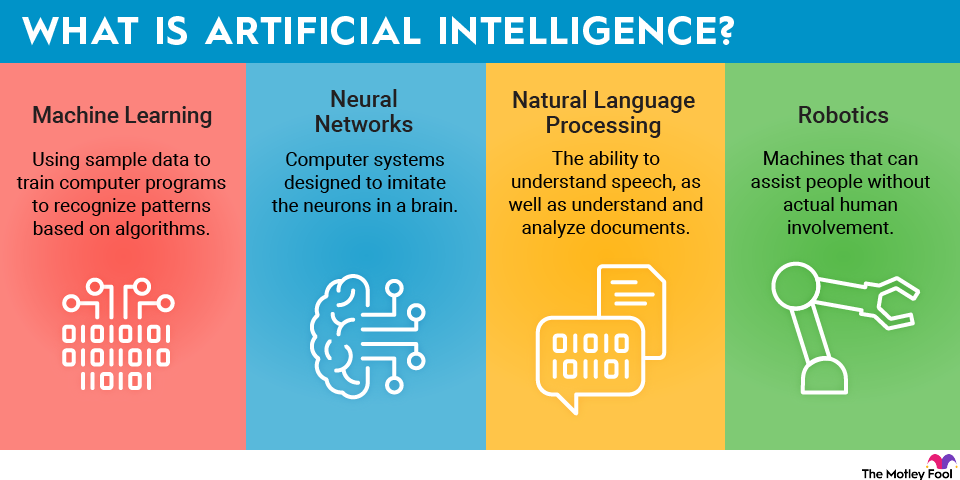
    https://m.foolcdn.com/media/dubs/original_images/what-is-artificial-intelligence-infographic.png

    4. AI in Everyday Products & Experiences

    Putting large models aside for a moment, AI is increasingly embedded in everyday tools and services:

    • OpenAI’s recent product update: “Introducing ChatGPT Atlas, the browser with ChatGPT built in.” OpenAI
    • At Amazon: Their CEO highlighted how generative-AI is expanding into Alexa, shopping assistants, seller-tools, etc. About Amazon
    • Small businesses: In the U.S., a survey found that nearly 89 % of small business owners indicated someone at their company currently uses an AI tool (for tasks like marketing text, email, summarising content). Axios

    So: AI isn’t just for big tech anymore — it’s creeping into mainstream workflows, products and services. That opens both opportunities (productivity, innovation) and risks (over-dependence, vendor lock-in, data governance).

    5. New Frontiers: Science, Materials, Construction, & More

    Beyond the usual suspects, AI is making inroads into more “industrial” or “scientific” domains:

    • In construction: 78 % of construction-industry leaders believe AI will enhance their sector, and two-thirds say it will be essential in 2-3 years. Autodesk
    • At Massachusetts Institute of Technology: Research shows generative-AI being used to create virtual training environments for robots, virtual spectrometers for material-analysis, and more. MIT News

    This points to: AI moving from digital front-ends (chatbots/image generation) to the “backend” of industry — manufacturing, construction, scientific modelling. The implications for business: If your domain is “non-digital”, you shouldn’t assume AI bypasses you — it may be coming to your core processes.

    6. What You Should Be Thinking About Right Now

    Inside the AI divide roiling video game giant Electronic Arts

    Here are some practical take-aways if you run a business, blog, or tech team:

    • Audit your AI readiness: Do you have clean data, infrastructure, governance, skills?
    • Start small but with action-oriented use-cases: It’s one thing to have “AI for answering customer chats”, another to have “AI autonomously manage inventory or make decisions”.
    • Consider ethics & trust: Model reliability, bias, human hand-over, job impact — these matter, especially as stakeholders become aware.
    • Keep an eye on regulation: Especially in Europe (and increasingly globally), AI-specific regulation is evolving quickly.
    • Explore domain-specific AI: If your field is construction, manufacturing, science, etc — watch for AI tools tailored to those sectors (not just “chatbots”).
    • Monitor infrastructure & cost: Large models, GPU/accelerator costs, energy/compute efficiency are non-trivial. As one source said: the boom is real, but the hardness lies in scale. Wikipedia

    💭 Final Thoughts

    AI’s transformation is no longer theoretical — it’s operational, economic, and deeply human.
    Whether you’re a small business owner, developer, or researcher, this is the moment to learn, adapt, and experiment. The winners of the AI era won’t just use AI — they’ll design with it.

  • The Growing Trends of Artificial Intelligence in Our Generation

    Trends of Artificial Intelligence

    Artificial Intelligence (AI) is no longer a distant dream or a sci-fi fantasy — it’s a living part of our daily reality. From the apps on our phones to the tools that power global industries, AI has become one of the most influential forces shaping our modern world. Let’s explore some of the biggest AI trends defining our generation today.

    1. Generative AI and Creativity

    The rise of generative AI tools — like ChatGPT, DALL·E, and Midjourney — has revolutionized how we create. From writing articles and designing graphics to composing music and coding, AI is becoming a powerful creative partner. This technology helps individuals and businesses produce content faster, smarter, and more efficiently than ever before.

    2. AI in Everyday Life

    AI quietly powers much of what we use daily — voice assistants like Siri and Alexa, smart home systems, personalized Netflix recommendations, and even Google Maps. These systems learn from our habits and preferences to make life easier, more connected, and more personal.

    3. AI and the Workplace

    Automation is transforming how we work. AI-driven tools are helping companies analyze data, predict market trends, and improve productivity. At the same time, new AI-powered roles are emerging — from prompt engineers to AI ethicists — reflecting the growing need for human-AI collaboration.

    4. Ethical AI and Regulation

    As AI grows more powerful, the question of ethics becomes more urgent. Governments and tech leaders are now focusing on creating responsible AI systems — ones that protect privacy, prevent bias, and serve the greater good. Transparency and fairness are key in shaping the future of this technology.

    5. AI in Education and Health

    AI is transforming education with personalized learning platforms that adapt to each student’s pace and style. In healthcare, AI assists doctors in diagnosing diseases faster and more accurately, improving patient outcomes and saving lives.

    6. The Future: Human + AI Partnership

    The trend is clear — AI is not replacing humans; it’s working with us. The most successful people and organizations in this generation will be those who learn to collaborate with AI tools effectively, blending human creativity with machine intelligence.


    💡 Final Thoughts

    AI is more than a trend — it’s a movement redefining how we live, work, and think. As technology continues to evolve, one thing is certain: those who embrace and understand AI today are shaping the future of tomorrow.

  • Tracking the evolution of Artificial Intelligence

    Artificial Intelligence feels like a technology that just burst into our lives, but its journey is a decades-long saga of ambitious theory, quiet failures, and explosive breakthroughs. To truly understand the power of the AI tools we use today, we have to look back at the three distinct phases that define its evolution.

    Phase I: The Age of Logic (1950s–1980s)

    In the beginning, researchers believed they could build intelligence by programming machines with explicit rules—a method called Symbolic AI or GOFAI (Good Old-Fashioned AI).

    The foundations were laid in 1956 at the Dartmouth workshop, where the term “Artificial Intelligence” was coined. Early programs, like the simple chatbot ELIZA (1966), were designed to mimic human conversation using basic pattern matching.

    This era was great for structured problems like chess, but it couldn’t handle the messiness of the real world. When experts couldn’t define enough rules to, say, recognize a cat in a photo, funding dried up, leading to the infamous “AI Winters.”

    Phase II: Learning from Data (1990s–2000s)

    As computing power grew, the focus shifted from programming intelligence to teaching it. This was the rise of Machine Learning (ML). Instead of hard-coded rules, algorithms started using statistical methods to analyze data and make predictions.

    A monumental moment came in 1997 when IBM’s Deep Blue defeated world chess champion Garry Kasparov. It proved that machines could master complex strategy through sheer computational power. Crucially, the explosion of the internet began to provide the massive datasets needed to train these new learning systems.

    Phase III: The Deep Learning Renaissance (2010s–Present)

    The current revolution is defined by Deep Learning—neural networks with multiple layers (hence “deep”) capable of automatically extracting complex patterns. This renaissance was fueled by three things:

    1. Big Data (Finally abundant and cheap).
    2. Fast GPUs (Providing the computational muscle).
    3. New Architectures (Like the Transformer).

    This era brought the superhuman achievements we recognize today:

    • 2016: AlphaGo mastered the intuitive game of Go, surpassing human experts.
    • 2018–Present: Generative AI exploded with the development of the Transformer architecture (the ‘T’ in GPT). Models like ChatGPT and showed that AI could not only recognize but also create human-quality text, code, and images.

    We are no longer just teaching machines; we are collaborating with them.

    Don’t Just Observe the Evolution—Join In!Are you as fascinated by the digital journey as I am?

Is this your new site? Log in to activate admin features and dismiss this message
Log In